Port de Saint-Georges-de-Rex – Saint-Georges-de-Rex
Description
English
Deutsch
Dutch
Español
Italiano
Description
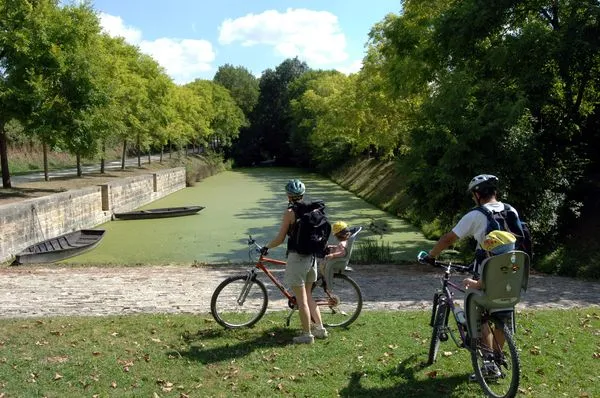
Le port de Saint-Georges-de-Rex est le seul n’étant pas établi en lisière de coteau. Le havre et son chenal d’accès (rigole de Rimonboeuf), entièrement creusés dans le calcaire de 1850 à 1870 pour approcher la cale d’accostage au plus près du village et le bourg aux 150 hectares de marais, sont reliés au canal du Chail et de la Grande Rigole de La Garette, en direction de Coulon, Marans ou Niort. Il est composé d’une cale pavée en pente douce, de quais en pierre de taille avec deux accès et d’un haut déversoir maçonné participant au maintien en eau du port. Le port naturel en ampoule est restauré dans le cadre des Grands Travaux du Marais Poitevin.
English
The port of Saint-Georges-de-Rex is not the only one to have been built on the edge of a hillside. The harbour and its canal (the rigole de Rimonboeuf) which were dug out in the limestone between 1850 and 1870 in order to bring the mooring stage closer to the village and the little market town closer to the 150 hectares of marshes, are linked to the canal of Chail and the Grande Rigole of La Garette, towards Coulon, Marans or Niort. It is composed of a paved mooring stage with a gentle slope, quays in cut stone with two access points and a high stone spillway which helps to keep water in the harbour. The natural harbour has been restored as part of the Great Works of the Marais Poitevin.
Deutsch
Der Hafen von Saint-Georges-de-Rex ist der einzige, der nicht am Rande des Hanges liegt. Der Hafen und sein Zugangskanal (Rigole de Rimonboeuf), der zwischen 1850 und 1870 vollständig in den Kalkstein gegraben wurde, um die Anlegestelle so nah wie möglich an das Dorf und den Marktflecken mit seinen 150 Hektar Sumpfgebiet heranzuführen, sind mit dem Kanal du Chail und der Grande Rigole de La Garette in Richtung Coulon, Marans oder Niort verbunden. Er besteht aus einem gepflasterten, sanft abfallenden Slip, Kais aus Quadersteinen mit zwei Zugängen und einem hohen, gemauerten Überlauf, der an der Wasserhaltung des Hafens beteiligt ist. Der natürliche ampullenförmige Hafen wird im Rahmen der Grands Travaux du Marais Poitevin restauriert.
Dutch
De haven van Saint-Georges-de-Rex is de enige haven die niet aan de rand van de heuvel ligt. De haven en zijn toegangskanaal (kanaal van Rimonboeuf), dat tussen 1850 en 1870 volledig uit de kalksteen is gegraven om de scheepshelling zo dicht mogelijk bij het dorp en de stad met zijn 150 hectare moeras te brengen, zijn verbonden met het kanaal van Chail en de Grande Rigole de La Garette, in de richting van Coulon, Marans of Niort. Het bestaat uit een zacht glooiende verharde scheepshelling, kades van essenhout met twee ingangen en een hoge gemetselde overlaat die helpt om de haven in het water te houden. De natuurlijke bolvormige haven is gerestaureerd als onderdeel van de Grote Werken van het Marais Poitevin.
Español
El puerto de Saint-Georges-de-Rex es el único no establecido en el borde de la ladera. El puerto y su canal de acceso (canal Rimonboeuf), completamente excavado en piedra caliza desde 1850 hasta 1870 para acercarse al muelle de acoplamiento más cerca del pueblo y el pueblo a 150 hectáreas de marismas, están conectados al Canal de Chail y la Grande Rigole de la Garette, en dirección a Coulon, Marans o Niort. Consiste en un varadero pavimentado de pendiente suave, muelles de piedra con dos entradas y un alto aliviadero de mampostería para ayudar a mantener el suministro de agua del puerto. El bulbo del puerto natural se restaura como parte de las Grandes obras de Marais Poitevin.
Italiano
Il porto di Saint-Georges-de-Rex è l'unico che non si trova sul bordo della collina. Il porto e il suo canale di accesso (canale di Rimonboeuf), interamente scavato nella roccia calcarea tra il 1850 e il 1870 per avvicinare il più possibile lo scalo di alaggio al villaggio e alla città con i suoi 150 ettari di palude, sono collegati al canale di Chail e alla Grande Rigole de La Garette, in direzione di Coulon, Marans o Niort. È costituito da uno scivolo pavimentato in leggera pendenza, da banchine in bugnato con due ingressi e da un alto scolmatore in muratura che contribuisce a mantenere il porto in acqua. Il porto naturale a forma di bulbo è stato restaurato nell'ambito delle Grandi Opere del Marais Poitevin.