ÉGLISE SAINTE ANNE – Le Buisson
Description
English
Deutsch
Dutch
Español
Italiano
Description
Le Buisson est un charmant village gévaudanais, bâti en amphithéatre sur le versant d'une colline que baigne le petit ruisseau du Merdaric.
Un château féodal, qui appartenait aux barons de Peyre, seigneurs des environs, existait encore au XIVe siècle. Près de ce château était édifiée l'église primitive de Sainte-Anne, citée en 1109 et appartenant au Bénédictins du Monastier. Démolie lors des guerres de Religion, elle fut reconstruite peu après mais s'effondre en 1808.
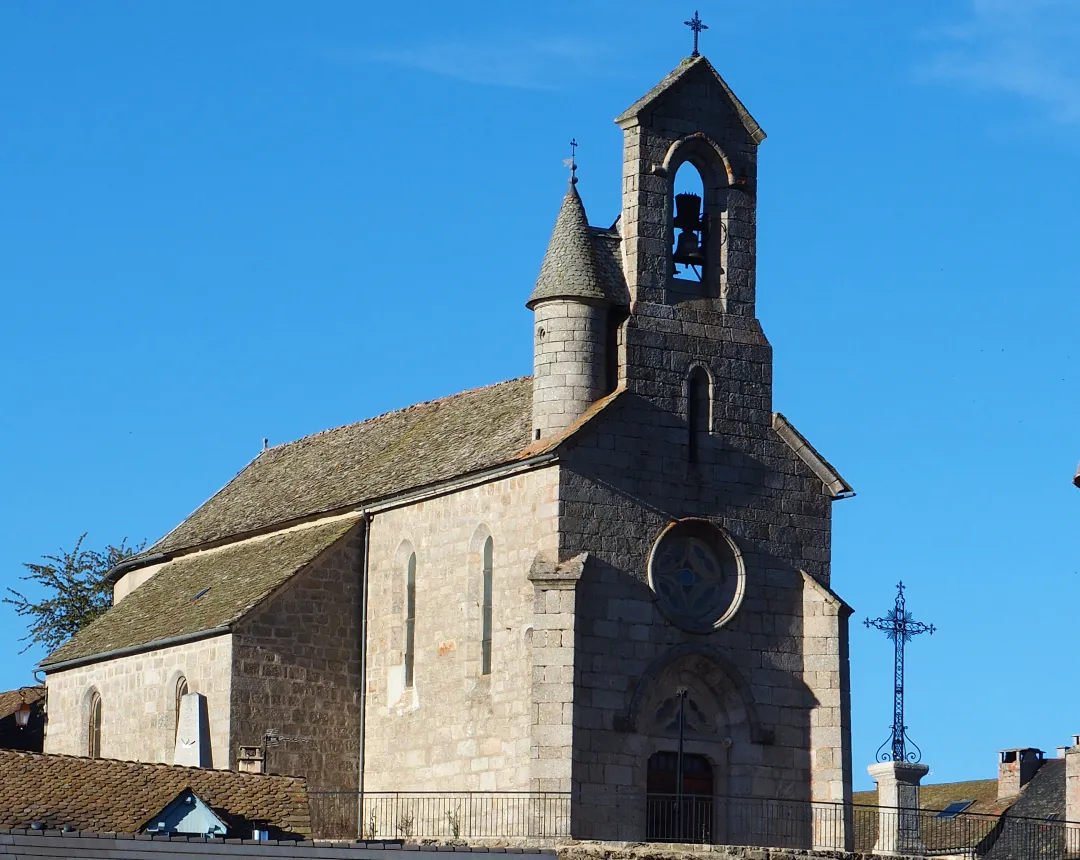
L'édifice reconstruit en réutilisant les matériaux de l'ancienne église en 1858, celui que nous voyons désormais, se situe un peu plus en hauteur, sur un terrain communément appelé « lou castel » (le Château en Occitan).
Il suit un plan en croix latine.
Depuis le parvis de l'église profitez d'une vue imprenable.
English
Le Buisson is a charming village in the Gévaud region, built in the shape of an amphitheatre on a hillside bordered by the Merdaric stream.
A feudal castle, belonging to the barons of Peyre, lords of the surrounding area, still existed in the 14th century. Near this castle stood the primitive church of Sainte-Anne, mentioned in 1109 and belonging to the Benedictine monks of Monastier. Demolished during the Wars of Religion, it was rebuilt shortly afterwards, but collapsed in 1808.
The building we can now see, rebuilt in 1858 using materials from the old church, is situated a little higher up, on land commonly known as "lou castel" (the castle in Occitan).
It follows a Latin cross plan.
The view from the church square is breathtaking.
Deutsch
Le Buisson ist ein charmantes Dorf in der Region Gevaudan. Es wurde amphitheatralisch am Hang eines Hügels gebaut, der von dem kleinen Bach Merdaric umspült wird.
Im 14. Jahrhundert gab es hier noch ein feudales Schloss, das den Baronen de Peyre, den Herren der Umgebung, gehörte. In der Nähe dieser Burg wurde die ursprüngliche Kirche Sainte-Anne errichtet, die 1109 erwähnt wurde und den Benediktinern von Le Monastier gehörte. Die während der Religionskriege zerstörte Kirche wurde kurz darauf wieder aufgebaut, stürzte jedoch 1808 ein.
Das Gebäude, das 1858 unter Verwendung der Materialien der alten Kirche wieder aufgebaut wurde und das wir nun sehen, liegt etwas höher auf einem Grundstück, das allgemein als "lou castel" (okzitanisch für "das Schloss") bekannt ist.
Sie folgt einem Grundriss in Form eines lateinischen Kreuzes.
Vom Vorplatz der Kirche aus haben Sie einen atemberaubenden Ausblick.
Dutch
Le Buisson is een charmant dorp in de regio Gévaud, gebouwd in de vorm van een amfitheater op de flank van een heuvel die baadt in de rivier de Merdaric.
Een feodaal kasteel, dat toebehoorde aan de baronnen van Peyre, heren van de omgeving, bestond nog in de 14e eeuw. Vlakbij dit kasteel stond de oorspronkelijke kerk van Sainte-Anne, vermeld in 1109 en eigendom van de benedictijnen van Monastier. De kerk werd afgebroken tijdens de godsdienstoorlogen en werd kort daarna herbouwd, maar stortte in 1808 in.
Het gebouw dat we nu kunnen zien, herbouwd in 1858 met materialen van de oude kerk, ligt iets hoger op een terrein dat bekend staat als "lou castel" (het kasteel in het Occitaans).
Het volgt een Latijns kruisplan.
Het uitzicht vanaf het kerkplein is adembenemend.
Español
Le Buisson es un encantador pueblo de la región de Gévaud, construido en forma de anfiteatro en la ladera de una colina bañada por el arroyo Merdaric.
En el siglo XIV aún existía un castillo feudal perteneciente a los barones de Peyre, señores de los alrededores. Cerca de este castillo se encontraba la primitiva iglesia de Sainte-Anne, mencionada en 1109 y perteneciente a los benedictinos de Monastier. Demolida durante las Guerras de Religión, fue reconstruida poco después, pero se derrumbó en 1808.
El edificio que podemos ver ahora, reconstruido en 1858 con materiales de la antigua iglesia, está situado un poco más arriba, en un terreno conocido comúnmente como "lou castel" (el castillo en occitano).
Sigue una planta de cruz latina.
La vista desde la plaza de la iglesia es impresionante.
Italiano
Le Buisson è un incantevole villaggio della regione del Gévaud, costruito ad anfiteatro sul fianco di una collina bagnata dal torrente Merdaric.
Nel XIV secolo esisteva ancora un castello feudale appartenuto ai baroni di Peyre, signori della zona circostante. Vicino a questo castello fu costruita la chiesa primitiva di Sainte-Anne, menzionata nel 1109 e appartenente ai Benedettini di Monastier. Demolita durante le guerre di religione, fu ricostruita poco dopo ma crollò nel 1808.
L'edificio che vediamo oggi, ricostruito nel 1858 con i materiali della vecchia chiesa, si trova un po' più in alto, su un terreno comunemente chiamato "lou castel" (il castello in occitano).
La pianta è a croce latina.
La vista dalla piazza della chiesa è mozzafiato.
Dans le village
, 48100 Le Buisson
Crédits: OTCCGD