Église de Saint-André – Saint-André-et-Appelles
Description
English
Deutsch
Dutch
Español
Italiano
Description
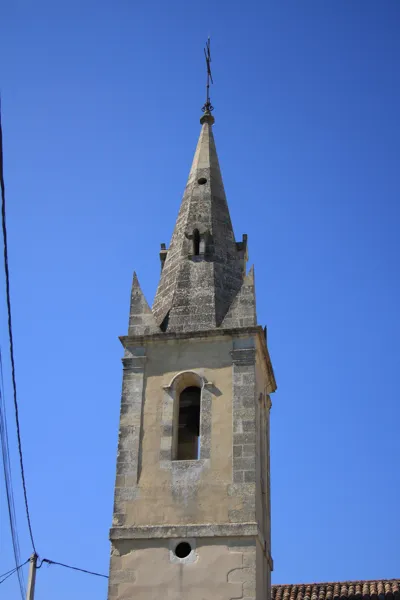
Église de Saint-André – XVIIème siècle – Pierre.
Cette église est construite après la destruction de Notre-Dame-des-Cabeauzes, un prieuré dépendant de l'abbaye de La Sauve Majeure, rasé pendant les guerres de Religion. Elle conserve deux tableaux récemment restaurés par M. Armand Fayen, dont l'un, datant du XVIème siècle, réalisé sous Henri II, représente le martyre de Saint Sébastien et le second, du XVIIème siècle, d'inspiration janséniste, une Crucifixion. Vivant sous Doclétien et dénoncé comme chrétien, Sébastien fut percé de flèches, sauvé par Sainte Irène, puis fustigé à mort. Le tableau qui lui est consacré ici le représente enchaîné, dans l'attente de son exécution.
English
Église de Saint-André – 17th century – Stone.
This church was built after the destruction of Notre-Dame-des-Cabeauzes, a priory belonging to the Abbey of La Sauve Majeure, which was razed during the Wars of Religion. It contains two paintings recently restored by Mr. Armand Fayen, one of which, dating from the 16th century and painted under Henri II, depicts the martyrdom of Saint Sébastien, and the second, from the 17th century, is a Jansenist Crucifixion. Living under Docletian and denounced as a Christian, Sebastian was pierced with arrows, saved by Saint Irene, then castigated to death. The painting dedicated to him here depicts him in chains, awaiting execution.
Deutsch
Kirche von Saint-André – 17. Jahrhundert – Stein.
Diese Kirche wurde nach der Zerstörung von Notre-Dame-des-Cabeauzes, einem von der Abtei La Sauve Majeure abhängigen Priorat, das während der Religionskriege dem Erdboden gleichgemacht wurde, errichtet. Sie beherbergt zwei kürzlich von Herrn Armand Fayen restaurierte Gemälde, von denen eines aus dem 16. Jahrhundert stammt, unter Heinrich II. entstanden ist und das Martyrium des Heiligen Sebastian darstellt, während das zweite aus dem 17. Jahrhundert stammt und von den Jansenisten inspiriert ist und eine Kreuzigung zeigt. Der unter Docletian lebende und als Christ denunzierte Sebastian wurde von Pfeilen durchbohrt, von der heiligen Irene gerettet und dann zu Tode gequält. Das Gemälde, das ihm hier gewidmet ist, zeigt ihn in Ketten, während er auf seine Hinrichtung wartet.
Dutch
Kerk van Saint-André – 17e eeuw – Steen.
Deze kerk werd gebouwd na de verwoesting van Notre-Dame-des-Cabeauzes, een priorij van de abdij van La Sauve Majeure, die tijdens de godsdienstoorlogen met de grond gelijk werd gemaakt. Het bevat twee schilderijen die onlangs zijn gerestaureerd door de heer Armand Fayen. Een daarvan, daterend uit de 16e eeuw en geschilderd onder Hendrik II, beeldt het martelaarschap van Sint Sebastiaan uit, terwijl de tweede, uit de 17e eeuw, een door Jansen geïnspireerde Kruisiging is. Sebastian, die onder Docletian leefde en als christen werd aangeklaagd, werd doorboord met pijlen, gered door de heilige Irene en vervolgens ter dood veroordeeld. Het schilderij dat hier aan hem is gewijd, toont hem geketend in afwachting van zijn executie.
Español
Iglesia de Saint-André – Siglo XVII – Piedra.
Esta iglesia fue construida tras la destrucción de Notre-Dame-des-Cabeauzes, priorato perteneciente a la abadía de La Sauve Majeure, arrasado durante las Guerras de Religión. Contiene dos cuadros recientemente restaurados por el Sr. Armand Fayen, uno de los cuales, del siglo XVI y pintado bajo Enrique II, representa el martirio de San Sebastián, mientras que el segundo, del siglo XVII, es una Crucifixión de inspiración jansenista. Viviendo bajo Docleciano y denunciado como cristiano, Sebastián fue atravesado por flechas, salvado por Santa Irene y luego castigado a muerte. El cuadro que se le dedica aquí lo representa encadenado, a la espera de su ejecución.
Italiano
Chiesa di Saint-André – XVII secolo – Pietra.
Questa chiesa fu costruita dopo la distruzione di Notre-Dame-des-Cabeauzes, un priorato appartenente all'abbazia di La Sauve Majeure, che fu raso al suolo durante le guerre di religione. Contiene due dipinti recentemente restaurati dal signor Armand Fayen, uno dei quali, risalente al XVI secolo e dipinto sotto Enrico II, raffigura il martirio di San Sebastiano, mentre il secondo, del XVII secolo, è una Crocifissione di ispirazione giansenista. Vissuto sotto Docleziano e denunciato come cristiano, Sebastiano fu trafitto da frecce, salvato da Sant'Irene e poi condannato a morte. Il dipinto a lui dedicato qui lo raffigura in catene, in attesa dell'esecuzione.