VESTIGES D'UN ETABLISSEMENT THERMAL GALLO-ROMAIN-CAZERES – Cazères
Description
English
Deutsch
Dutch
Español
Italiano
Description
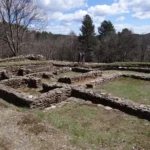
Un petit établissement thermal gallo-romain a été fouillé dans les années 1970. Il est visible, quoique non signalé.
Le site de Saint-Vincent, découvert au XXe siècle sur la rive droite de la Garonne, recouvre un complexe antique qui remonte à la période de la Tène, entre 450 et 50 avant J.C. Très aménagé dans l'antiquité gallo-romaine, il est alors doté d'un petit ensemble thermal avec des salles à hypocauste. Au Moyen Âge, il appartient aux Comtes de Comminges. Aux environs de l'an mille, Roger, qui demeure au château de Cazères, en fait don à l'abbaye bénédictine de Lézat pour son salut et celui de sa famille. C'est sur cet alleu de Saint-Vincent qu'est créé par la suite le site paroissial de la communauté de Couladère, avec église et cimetière. Thermes de Saint-Vincent : pièce demi-circulaire du frigidarium avec son égout d’évacuation.
English
A small Gallo-Roman spa was excavated in the 1970s. It is visible, although not indicated.
The site of Saint-Vincent, discovered in the 20th century on the right bank of the Garonne, covers an ancient complex dating back to the La Tène period, between 450 and 50 BC. It was very well developed in Gallo-Roman antiquity, with a small thermal complex with hypocaust rooms. In the Middle Ages, it belongs to the Counts of Comminges. Around the year 1000, Roger, who lived in the castle of Cazères, donated it to the Benedictine abbey of Lézat for his salvation and that of his family It is on this alleu of Saint-Vincent that the parish site of the community of Couladère is created, with church and cemetery. Thermes de Saint-Vincent : semi-circular room of the frigidarium with its drain.
Deutsch
Ein kleines gallo-römisches Thermalbad wurde in den 1970er Jahren ausgegraben. Sie ist sichtbar, wenn auch nicht ausgeschildert.
Jahrhundert am rechten Ufer der Garonne entdeckte Stätte Saint-Vincent bedeckt einen antiken Komplex, der auf die La-Tène-Zeit zwischen 450 und 50 v. Chr. zurückgeht. In der gallo-römischen Antike war er stark ausgebaut und verfügte über einen kleinen Thermalkomplex mit Hypokaustenhallen. Im Mittelalter gehörte es den Grafen von Comminges. Um das Jahr 1000 schenkte Roger, der im Schloss von Cazères wohnte, es der Benediktinerabtei von Lézat für sein Seelenheil und das seiner Familie Auf diesem Alleu de Saint-Vincent entstand später der Pfarrort der Gemeinde Couladère mit Kirche und Friedhof. Saint-Vincent-Thermen: Halbrunder Raum des Frigidariums mit Abwasserkanal.
Dutch
Een klein Gallo-Romeins kuuroord werd opgegraven in de jaren 1970. Het is zichtbaar, hoewel niet gemarkeerd.
De site van Saint-Vincent, ontdekt in de 20e eeuw op de rechteroever van de Garonne, omvat een oud complex uit de periode van La Tène, tussen 450 en 50 voor Christus. Het was zeer goed ontwikkeld in de Gallo-Romeinse oudheid, met een klein thermisch complex met hypocaustische kamers. In de middeleeuwen behoorde het toe aan de graven van Comminges. Rond het jaar 1000 schonk Roger, die het kasteel van Cazères bewoonde, het aan de benedictijnenabdij van Lézat voor zijn eigen veiligheid en die van zijn familie In deze steeg van Saint-Vincent ontstond de parochieplaats van de gemeente Couladère, met een kerk en een begraafplaats. Thermen van Saint-Vincent: halfronde zaal van het frigidarium met zijn afvoer.
Español
En la década de 1970 se excavó un pequeño balneario galo-romano. Es visible, aunque no está marcado.
El yacimiento de Saint-Vincent, descubierto en el siglo XX en la orilla derecha del Garona, abarca un antiguo complejo que se remonta a la época de La Tène, entre el 450 y el 50 a.C. Estaba muy bien desarrollada en la antigüedad galorromana, con un pequeño complejo termal con salas de hipocausto. En la Edad Media, pertenecía a los condes de Comminges. Hacia el año 1000, Roger, que vivía en el castillo de Cazères, lo donó a la abadía benedictina de Lézat para su propia seguridad y la de su familia En este callejón de Saint-Vincent se creó el recinto parroquial de la comunidad de Couladère, con una iglesia y un cementerio. Thermes de Saint-Vincent: sala semicircular del frigidarium con su desagüe.
Italiano
Negli anni Settanta è stato scavato un piccolo impianto termale gallo-romano. È visibile, anche se non segnalato.
Il sito di Saint-Vincent, scoperto nel XX secolo sulla riva destra della Garonna, copre un antico complesso risalente al periodo di La Tène, tra il 450 e il 50 a.C.. Era molto sviluppata nell'antichità gallo-romana, con un piccolo complesso termale con sale ipocausto. Nel Medioevo apparteneva ai conti di Comminges. Intorno all'anno 1000, Ruggero, che viveva nel castello di Cazères, lo donò all'abbazia benedettina di Lézat per la propria sicurezza e quella della sua famiglia È su questo vicolo di Saint-Vincent che è stato creato il sito parrocchiale della comunità di Couladère, con una chiesa e un cimitero. Thermes de Saint-Vincent: sala semicircolare del frigidarium con il suo scarico.
, 31220 Cazères