CALVAIRE DU MONT ARES – Nestier
Description
English
Deutsch
Dutch
Español
Italiano
Description
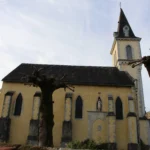
En 1854, à l’initiative du curé Béjottes, 12 chapelles sont construites sur le mont Arès : 11 chapelles se succèdent dans la pente, formant autant de stations du chemin de croix. Au sommet, la chapelle haute domine la plaine de la Neste. Au pied de l’ensemble, la construction d’un « monastère » est entamée par les bénédictins Olivétains de Saint-Bertrand-de-Comminges. Tombés en ruine au cours au XXe siècle, le site est restauré par des bénévoles à partir de 1983. La restauration du monastère en gîte et l’aménagement d’un théâtre de verdure permet d’accueillir des manifestations culturelles. En 1996, deux artistes, Marito et Christian Soucaret réalisent une crucifixion en céramique pour le tympan de la chapelle haute. L’ensemble est inscrit à l’inventaire supplémentaire des Monuments historiques en 1989.
Le site est accessible à pied et plusieurs sentiers de randonnées permettent de découvrir les environs et le village.
English
In 1854, on the initiative of parish priest Béjottes, 12 chapels were built on Mont Arès: 11 chapels follow one another up the slope, forming as many stations of the Way of the Cross. At the summit, the high chapel overlooks the Neste plain. At the foot of the complex, the Olivetan Benedictines of Saint-Bertrand-de-Comminges began construction of a "monastery". After falling into ruin during the 20th century, the site was restored by volunteers from 1983 onwards. The restoration of the monastery as a gîte and the creation of an open-air theater made it possible to host cultural events. In 1996, two artists, Marito and Christian Soucaret, created a ceramic crucifixion for the tympanum of the upper chapel. In 1989, the entire complex was listed on the supplementary inventory of historic monuments.
The site is accessible on foot, and there are several footpaths for exploring the surrounding area and village.
Deutsch
1854 wurden auf Initiative des Pfarrers Béjottes 12 Kapellen auf dem Berg Arès errichtet: 11 Kapellen reihen sich am Hang aneinander und bilden ebenso viele Stationen des Kreuzwegs. Auf dem Gipfel dominiert die hohe Kapelle die Ebene der Neste. Am Fuße des Komplexes wird mit dem Bau eines "Klosters" durch die Olivetaner Benediktiner von Saint-Bertrand-de-Comminges begonnen. Jahrhundert verfallen, wurde die Anlage ab 1983 von Freiwilligen restauriert. Die Restaurierung des Klosters als Herberge und die Einrichtung eines Theaters im Grünen ermöglichen es, kulturelle Veranstaltungen zu veranstalten. Im Jahr 1996 schufen die beiden Künstler Marito und Christian Soucaret eine Kreuzigung aus Keramik für das Tympanon der oberen Kapelle. Das Ensemble wurde 1989 in das Zusatzinventar der historischen Monumente aufgenommen.
Die Anlage ist zu Fuß erreichbar und es gibt mehrere Wanderwege, auf denen man die Umgebung und das Dorf erkunden kann.
Dutch
In 1854 werden op initiatief van pastoor Béjottes 12 kapellen gebouwd op de Mont Arès: 11 kapellen werden achtereenvolgens op de helling gebouwd en vormden evenveel staties van de kruisweg. Op de top kijkt de hoge kapel uit over de vlakte van de Neste. Aan de voet van het complex begonnen de Olivetaanse benedictijnen van Saint-Bertrand-de-Comminges met de bouw van een "klooster". Na in verval te zijn geraakt in de 20e eeuw, werd de site vanaf 1983 gerestaureerd door vrijwilligers. De restauratie van het klooster als gîte en de creatie van een openluchttheater maakten het mogelijk om culturele evenementen te organiseren. In 1996 maakten twee kunstenaars, Marito en Christian Soucaret, een keramisch kruisbeeld voor het timpaan van de bovenste kapel. Het hele complex werd in 1989 opgenomen in de aanvullende inventaris van historische monumenten.
De site is te voet bereikbaar en er zijn verschillende wandelpaden om de omgeving en het dorp te verkennen.
Español
En 1854, por iniciativa del párroco Béjottes, se construyeron 12 capillas en el monte Arès: 11 capillas se construyeron una tras otra en la ladera, formando otras tantas estaciones del Vía Crucis. En la cima, la capilla mayor domina la llanura del Neste. Al pie del complejo, los benedictinos olivetanos de Saint-Bertrand-de-Comminges comenzaron a construir un "monasterio". Tras caer en la ruina durante el siglo XX, el lugar fue restaurado por voluntarios a partir de 1983. El monasterio se restauró como casa rural y se construyó un teatro al aire libre para albergar actos culturales. En 1996, dos artistas, Marito y Christian Soucaret, crearon una crucifixión de cerámica para el tímpano de la capilla superior. El conjunto fue inscrito en el inventario suplementario de monumentos históricos en 1989.
El sitio es accesible a pie, y hay varios senderos para explorar los alrededores y el pueblo.
Italiano
Nel 1854, su iniziativa del parroco Béjottes, furono costruite 12 cappelle sul Mont Arès: 11 cappelle furono costruite in successione sul pendio, formando altrettante stazioni della Via Crucis. In cima, la cappella alta si affaccia sulla piana del Neste. Ai piedi del complesso, i benedettini olivetani di Saint-Bertrand-de-Comminges iniziarono a costruire un "monastero". Dopo essere caduto in rovina nel corso del XX secolo, il sito è stato restaurato da volontari a partire dal 1983. Il restauro del monastero come gîte e la creazione di un teatro all'aperto hanno permesso di ospitare eventi culturali. Nel 1996, due artisti, Marito e Christian Soucaret, hanno realizzato una crocifissione in ceramica per il timpano della cappella superiore. L'intero complesso è stato inserito nell'inventario supplementare dei monumenti storici nel 1989.
Il sito è accessibile a piedi e ci sono diversi sentieri per esplorare i dintorni e il villaggio.