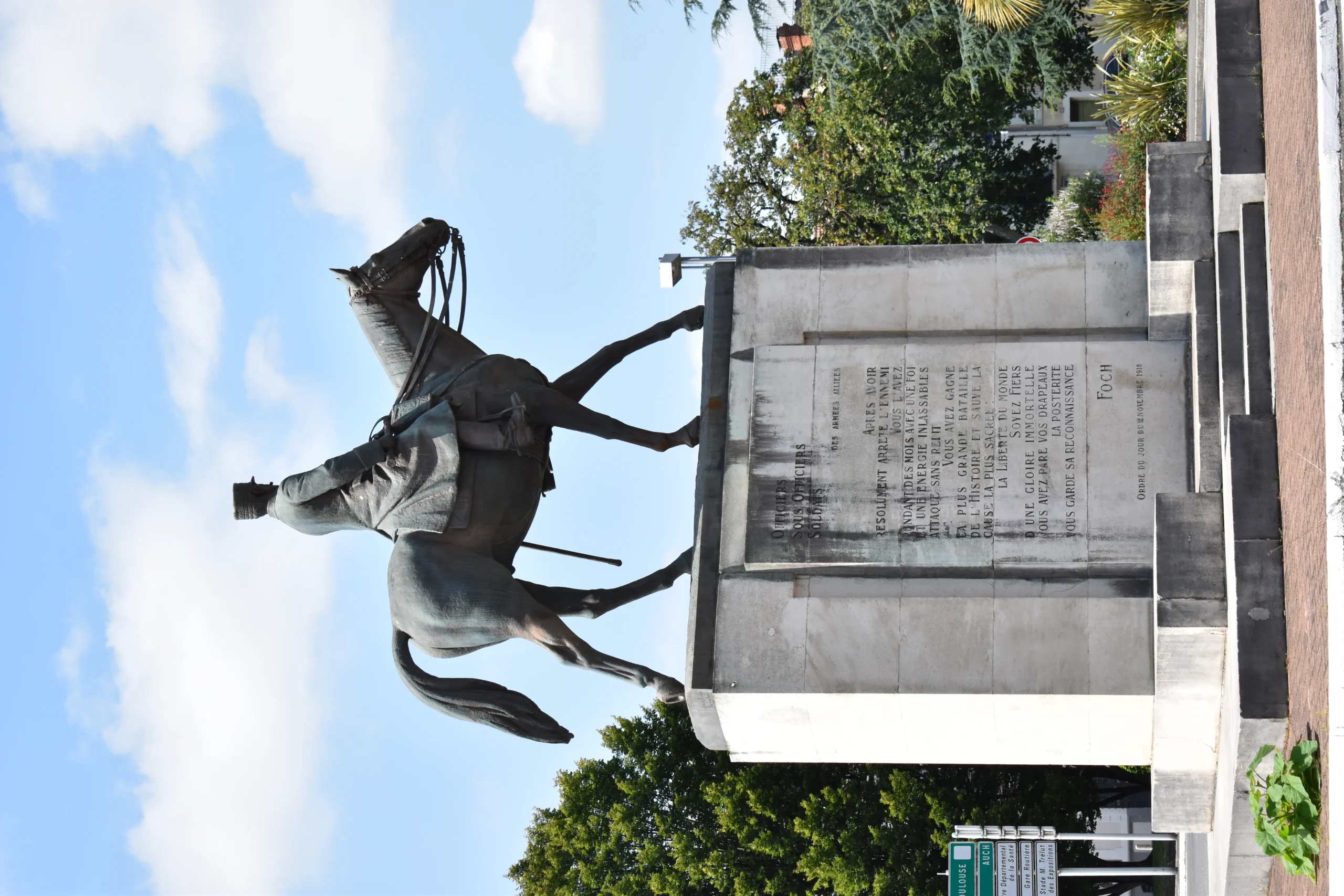
LA STATUE DU MARÉCHAL FOCH
Description
English
Deutsch
Dutch
Español
Italiano
Description
Trois fois maréchal, vainqueur de la Première Guerre mondiale, l’illustre tarbais représenté à cheval reste un puissant symbole.
Face à la caserne du 1er Régiment des Hussards Parachutistes, la statue du maréchal Ferdinand Foch (1851-1929) trône dans une magistrale mise en scène redonnant aux Allées leur vocation de parade militaire. Foch ne voulait pas de statue de son vivant : « Nous avons mieux à faire pour le bien public » disait-il. En 1932, trois ans après sa mort, une statue de Michelet réalisée grâce à une souscription rend hommage au tarbais le plus célèbre du XX° siècle. Elle prenait désormais la place de celle du Baron Larrey : autre temps, autre symbole.
English
Three times marshal, winner of the First World War, the illustrious Tarbais represented on horseback remains a powerful symbol.
Opposite the barracks of the 1st Regiment of Parachute Hussars, the statue of Marshal Ferdinand Foch (1851-1929) is enthroned in a masterly staging that gives back to the Allées their vocation of military parade. Foch did not want a statue during his lifetime: "We have better things to do for the public good" he said. In 1932, three years after his death, a statue of Michelet made thanks to a subscription paid homage to the most famous Tarbais of the 20th century. It now took the place of Baron Larrey's: another time, another symbol.
Deutsch
Der dreimalige Marschall und Sieger des Ersten Weltkriegs, der in Tarbais zu Pferd dargestellt wird, bleibt ein mächtiges Symbol.
Gegenüber der Kaserne des 1. Fallschirmjägerregiments thront die Statue von Marschall Ferdinand Foch (1851-1929) in einer meisterhaften Inszenierung, die den Allées ihre Berufung als Militärparade zurückgibt. Foch wollte zu Lebzeiten keine Statue: "Wir haben Besseres für das öffentliche Wohl zu tun", sagte er. 1932, drei Jahre nach seinem Tod, wurde der berühmteste Tarbais des 20. Jahrhunderts mit einer Statue von Michelet geehrt, die dank einer Subskription realisiert werden konnte. Jahrhunderts. Sie nahm nun den Platz der Statue von Baron Larrey ein: eine andere Zeit, ein anderes Symbol.
Dutch
Driemaal maarschalk, winnaar van de Eerste Wereldoorlog, blijft de illustere Tarbais te paard een krachtig symbool.
Tegenover de barakken van het 1ste Parachute Hussars Regiment troont het standbeeld van Maarschalk Ferdinand Foch (1851-1929) in een meesterlijk decor, waardoor de Allées hun militaire parade roeping terugkrijgen. Foch wilde geen standbeeld tijdens zijn leven: "We hebben betere dingen te doen voor het algemeen belang" zei hij. In 1932, drie jaar na zijn dood, werd dankzij een inschrijving een standbeeld van Michelet opgericht als eerbetoon aan de beroemdste Tarbais van de 20e eeuw. Het nam de plaats in van het standbeeld van Baron Larrey: een andere tijd, een ander symbool.
Español
Tres veces mariscal, vencedor de la Primera Guerra Mundial, el ilustre Tarbais representado a caballo sigue siendo un poderoso símbolo.
Frente al cuartel del 1er Regimiento de Húsares Paracaidistas, la estatua del Mariscal Ferdinand Foch (1851-1929) se entroniza en un marco magistral, devolviendo a los Allées su vocación de desfile militar. Foch no quería una estatua en vida: "Tenemos mejores cosas que hacer por el bien público", dijo. En 1932, tres años después de su muerte, se erigió una estatua de Michelet gracias a una suscripción para rendir homenaje al Tarbais más famoso del siglo XX. Ocupó el lugar de la estatua del barón Larrey: otro tiempo, otro símbolo.
Italiano
Tre volte maresciallo, vincitore della Prima Guerra Mondiale, l'illustre Tarbais raffigurato a cavallo rimane un simbolo potente.
Di fronte alla caserma del 1° Reggimento Ussari Paracadutisti, la statua del Maresciallo Ferdinand Foch (1851-1929) troneggia in una cornice magistrale, restituendo alle Allées la loro vocazione di parata militare. Foch non volle una statua durante la sua vita: "Abbiamo cose migliori da fare per il bene pubblico", disse. Nel 1932, tre anni dopo la sua morte, fu eretta una statua di Michelet grazie a una sottoscrizione per rendere omaggio al più famoso Tarbais del XX secolo. Ha preso il posto della statua del barone Larrey: un altro tempo, un altro simbolo.