Eglise Saint Rémi de Flize – Flize
Description
English
Deutsch
Dutch
Español
Italiano
Description
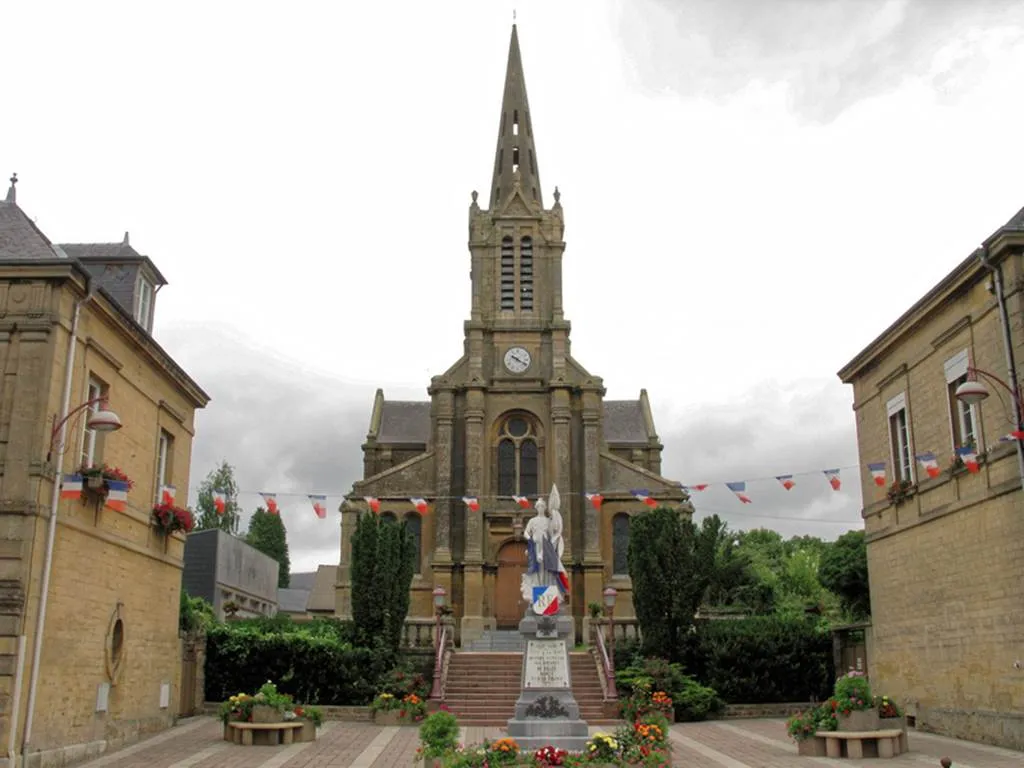
En 1859, une souscription fut lancée pour reconstruire l'église Saint-Rémi. Un devis détaillé établi par l'architecte Reimbeau de Reims en 1860 précisa le projet, et les travaux commencèrent en avril 1861, utilisant diverses pierres locales pour la construction. L'église fut consacrée le 30 octobre 1866 par l'archevêque Gousset, et la réception des travaux eut lieu en 1868 sous la direction de Jean-Baptiste Couty. Cette reconstruction s'inscrivait dans un projet plus vaste incluant la mairie et le presbytère, marquant l'entrée de l'esplanade du monument. En 1873, Couty proposa la construction d'un perron d'accès. L'église, de style néo-classique, a vu sa flèche du clocher détruite lors des conflits mondiaux, remplacée par une structure en béton.Entre 1839 et 1846, des projets avaient déjà été envisagés pour agrandir l'ancienne église, jugée trop petite. L'architecte Delerue avait dessiné des plans pour agrandir la nef et le chœur, ainsi que pour ajouter une chapelle au sud. La nouvelle église est située au centre du village, orientée au nord, avec un plan en croix latine. La façade principale, dominée par le clocher, intègre un vestibule d'entrée à la nef, entourée de deux chapelles. La nef à trois vaisseaux, avec un transept saillant et un chœur à abside hémicirculaire, est soutenue par des colonnes en fonte.Les matériaux de construction incluent de la pierre de taille de Dom-le-Mesnil et du moellon. L'intérieur, entièrement voûté d'ogives, présente des surfaces enduites et des sols variés, du ciment polychrome au calcaire. Le clocher, qui compte trois niveaux, est également voûté et couvert d'une flèche polygonale en béton, tandis que le reste de l'édifice bénéficie de toits à longs pans et d'une croupe ronde sur le chœur.
English
In 1859, a subscription was launched to rebuild Saint-Rémi church. A detailed estimate drawn up by architect Reimbeau of Reims in 1860 specified the project, and work began in April 1861, using various local stones for the construction. The church was consecrated on October 30, 1866 by Archbishop Gousset, and acceptance of the work took place in 1868 under the direction of Jean-Baptiste Couty. The reconstruction was part of a larger project that included the town hall and presbytery, marking the entrance to the monument's esplanade. In 1873, Couty proposed the construction of an access stoop. Between 1839 and 1846, plans had already been made to enlarge the old church, which was considered too small. Architect Delerue had drawn up plans to enlarge the nave and choir, and to add a chapel to the south. The new church is located in the center of the village, facing north, with a Latin cross plan. The main façade, dominated by the bell tower, incorporates an entrance vestibule to the nave, surrounded by two chapels. The three-vessel nave, with a projecting transept and a choir with a semicircular apse, is supported by cast-iron columns.construction materials include Dom-le-Mesnil ashlar and rubble stone. The interior, entirely rib-vaulted, features plastered surfaces and floors ranging from polychrome cement to limestone. The three-storey bell tower is also vaulted and covered by a polygonal concrete spire, while the rest of the building has long-sloped roofs and a round hipped roof over the choir.
Deutsch
1859 wurde eine Subskription für den Wiederaufbau der Kirche Saint-Rémi aufgelegt. Ein detaillierter Kostenvoranschlag des Architekten Reimbeau aus Reims im Jahr 1860 präzisierte das Projekt, und die Bauarbeiten begannen im April 1861, wobei verschiedene lokale Steine für den Bau verwendet wurden. Die Kirche wurde am 30. Oktober 1866 von Erzbischof Gousset geweiht, und die Bauabnahme fand 1868 unter der Leitung von Jean-Baptiste Couty statt. Dieser Wiederaufbau war Teil eines größeren Projekts, das auch das Rathaus und das Pfarrhaus umfasste und den Eingang zur Esplanade des Denkmals markierte. Im Jahr 1873 schlug Couty den Bau einer Zugangstreppe vor. Bei der Kirche im neoklassizistischen Stil wurde die Turmspitze während der Weltkriege zerstört und durch eine Betonkonstruktion ersetzt.1839-1846 gab es bereits Pläne, die alte Kirche zu vergrößern, da sie als zu klein erachtet wurde. Der Architekt Delerue hatte Pläne zur Vergrößerung des Kirchenschiffs und des Chors sowie zur Hinzufügung einer Kapelle im Süden gezeichnet. Die neue Kirche befindet sich im Zentrum des Dorfes, ist nach Norden ausgerichtet und hat einen Grundriss in Form eines lateinischen Kreuzes. Die Hauptfassade, die vom Glockenturm dominiert wird, integriert eine Eingangshalle in das Kirchenschiff, das von zwei Kapellen umgeben ist. Das dreischiffige Langhaus mit einem vorspringenden Querschiff und einem Chor mit halbkreisförmiger Apsis wird von gusseisernen Säulen gestützt. Die Baumaterialien umfassen Stein aus Dom-le-Mesnil und Bruchstein. Der Innenraum ist vollständig mit einem Kreuzrippengewölbe versehen und weist verputzte Oberflächen und verschiedene Böden auf, die von mehrfarbigem Zement bis hin zu Kalkstein reichen. Der dreistöckige Glockenturm ist ebenfalls gewölbt und wird von einer polygonalen Betonspitze bedeckt.
Dutch
In 1859 werd er een inschrijving gelanceerd om de Saint-Rémi kerk te herbouwen. De architect Reimbeau uit Reims maakte in 1860 een gedetailleerde kostenraming voor het project en in april 1861 werd begonnen met de bouw van verschillende plaatselijke stenen. De kerk werd op 30 oktober 1866 ingewijd door aartsbisschop Gousset en het werk werd in 1868 opgeleverd onder leiding van Jean-Baptiste Couty. De reconstructie maakte deel uit van een breder project dat ook het stadhuis en de pastorie omvatte en de toegang tot de esplanade van het monument markeerde. In 1873 stelde Couty de bouw van een toegangsportaal voor. Tussen 1839 en 1846 waren er al plannen om de oude kerk, die te klein werd geacht, uit te breiden. De architect Delerue maakte plannen om het schip en het koor te vergroten en een kapel toe te voegen aan de zuidkant. De nieuwe kerk ligt in het centrum van het dorp, op het noorden, met een Latijns kruis. De hoofdgevel, gedomineerd door de klokkentoren, bevat een voorportaal naar het schip, omringd door twee kapellen. Het schip met drie schepen, een uitspringend dwarsschip en een koor met een halfronde apsis, wordt ondersteund door gietijzeren kolommen. De bouwmaterialen zijn arduin van Dom-le-Mesnil en breuksteen. Het interieur, volledig met ribgewelven, heeft gepleisterde oppervlakken en een verscheidenheid aan vloeren, van polychroom cement tot kalksteen. De klokkentoren met drie verdiepingen is ook gewelfd en heeft een veelhoekige betonnen spits, terwijl de rest van het gebouw langwerpige daken heeft en een rond schilddak boven het koor.
Español
En 1859 se lanzó una suscripción para reconstruir la iglesia de Saint-Rémi. En 1860, el arquitecto Reimbeau de Reims elaboró un presupuesto detallado del proyecto, y las obras comenzaron en abril de 1861, utilizando diversas piedras locales para la construcción. La iglesia fue consagrada el 30 de octubre de 1866 por el arzobispo Gousset, y las obras se entregaron en 1868 bajo la dirección de Jean-Baptiste Couty. La reconstrucción formaba parte de un proyecto más amplio que incluía el ayuntamiento y el presbiterio, marcando la entrada a la explanada del monumento. En 1873, Couty propuso la construcción de un pórtico de acceso. Entre 1839 y 1846, ya se había proyectado ampliar la antigua iglesia, considerada demasiado pequeña. El arquitecto Delerue elaboró los planos para ampliar la nave y el coro, y añadir una capilla al sur. La nueva iglesia está situada en el centro del pueblo, orientada al norte, con planta de cruz latina. La fachada principal, dominada por el campanario, incorpora un vestíbulo de entrada a la nave, rodeado de dos capillas. La nave, de tres naves, con crucero saliente y coro con ábside semicircular, está sostenida por columnas de hierro fundido. Los materiales de construcción son el sillar de Dom-le-Mesnil y la piedra de mampostería. El interior, enteramente abovedado, presenta superficies enlucidas y suelos variados, desde cemento policromado hasta piedra caliza. El campanario, de tres pisos, también está abovedado y cubierto por una aguja poligonal de hormigón, mientras que el resto del edificio tiene tejados a dos aguas y un tejado redondo a cuatro aguas sobre el coro.
Italiano
Nel 1859 fu lanciata una sottoscrizione per la ricostruzione della chiesa di Saint-Rémi. Un preventivo dettagliato redatto dall'architetto Reimbeau di Reims nel 1860 illustrava il progetto e i lavori iniziarono nell'aprile del 1861, utilizzando diverse pietre locali per la costruzione. La chiesa fu consacrata il 30 ottobre 1866 dall'arcivescovo Gousset e i lavori furono consegnati nel 1868 sotto la direzione di Jean-Baptiste Couty. La ricostruzione faceva parte di un progetto più ampio che comprendeva il municipio e il presbiterio, che segnava l'ingresso alla spianata del monumento. Nel 1873, Couty propose la costruzione di un portico di accesso. Tra il 1839 e il 1846 era già stato progettato l'ampliamento della vecchia chiesa, ritenuta troppo piccola. L'architetto Delerue elaborò un progetto di ampliamento della navata e del coro e di aggiunta di una cappella a sud. La nuova chiesa si trova al centro del villaggio, rivolta a nord, con una pianta a croce latina. La facciata principale, dominata dal campanile, incorpora un vestibolo d'ingresso alla navata, circondato da due cappelle. La navata centrale a tre navate, con transetto sporgente e coro con abside semicircolare, è sostenuta da colonne in ghisa; i materiali di costruzione sono il bugnato di Dom-le-Mesnil e il macigno. L'interno, interamente voltato a crociera, presenta superfici intonacate e una varietà di pavimenti, dal cemento policromo alla pietra calcarea. Il campanile a tre piani è anch'esso voltato e coperto da una cuspide poligonale in cemento, mentre il resto dell'edificio ha tetti a spioventi lunghi e un tetto a capanna rotondo sul coro.
17 rue de Sedan, 08160 Flize