Eglise Saint-Pierre – Condren
Description
English
Deutsch
Dutch
Español
Italiano
Description
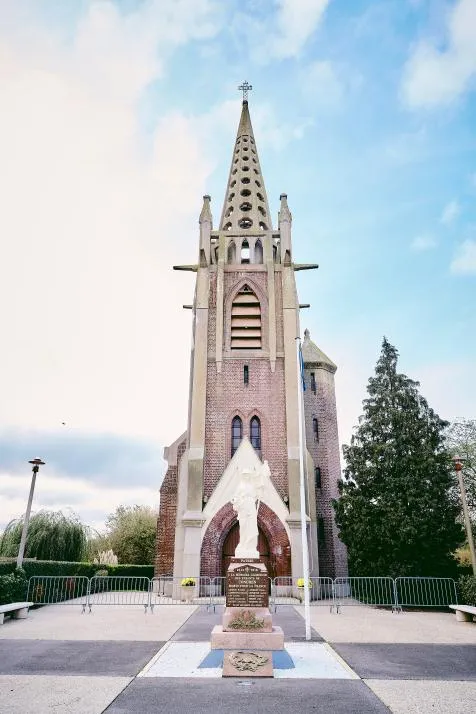
Reconstruite après la Première Guerre Mondiale, puisque l'église de Condren fut comme 300 autres, détruite au cours de celle-ci. Avec son clocher en béton ajouré, et ses vitraux situés dans le chœur et la nef, représentant la Croix et les Béatitudes, l'église de Condren représente l'architecture typique de l'après guerre où le béton et l'art déco sont rois.
English
Rebuilt after the First World War, since the church of Condren was like 300 others, destroyed during it. With its openwork concrete bell tower, and its stained glass windows located in the choir and the nave, representing the Cross and the Beatitudes, the church of Condren represents the typical architecture of the post-war period where concrete and art deco are king.
Deutsch
Nach dem Ersten Weltkrieg wiederaufgebaut, da die Kirche von Condren wie 300 andere während des Krieges zerstört wurde. Mit ihrem durchbrochenen Betonturm und den Glasfenstern im Chor und im Kirchenschiff, die das Kreuz und die Seligpreisungen darstellen, repräsentiert die Kirche von Condren die typische Architektur der Nachkriegszeit, in der Beton und Art déco vorherrschten.
Dutch
Herbouwd na de Eerste Wereldoorlog, aangezien de kerk van Condren, net als 300 andere, tijdens de oorlog werd verwoest. Met zijn betonnen klokkentoren en glas-in-loodramen in het koor en het schip, die het kruis en de zaligsprekingen voorstellen, vertegenwoordigt de kerk van Condren de typische naoorlogse architectuur waar beton en art deco koning zijn.
Español
Reconstruida después de la Primera Guerra Mundial, ya que la iglesia de Condren fue, como otras 300, destruida durante la guerra. Con su campanario de hormigón, y sus vidrieras en el coro y la nave, que representan la Cruz y las Bienaventuranzas, la iglesia de Condren representa la típica arquitectura de posguerra donde el hormigón y el art decó son los reyes.
Italiano
Ricostruita dopo la Prima Guerra Mondiale, poiché la chiesa di Condren fu distrutta, come altre 300, durante la guerra. Con il suo campanile in cemento e le sue vetrate nel coro e nella navata, che rappresentano la Croce e le Beatitudini, la chiesa di Condren rappresenta la tipica architettura del dopoguerra, dove il cemento e l'art déco la fanno da padrone.
115-119 chaussée Brunehaut, 02300 Condren
Crédits: Jerome Halatre - OT Coeur de Picard