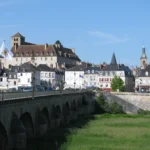
Eglise et crypte Saint-Aré – Decize
Description
English
Deutsch
Dutch
Español
Italiano
Description
L’église paroissiale est dédiée à Saint-Aré, évêque de Nevers de 548 à 558.
Selon ses dernières volontés et pour déterminer le lieu de sa sépulture, à sa mort son corps fût déposé dans une barque. Contre toute attente, la barque remonta la Loire depuis Nevers jusqu’à Decize, où le Saint fût inhumé.
L’église construite au 11ème siècle a été remaniée au 17ème et au 19ème siècles.
De l’édifice roman, seul subsiste le chœur abritant la crypte bâtie au 7ème siècle en l’honneur de Saint-Aré. L'église est ouverte tous les jours au public. Crypte fermée mais visible (porte en fer forgée).
Avec des guides conférencières, visites guidées de l'église et de la crypte en été et toute l'année pour les groupes.
English
The parish church is dedicated to Saint-Aré, bishop of Nevers from 548 to 558.
According to his last wishes and in order to determine the place of his burial, his body was placed in a boat at his death. Against all odds, the boat sailed up the Loire from Nevers to Decize, where the Saint was buried.
The church, built in the 11th century, was remodelled in the 17th and 19th centuries.
Of the Romanesque building, only the choir remains, which houses the crypt built in the 7th century in honour of Saint-Aré. The church is open to the public every day. Crypt closed but visible (wrought iron door).
Guided tours of the church and the crypt in summer and all year round for groups.
Deutsch
Die Pfarrkirche ist Saint-Aré gewidmet, der von 548 bis 558 Bischof von Nevers war.
Gemäß seinem letzten Willen und um den Ort seiner Beerdigung zu bestimmen, wurde sein Leichnam nach seinem Tod in ein Boot gelegt. Entgegen allen Erwartungen fuhr das Boot von Nevers die Loire hinauf bis nach Decize, wo der Heilige beigesetzt wurde.
Die im 11. Jahrhundert erbaute Kirche wurde im 17. und 19. Jahrhundert umgebaut.
Von dem romanischen Gebäude ist nur noch der Chor erhalten, der die Krypta beherbergt, die im 7. Die Kirche ist täglich für die Öffentlichkeit zugänglich. Die Krypta ist geschlossen, aber sichtbar (schmiedeeiserne Tür).
Mit Fremdenführerinnen werden im Sommer und das ganze Jahr über Führungen durch die Kirche und die Krypta für Gruppen angeboten.
Dutch
De parochiekerk is gewijd aan Saint-Aré, bisschop van Nevers van 548 tot 558.
Volgens zijn laatste wensen en om de plaats van zijn begrafenis te bepalen, werd zijn lichaam bij zijn dood in een boot geplaatst. Tegen alle verwachtingen in voer de boot de Loire op van Nevers naar Decize, waar de heilige werd begraven.
De kerk, gebouwd in de 11e eeuw, werd in de 17e en 19e eeuw verbouwd.
Van het Romaanse gebouw is alleen het koor overgebleven, waarin zich de crypte bevindt die in de 7e eeuw ter ere van Saint-Aré werd gebouwd. De kerk is elke dag open voor het publiek. De crypte is gesloten maar zichtbaar (smeedijzeren deur).
Rondleidingen in de kerk en de crypte in de zomer en het hele jaar door voor groepen.
Español
La iglesia parroquial está dedicada a Saint-Aré, obispo de Nevers de 548 a 558.
De acuerdo con su última voluntad y para determinar el lugar de su entierro, su cuerpo fue colocado en un barco a su muerte. Contra todo pronóstico, el barco remontó el Loira desde Nevers hasta Decize, donde fue enterrado el Santo.
La iglesia, construida en el siglo XI, fue remodelada en los siglos XVII y XIX.
Del edificio románico sólo se conserva el coro, que alberga la cripta construida en el siglo VII en honor de Saint-Aré. La iglesia está abierta al público todos los días. La cripta está cerrada pero visible (puerta de hierro forjado).
Visitas guiadas de la iglesia y la cripta en verano y todo el año para grupos.
Italiano
La chiesa parrocchiale è dedicata a Saint-Aré, vescovo di Nevers dal 548 al 558.
Secondo le sue ultime volontà e per determinare il luogo della sua sepoltura, alla sua morte il corpo è stato posto in una barca. Contro ogni previsione, la barca risalì la Loira da Nevers a Decize, dove il Santo era sepolto.
La chiesa, costruita nell'XI secolo, è stata rimaneggiata nel XVII e nel XIX secolo.
Dell'edificio romanico rimane solo il coro, che ospita la cripta costruita nel VII secolo in onore di Saint-Aré. La chiesa è aperta al pubblico tutti i giorni. La cripta è chiusa ma visibile (porta in ferro battuto).
Visite guidate alla chiesa e alla cripta in estate e tutto l'anno per gruppi.
Moyens de paiement: Espèce - Chèque
Rue Jean-Jacques Rousseau, 58300 Decize