Eglise de Saint-Agnan – Ségur
Description
English
Deutsch
Dutch
Español
Italiano
Description
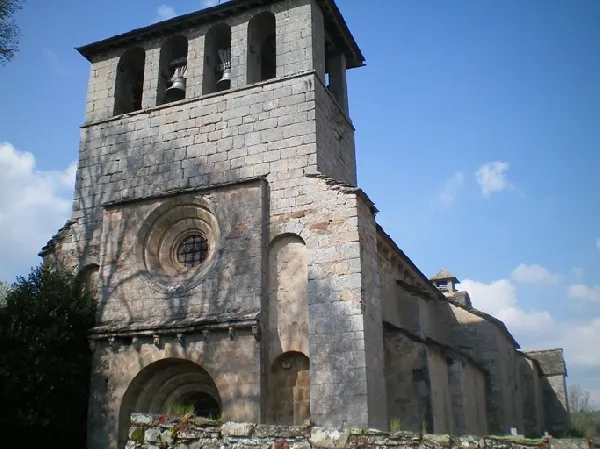
Monument historique classé.Il possède un portail identique à celui de l'église de Saint-Amans-du-Ram (commune de Vezins-de-Lévézou). Le choeur a été construit en 1440 (chevet carré voûté et croisée d'ogives). Dans une chapelle, se trouve un sarcophage gallo-romain aux parois sculptées, figurant un atelier de forgeron. Stylistiquement, il ne peut être daté avant le IV ème siècle.
L'église fut donnée en 1123 par Begon de Creissels à ses frères au monastère de Nobiliacum (St Léons). Un château construit après 1592 par Antoine d Hébles aux Julien de Pégayrolles, puis aux Micheau. Il servi sous la Révolution de maison de réclusion.
http://www.egliseetpatrimoine-stagnan.fr/lire.php?rub=HISTOIRE
English
It has a portal identical to that of the church of Saint-Amans-du-Ram (commune of Vezins-de-Lévézou). The choir was built in 1440 (square vaulted chevet and cross ribbed). In a chapel, there is a Gallo-Roman sarcophagus with carved walls, representing a blacksmith's workshop. Stylistically, it cannot be dated before the 4th century.
The church was donated in 1123 by Begon de Creissels to his brothers at the monastery of Nobiliacum (St Léons). A castle built after 1592 by Antoine d Hébles to the Julien de Pégayrolles, then to the Micheau. It was used during the Revolution as a house of confinement.
http://www.egliseetpatrimoine-stagnan.fr/lire.php?rub=HISTOIRE
Deutsch
Sie besitzt ein Portal, das mit dem der Kirche von Saint-Amans-du-Ram (Gemeinde Vezins-de-Lévézou) identisch ist. Der Chor wurde 1440 erbaut (quadratischer gewölbter Kopfteil mit Kreuzrippengewölbe). In einer Kapelle befindet sich ein gallo-römischer Sarkophag mit geschnitzten Wänden, die eine Schmiedewerkstatt darstellen. Stilistisch kann er nicht vor das 4. Jahrhundert datiert werden.
Die Kirche wurde 1123 von Begon de Creissels an seine Brüder im Kloster von Nobiliacum (St. Léons) verschenkt. Ein Schloss, das nach 1592 von Antoine d Hébles an die Julien de Pégayrolles und später an die Micheau erbaut wurde. Während der Revolution diente es als Zuchthaus.
http://www.egliseetpatrimoine-stagnan.fr/lire.php?rub=HISTOIRE
Dutch
Het portaal is identiek aan dat van de kerk van Saint-Amans-du-Ram (gemeente Vezins-de-Lévézou). Het koor werd gebouwd in 1440 (vierkant gewelf en geribde kruising). In een kapel bevindt zich een Gallo-Romeinse sarcofaag met gebeeldhouwde wanden, die de werkplaats van een smid voorstelt. Stilistisch kan het niet voor de 4e eeuw gedateerd worden.
De kerk werd in 1123 geschonken door Begon de Creissels aan zijn broeders in het klooster van Nobiliacum (St Léons). Een kasteel gebouwd na 1592 door Antoine d'Hébles aan de Julien de Pégayrolles, vervolgens aan de Micheau. Het werd tijdens de Revolutie gebruikt als huis van bewaring.
http://www.egliseetpatrimoine-stagnan.fr/lire.php?rub=HISTOIRE
Español
Tiene un portal idéntico al de la iglesia de Saint-Amans-du-Ram (municipio de Vezins-de-Lévézou). El coro se construyó en 1440 (cabecera de bóveda cuadrada y crucero de crucería). En una capilla, hay un sarcófago galo-romano con paredes esculpidas, que representa un taller de herrería. Estilísticamente, no puede datarse antes del siglo IV.
La iglesia fue donada en 1123 por Begon de Creissels a sus hermanos del monasterio de Nobiliacum (San León). Un castillo construido después de 1592 por Antoine d'Hébles a los Julien de Pégayrolles, luego a los Micheau. Se utilizó durante la Revolución como casa de detención.
http://www.egliseetpatrimoine-stagnan.fr/lire.php?rub=HISTOIRE
Italiano
Ha un portale identico a quello della chiesa di Saint-Amans-du-Ram (comune di Vezins-de-Lévézou). Il coro fu costruito nel 1440 (volta quadrata e crociera a costoloni). In una cappella si trova un sarcofago gallo-romano con pareti scolpite, che rappresenta l'officina di un fabbro. Stilisticamente non può essere datato prima del IV secolo.
La chiesa fu donata nel 1123 da Begon de Creissels ai suoi fratelli del monastero di Nobiliacum (St Léons). Un castello costruito dopo il 1592 da Antoine d'Hébles ai Julien de Pégayrolles, poi ai Micheau. Durante la Rivoluzione fu utilizzato come casa di detenzione.
http://www.egliseetpatrimoine-stagnan.fr/lire.php?rub=HISTOIRE
Saint-Agnan, 12290 Ségur
Crédits: OFFICE DE TOURISME DE PARELOUP LEVEZOU