COUVENT DES URSULINES – Ispagnac
Description
English
Deutsch
Dutch
Español
Italiano
Description
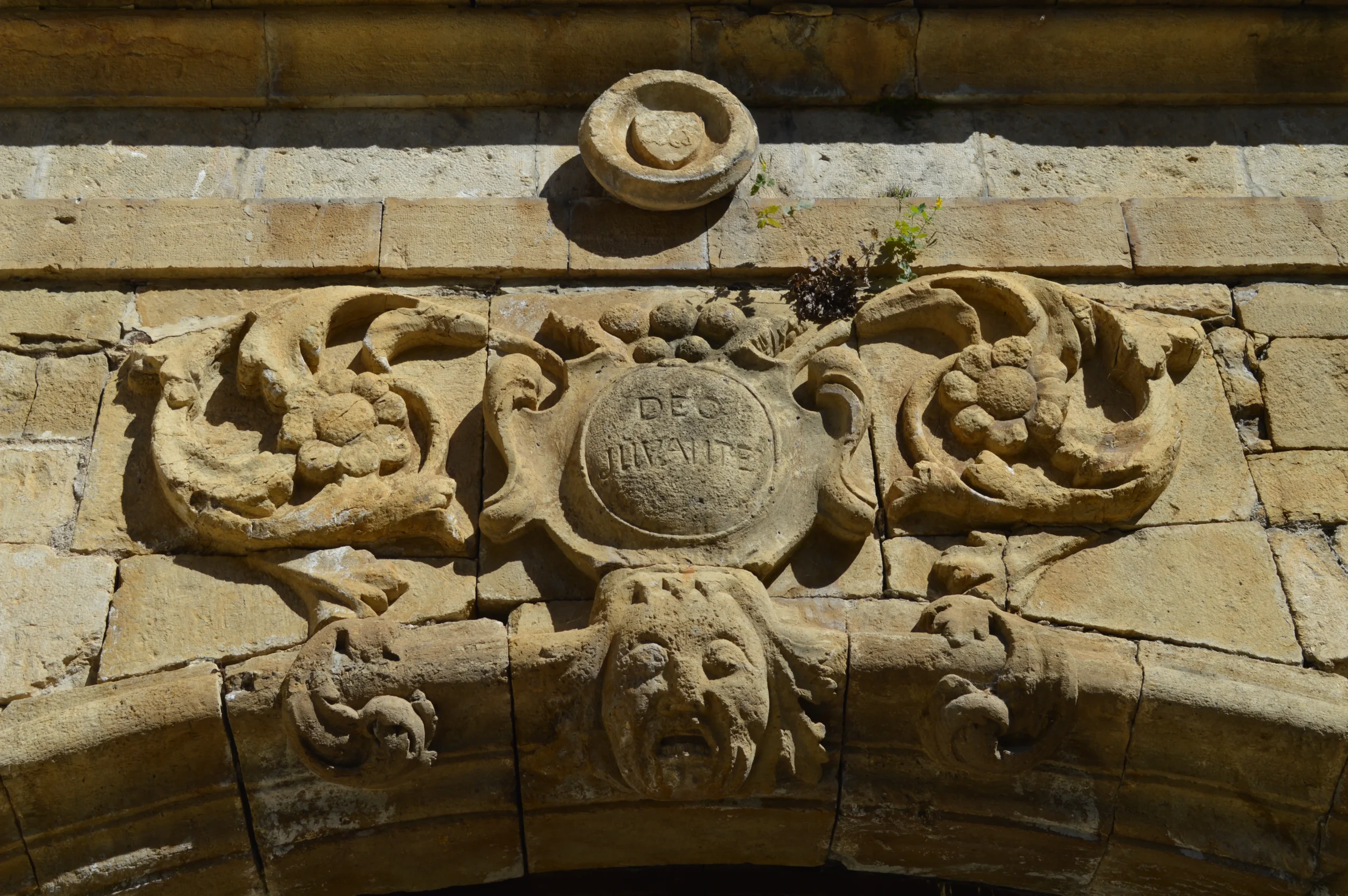
La structure du portail est en arc surbaissé avec piédroits et linteaux moulurés. La clef de l'arc est sculptée et représente un masque surmonté d'un écusson portant l'inscription "DEO JUVANTE", ("Avec l'aide de Dieu"), la devise de la famille de Chateauneuf-Randon, ce qui laisse penser que le portail pourrait avoir appartenu à cette famille. De cet écusson partent deux volutes en feuillage se terminant par un motif floral stylisé.
Le portail est surmonté par une corniche au milieu de laquelle, et à l'aplomb de la clef, se trouve un cabochon sculpté. A l'intérieur, le traitement de l'escalier est également remarquable, et offre un bel exemple de stéréotomie du XVIIe siècle. Il présente un plan carré, sur deux étages, avec paliers intermédiaires. Les arcs se contrebutent par eux-mêmes et laissent l'intérieur de l'escalier à vide, sans point d'appui. De même les retombées de l'arc se terminent par un motif sculpté.
English
The structure of the portal is a low arch with moulded pedestals and lintels. The key of the arch is sculpted and represents a mask surmounted by a shield bearing the inscription "DEO JUVANTE", ("With the help of God"), the motto of the Chateauneuf-Randon family, which suggests that the portal may have belonged to this family. From this coat of arms, two foliage scrolls end in a stylised floral motif.
The portal is surmounted by a cornice in the middle of which, and in line with the key, is a carved cabochon. Inside, the treatment of the staircase is also remarkable, and offers a fine example of 17th century stereotomy. It has a square plan, on two floors, with intermediate landings. The arches are self-bracing, leaving the inside of the staircase empty, without any support. Also, the arches end with a sculpted motif.
Deutsch
Die Struktur des Portals ist ein Flachbogen mit geformten Sockeln und Stürzen. Der Schlüssel des Bogens ist geschnitzt und stellt eine Maske dar, die von einem Wappenschild mit der Inschrift "DEO JUVANTE" ("Mit Gottes Hilfe"), dem Motto der Familie de Chateauneuf-Randon, überragt wird, was darauf schließen lässt, dass das Portal dieser Familie gehört haben könnte. Von diesem Wappen gehen zwei Laubvoluten aus, die in einem stilisierten Blumenmotiv enden.
Das Portal wird von einem Gesims gekrönt, in dessen Mitte und lotrecht zum Schlüssel sich ein geschnitzter Cabochon befindet. Im Inneren des Gebäudes ist die Treppe ebenfalls bemerkenswert und ein schönes Beispiel für die Stereotomie des 17. Jahrhundert. Sie hat einen quadratischen Grundriss, zwei Stockwerke mit Zwischenpodesten. Die Bögen stützen sich selbst ab und lassen das Innere der Treppe leer und ohne Stützpunkt. Auch die Bogenauflagen enden in einem geschnitzten Motiv.
Dutch
Het portaal heeft een lage boog met geprofileerde stijlen en lateien. De sleutel van de boog is gebeeldhouwd en stelt een masker voor met daarboven een schild met de inscriptie "DEO JUVANTE" ("Met Gods hulp"), het motto van de Chateauneuf-Randon familie, wat suggereert dat de poort tot deze familie behoorde. Twee bladerranken eindigen in een gestileerd bloemmotief.
De poort wordt bekroond door een kroonlijst met in het midden een gebeeldhouwde cabochon net boven de sleutel. Binnen is ook de behandeling van het trappenhuis opmerkelijk, een mooi voorbeeld van 17e-eeuwse stereotomie. De trap heeft een vierkante plattegrond met twee verdiepingen en tussenbordessen. De bogen zijn zelfdragend, waardoor de binnenkant van de trap leeg is, zonder steunpunt. De bogen eindigen ook in een gebeeldhouwd motief.
Español
El portal es de arco rebajado, con jambas y dinteles moldurados. La clave del arco está tallada y representa una máscara coronada por un escudo con la inscripción "DEO JUVANTE" ("Con la ayuda de Dios"), lema de la familia Chateauneuf-Randon, lo que sugiere que el portal pudo pertenecer a esta familia. Dos volutas de follaje terminan en un motivo floral estilizado.
La puerta está rematada por una cornisa, en cuyo centro hay un cabujón tallado justo encima de la llave. En el interior, destaca también el tratamiento de la escalera, un buen ejemplo de la estereotomía del siglo XVII. La escalera es de planta cuadrada con dos pisos y descansillos intermedios. Los arcos son autoportantes, dejando el interior de la escalera vacío, sin punto de apoyo. Asimismo, los arcos terminan en un motivo esculpido.
Italiano
Il portale è una struttura ad arco ribassato con stipiti e architravi modanati. La chiave dell'arco è scolpita e rappresenta una maschera sormontata da uno scudo con l'iscrizione "DEO JUVANTE" ("Con l'aiuto di Dio"), il motto della famiglia Chateauneuf-Randon, il che suggerisce che il portale potrebbe essere appartenuto a questa famiglia. Due volute di fogliame terminano con un motivo floreale stilizzato.
Il portale è sormontato da una cornice, al centro della quale si trova un cabochon intagliato appena sopra la chiave. All'interno è notevole anche il trattamento della scala, che costituisce un bell'esempio di stereotomia del XVII secolo. La scala è a pianta quadrata con due piani e pianerottoli intermedi. Gli archi sono autoportanti, lasciando l'interno della scala vuoto, senza alcun punto di appoggio. Allo stesso modo, gli archi terminano con un motivo scolpito.
25, chemin Royal, 48320 Ispagnac
Crédits: Roxane Carrat - Conseil départemental Lozère