CHAPELLE SAINT-ROCH PRES DE LAJO – Lajo
Description
English
Deutsch
Dutch
Español
Italiano
Description
En 1721, les habitants de Lajo portèrent une requête devant l'évêque de Mende pour la construction d'une église. Onze ans plus tard, l’église Saint-Roch sort de terre, édifiée avec les pierres de la chapelle de l'Hospitalet qui était délabrée. Elle subit des transformations durant le XIXe s. En 1887, la voûte est reconstruite et une chapelle est élevée au nord de la seconde travée.
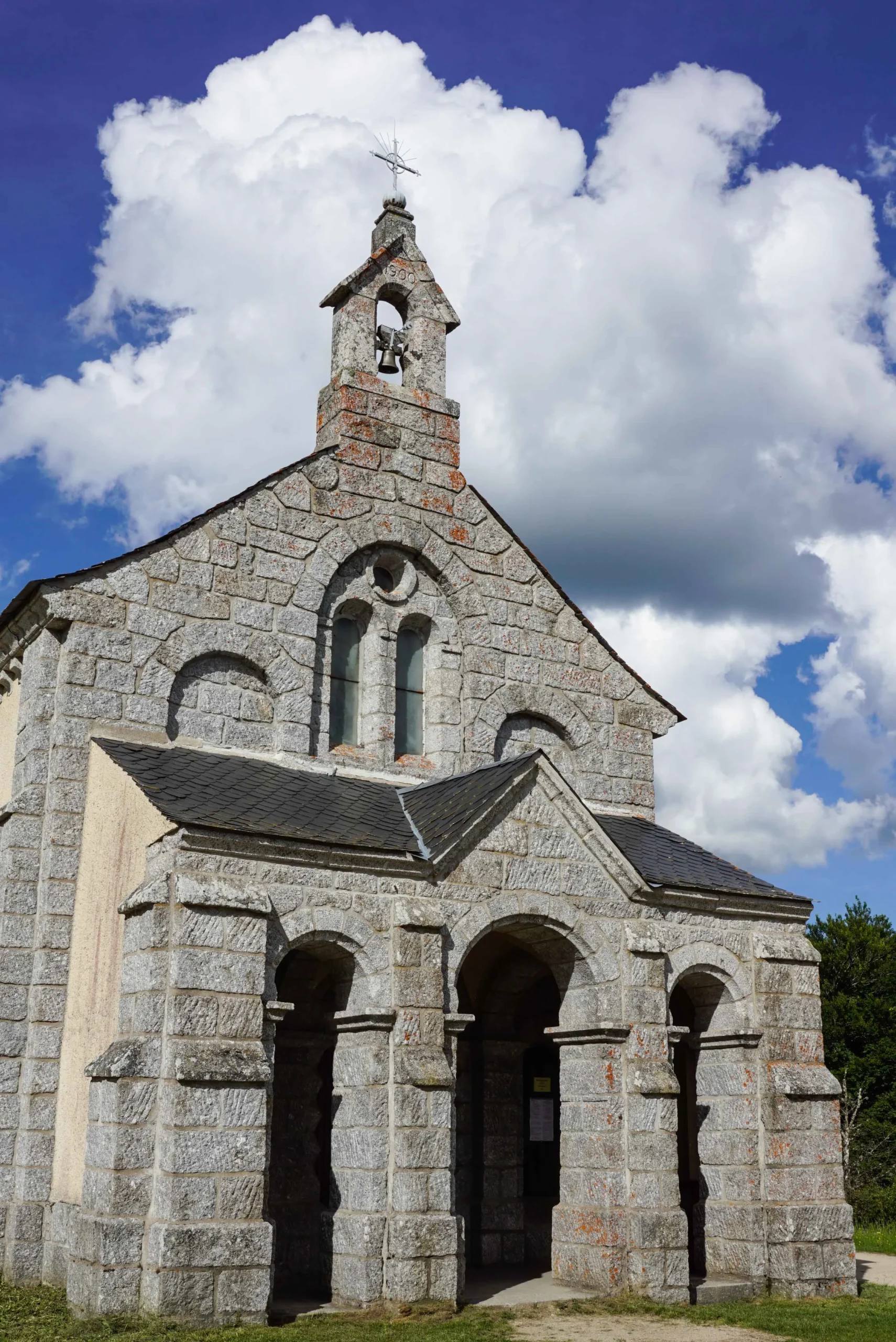
Construite en grand appareil de granite, l’église présente une architecture typiquement néo-romane. On distingue son imposant clocher-flèche carré accolé à la façade sud de l’édifice. À l’intérieur, l’église présente une nef unique voûtée en berceau plein cintre composée de deux travées. Les vitraux du chœur et des chapelles sont contemporains. Les chapiteaux sur lesquels reposent les arcs doubleaux sont ornés de motifs végétaux et figurés. La particularité réside dans la fresque, peinte sur le cul-de-four, réalisée en 1992, représentant le Christ attablé avec les pèlerins d’Emmaüs.
English
In 1721, the inhabitants of Lajo petitioned the bishop of Mende for the construction of a church. Eleven years later, the church of St. Roch came out of the ground, built with the stones of the dilapidated Hospitalet chapel. It underwent transformations during the 19th century. In 1887, the vault was rebuilt and a chapel was built to the north of the second bay.
Built in granite, the church has a typical neo-Romanesque architecture. Its imposing square bell-tower-arrow is attached to the south facade of the building Inside, the church has a single nave with a barrel vault consisting of two bays. The stained glass windows in the choir and the chapels are contemporary. The capitals on which the double arches rest are decorated with plant and figurative motifs. The particularity lies in the fresco, painted on the cul-de-four, carried out in 1992, representing Christ at the table with the Emmaus pilgrims.
Deutsch
1721 brachten die Einwohner von Lajo beim Bischof von Mende eine Bitte um den Bau einer Kirche vor. Elf Jahre später wurde die Kirche Saint-Roch aus den Steinen der baufälligen Kapelle von L'Hospitalet errichtet. Im Laufe des 19. Jahrhunderts wurde sie umgebaut. Im Jahr 1887 wurde das Gewölbe wieder aufgebaut und eine Kapelle im Norden des zweiten Jochs errichtet.
Die Kirche wurde aus Granit gebaut und weist eine typisch neoromanische Architektur auf. Auffällig ist der imposante quadratische Glockenturm, der an die Südfassade des Gebäudes angebaut ist Das Innere der Kirche besteht aus einem einzigen Schiff mit Tonnengewölbe, das aus zwei Jochen besteht. Die Glasfenster im Chor und in den Kapellen sind zeitgenössisch. Die Kapitelle, auf denen die Doppelbögen ruhen, sind mit pflanzlichen und figürlichen Motiven verziert. Eine Besonderheit ist das 1992 gemalte Fresko, das Christus beim Essen mit den Emmaus-Pilgern darstellt.
Dutch
In 1721 verzochten de inwoners van Lajo de bisschop van Mende om een kerk te bouwen. Elf jaar later werd de kerk Saint-Roch gebouwd met de stenen van de vervallen kapel Hospitalet. Het onderging transformaties tijdens de 19e eeuw. In 1887 werd het gewelf herbouwd en werd ten noorden van de tweede travee een kapel gebouwd.
De kerk is gebouwd in grote granieten eenheden en heeft een typisch neoromaanse architectuur. De imposante vierkante klokkentoren is bevestigd aan de zuidelijke gevel van het gebouw Binnen heeft de kerk één schip met een tongewelf en twee traveeën. De gebrandschilderde ramen in het koor en de kapellen zijn eigentijds. De kapitelen waarop de dubbele bogen rusten zijn versierd met planten- en figuratieve motieven. Bijzonder is het fresco dat in 1992 op de cul-de-four werd geschilderd en Christus voorstelt aan tafel met de pelgrims van Emmaüs.
Español
En 1721, los habitantes de Lajo solicitaron al obispo de Mende la construcción de una iglesia. Once años más tarde, se construyó la iglesia de Saint-Roch con las piedras de la ruinosa capilla del Hospitalet. Sufrió transformaciones durante el siglo XIX. En 1887 se reconstruyó la bóveda y se construyó una capilla al norte de la segunda nave.
La iglesia fue construida en grandes unidades de granito y tiene una arquitectura neorrománica típica. Su imponente campanario cuadrado puede verse adosado a la fachada sur del edificio En el interior, la iglesia tiene una sola nave con bóveda de cañón y dos tramos. Las vidrieras del coro y de las capillas son contemporáneas. Los capiteles sobre los que se apoyan los arcos dobles están decorados con motivos vegetales y figurativos. Destaca el fresco pintado en 1992 en el pasillo central, que representa a Cristo sentado a la mesa con los peregrinos de Emaús.
Italiano
Nel 1721, gli abitanti di Lajo chiesero al vescovo di Mende di costruire una chiesa. Undici anni dopo, la chiesa di Saint-Roch fu costruita con le pietre della fatiscente cappella dell'Hospitalet. Ha subito trasformazioni nel corso del XIX secolo. Nel 1887, la volta fu ricostruita e fu costruita una cappella a nord della seconda campata.
La chiesa è stata costruita in grandi unità di granito e presenta una tipica architettura neoromanica. Il suo imponente campanile quadrato è visibile sulla facciata meridionale dell'edificio All'interno, la chiesa è a navata unica con volta a botte e due campate. Le vetrate del coro e delle cappelle sono contemporanee. I capitelli su cui poggiano i doppi archi sono decorati con motivi vegetali e figurativi. Una particolarità è l'affresco dipinto sul cul-de-four nel 1992, che raffigura Cristo a tavola con i pellegrini di Emmaus.
Contemporain
, 48120 Lajo
Crédits: Marion Larguier