Chapelle des Jésuites – Lycée du Sacré Cœur – Aix-en-Provence
Description
English
Deutsch
Dutch
Español
Italiano
Description
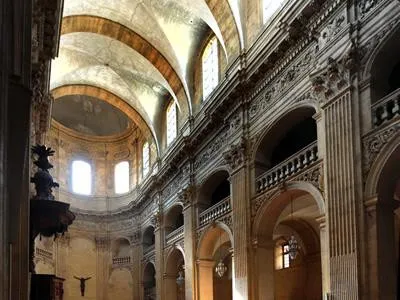
L'architecte Laurent Vallon réalise ici sa première église suivront celle du Saint-Esprit, des Prêcheurs et Saint-Jean-Baptiste-du-Faubourg. Il la positionne dans la perspective de la rue Félicien David. La haute façade appelée à recevoir une décoration baroque, reste inachevée. Cette chapelle possède toutefois un élément décoratif inattendu : une anamorphose murale, la seule conservée en France. Elle est située au-dessus de la nef mais n'est pas accessible au public. Sur plus de 8 mètres de long se déploie un paysage littoral, une ville portuaire fortifiée. Lisbonne aurait été prise comme modèle. Par la magie du redressement optique, selon son positionnement le spectateur peut voir deux perspectives différentes, notamment la tentation de Saint Pierre. En 1973, le site est classé monument historique, et il fut rebaptisé Couvent des Jésuites. La chapelle accueille des manifestations culturelles de manière ponctuelle.
English
Architect Laurent Vallon built his first church here, followed by those of the Saint-Esprit, Prêcheurs and Saint-Jean-Baptiste-du-Faubourg. He positioned it in the perspective of rue Félicien David. The high façade, intended for Baroque decoration, remains unfinished. The chapel does, however, feature an unexpected decorative element: a mural anamorphosis, the only one preserved in France. It is located above the nave, but is not accessible to the public. Over 8 meters long, it depicts a coastal landscape, a fortified port city. Lisbon is said to have been taken as a model. Through the magic of optical straightening, the viewer can see two different perspectives, including the Temptation of Saint Peter, depending on his or her position. In 1973, the site was listed as a historic monument, and renamed the Jesuit Convent. The chapel is occasionally used for cultural events.
Deutsch
Der Architekt Laurent Vallon baute hier seine erste Kirche, der später die Kirchen Saint-Esprit, des Prêcheurs und Saint-Jean-Baptiste-du-Faubourg folgten. Er positioniert sie in der Perspektive der Rue Félicien David. Die hohe Fassade, die eine barocke Dekoration erhalten sollte, blieb unvollendet. Die Kapelle besitzt jedoch ein unerwartetes dekoratives Element: eine Wandanamorphose, die einzige in Frankreich erhaltene. Sie befindet sich über dem Kirchenschiff, ist jedoch für die Öffentlichkeit nicht zugänglich. Auf einer Länge von über 8 Metern entfaltet sich eine Küstenlandschaft, eine befestigte Hafenstadt. Lissabon wäre als Vorbild genommen worden. Durch die Magie der optischen Gleichrichtung kann der Betrachter je nach seiner Position zwei verschiedene Perspektiven sehen, insbesondere die Versuchung des Heiligen Petrus. Im Jahr 1973 wurde die Anlage unter Denkmalschutz gestellt und in Jesuitenkloster umbenannt. In der Kapelle finden punktuell kulturelle Veranstaltungen statt.
Dutch
De architect Laurent Vallon bouwde hier zijn eerste kerk, gevolgd door de Saint-Esprit, de Prêcheurs en de Saint-Jean-Baptiste-du-Faubourg. Hij plaatste het in het perspectief van de Rue Félicien David. De hoge gevel, die in barokstijl moest worden versierd, blijft onvoltooid. Deze kapel heeft echter een onverwacht decoratief element: een muuranamorfose, de enige die in Frankrijk bewaard is gebleven. Het bevindt zich boven het schip, maar is niet toegankelijk voor het publiek. Het is meer dan 8 meter lang en toont een kustlandschap, een versterkte havenstad. Lissabon zou als voorbeeld zijn genomen. Door de magie van optische rectificatie kan de kijker, afhankelijk van zijn positie, twee verschillende perspectieven zien, met name de verleiding van Sint Pieter. In 1973 werd de site geklasseerd als historisch monument en omgedoopt tot Jezuïetenklooster. In de kapel vinden af en toe culturele evenementen plaats.
Español
El arquitecto Laurent Vallon construyó aquí su primera iglesia, seguida de la de Saint-Esprit, la de Prêcheurs y la de Saint-Jean-Baptiste-du-Faubourg. Lo situó en la perspectiva de la calle Félicien David. La fachada alta, que debía estar decorada en estilo barroco, quedó inacabada. Sin embargo, esta capilla tiene un elemento decorativo inesperado: una anamorfosis mural, la única que se conserva en Francia. Se encuentra sobre la nave, pero no es accesible al público. De más de 8 metros de longitud, muestra un paisaje costero, una ciudad portuaria fortificada. Lisboa habría sido tomada como modelo. Gracias a la magia de la rectificación óptica, dependiendo de su posición, el espectador puede ver dos perspectivas diferentes, especialmente la tentación de San Pedro. En 1973, el lugar fue clasificado como monumento histórico y pasó a llamarse Convento de los Jesuitas. La capilla acoge ocasionalmente actos culturales.
Italiano
L'architetto Laurent Vallon costruì qui la sua prima chiesa, seguita da Saint-Esprit, Prêcheurs e Saint-Jean-Baptiste-du-Faubourg. L'ha posizionata nella prospettiva di rue Félicien David. L'alta facciata, che doveva essere decorata in stile barocco, rimase incompiuta. Tuttavia, questa cappella presenta un elemento decorativo inaspettato: un'anamorfosi muraria, l'unica conservata in Francia. Si trova sopra la navata centrale ma non è accessibile al pubblico. Lunga oltre 8 metri, mostra un paesaggio costiero, una città portuale fortificata. Lisbona sarebbe stata presa a modello. Grazie alla magia della rettifica ottica, a seconda della sua posizione, lo spettatore può vedere due prospettive diverse, in particolare la tentazione di San Pietro. Nel 1973, il sito è stato classificato come monumento storico e rinominato Convento dei Gesuiti. La cappella ospita occasionalmente eventi culturali.
Classique
22 rue Lacépède, 13100 Aix-en-Provence
Crédits: JC Carbonne

