AQUEDUC ROMAIN – Tibiran-Jaunac
Description
English
Deutsch
Dutch
Español
Italiano
Description
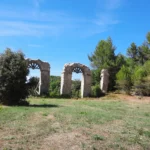
Au premier siècle de notre ère, les romains construisirent un aqueduc à partir de la source de Tibiran. Son débit d’étiage (3 000 m3 / jour) suffisait à alimenter Lugdunum Convenarum, rebaptisée aujourd’hui Saint-Bertrand en Comminges, qui devait compter 5 000 à 10 000 habitants. Seules quelques pierres sont encore visibles de nos jours.
English
In the first century AD, the Romans built an aqueduct from the source of Tibiran. Its low water flow (3,000 m3 /day) was sufficient to supply Lugdunum Convenarum, now renamed Saint-Bertrand en Comminges, which must have had 5,000 to 10,000 inhabitants. Only a few stones are still visible today.
Deutsch
Im ersten Jahrhundert n. Chr. bauten die Römer ein Aquädukt von der Tibiran-Quelle aus. Seine Niedrigwassermenge (3.000 m3 / Tag) reichte aus, um Lugdunum Convenarum, das heute in Saint-Bertrand en Comminges umbenannt wurde und 5.000 bis 10.000 Einwohner hatte, zu versorgen. Nur wenige Steine sind heute noch zu sehen.
Dutch
In de eerste eeuw na Christus bouwden de Romeinen een aquaduct vanaf de Tibiran-bron. Het lage waterdebiet (3.000 m3 / dag) was voldoende om Lugdunum Convenarum, dat nu Saint-Bertrand en Comminges heet en 5.000 tot 10.000 inwoners moet hebben gehad, van water te voorzien. Slechts enkele stenen zijn vandaag nog zichtbaar.
Español
En el siglo I d.C., los romanos construyeron un acueducto desde el manantial tibirano. Su escaso caudal (3.000 m3/día) era suficiente para abastecer a Lugdunum Convenarum, ahora rebautizada como Saint-Bertrand en Comminges, que debía tener entre 5.000 y 10.000 habitantes. Sólo unas pocas piedras son todavía visibles hoy en día.
Italiano
Nel I secolo d.C., i Romani costruirono un acquedotto dalla sorgente di Tibiran. La sua bassa portata d'acqua (3.000 m3 /giorno) era sufficiente per rifornire Lugdunum Convenarum, oggi ribattezzata Saint-Bertrand en Comminges, che doveva avere dai 5.000 ai 10.000 abitanti. Oggi sono visibili solo alcune pietre.
, 65150 Tibiran-Jaunac