Tourtrès, du pech du moulin à vent au bois de Verteuil – Tourtrès
Description
English
Deutsch
Dutch
Español
Italiano
Description
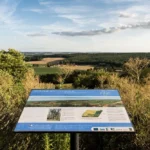
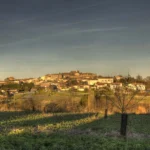
Au départ du village panoramique de Tourtrès, cinq panneaux thématiques présentent les paysages, l'habitat, les productions agricoles, l'histoire du village et l'évolution du site. Le circuit s'enfonce ensuite dans le bois de Verteuil, siège de nombreuses palombières (circuit à éviter en période de chasse). Le pech de Tourtrès offre une vue à 360° sur la campagne environnante. Le "moulin tour" y aurait été bâti en 1620, avec deux autres moulins donnant ainsi son nom au site "Tourtrès". Un seul subsiste de nos jours. Détruit en 1892, il fut reconstruit dès 1895. Il est maintenant doté d'ailes à entoiler. L'église, entourée de son cimetière, couronne le sommet du "pech". La nef simple est terminée par un chevet à pans coupés. Les murs sont en moellon de tuf et de silex mêlés, sauf la façade occidentale, en pierre de taille. Le clocher-mur est percé de 4 baies abritant 2 cloches.
English
Starting from the panoramic village of Tourtrès, five thematic panels present the landscapes, the habitat, the agricultural productions, the history of the village and the evolution of the site. The circuit then goes into the Verteuil woods, home to numerous doves (circuit to be avoided during hunting season). Le pech de Tourtrès offers a 360° view of the surrounding countryside. The "moulin tour" would have been built there in 1620, with two other mills giving its name to the site "Tourtrès". Only one remains today. Destroyed in 1892, it was rebuilt in 1895. It is now equipped with wings to be covered. The church, surrounded by its cemetery, crowns the top of the "pech". The single nave is finished by a chevet with cut-off sides. The walls are made of mixed tuff and flint rubble, except for the western facade, which is made of dressed stone. The bell-tower-wall is pierced by 4 bays shel
Deutsch
Vom Panoramadorf Tourtrès aus werden auf fünf thematischen Tafeln die Landschaften, die Siedlungen, die landwirtschaftlichen Produktionen, die Geschichte des Dorfes und die Entwicklung des Ortes vorgestellt. Der Rundweg führt dann in den Wald von Verteuil, in dem sich zahlreiche Taubenschläge befinden (der Rundweg sollte während der Jagdzeit gemieden werden). Der Pech de Tourtrès bietet einen 360°-Blick auf die umliegende Landschaft. Die "Moulin Tour" soll hier 1620 zusammen mit zwei anderen Mühlen erbaut worden sein, wodurch der Ort seinen Namen "Tourtrès" erhielt. Heute gibt es nur noch eine. Sie wurde 1892 zerstört und 1895 wieder aufgebaut. Sie verfügt nun über Flügel, die bespannt werden können. Die Kirche, die von ihrem Friedhof umgeben ist, krönt den Gipfel des "pech". Das einfache Kirchenschiff wird von einem abgeschrägten Kopfende abgeschlossen. Die Mauern bestehen aus Tuff- und
Dutch
Vanuit het panoramische dorp Tourtrès presenteren vijf thematische panelen het landschap, de habitat, de landbouwproductie, de geschiedenis van het dorp en de evolutie van de site. De route gaat vervolgens het bos van Verteuil in, waar veel duivenholen zijn (vermijd deze route tijdens het jachtseizoen). De pech de Tourtrès biedt een uitzicht van 360° op het omringende landschap. De "molentoren" zou daar gebouwd zijn in 1620, met twee andere molens die de naam "Tourtrès" aan de site geven. Vandaag is er nog maar één over. Verwoest in 1892, herbouwd in 1895. Het is nu uitgerust met canvas vleugels. De kerk, omgeven door het kerkhof, bekroont de top van de "pech". Het enkele schip eindigt in een gekanteld chevet. De muren zijn van tufsteen en vuursteenpuin, behalve de westelijke gevel, die van ashlar is. De klokkentoren heeft 4 traveeën met 2 klokken.
Español
Partiendo del pueblo panorámico de Tourtrès, cinco paneles temáticos presentan el paisaje, el hábitat, la producción agrícola, la historia del pueblo y la evolución del lugar. A continuación, el itinerario se adentra en el bosque de Verteuil, donde se encuentran numerosos agujeros de palomas (evite esta ruta durante la temporada de caza). El pech de Tourtrès ofrece una vista de 360° de los alrededores. La "torre del molino" se habría construido allí en 1620, con otros dos molinos que dan nombre al lugar "Tourtrès". Hoy sólo queda uno. Destruido en 1892, fue reconstruido en 1895. Ahora está equipado con alas de lona. La iglesia, rodeada de su cementerio, corona la cima del "pech". La nave única termina en una cabecera inclinada. Los muros son de toba y de cascotes de sílex, excepto la fachada occidental, que es de sillería. La torre-campanario tiene 4 tramos que albergan 2 campanas.
Italiano
Partendo dal villaggio panoramico di Tourtrès, cinque pannelli tematici presentano il paesaggio, l'habitat, la produzione agricola, la storia del villaggio e l'evoluzione del sito. Il percorso si addentra poi nel bosco di Verteuil, sede di numerose tane di piccioni (evitare questo percorso durante la stagione della caccia). Il pech de Tourtrès offre una vista a 360° sulla campagna circostante. La "torre del mulino" sarebbe stata costruita nel 1620, con altri due mulini che hanno dato il nome al sito "Tourtrès". Oggi ne rimane solo uno. Distrutta nel 1892, fu ricostruita nel 1895. Ora è dotato di ali in tela. La chiesa, circondata dal suo cimitero, corona la cima del "pech". L'unica navata termina con un chevet a sbalzo. Le pareti sono in tufo e selce, ad eccezione della facciata occidentale, che è in bugnato. Il campanile a muro ha 4 campate che ospitano 2 campane.
Vtt - Faune - flore - Environnement et nature - Plante et fleur - Equitation
Type: En boucle
Distance: 11000.0
, 47380 Tourtrès

Crédits: Joël MACE - CDT 47