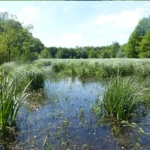
L'étang du Perron – Point 1 Un petit air de bocage
Description
English
Deutsch
Dutch
Español
Italiano
Description
Chêne, érable, orme, noisetier, aubépine, sureau, prunellier, saule, viorne… Ces arbres et arbustes sont encore jeunes mais vont constituer progressivement une belle haie bocagère sur le site.
Créée au Moyen-Age, ce type de haie, conduite naturellement ou sous forme 'plessée', servait d’enclos pour le bétail.
Elle était également source de bois de chauffage, notamment grâce à la taille de ses arbres en 'tétards'.
English
Oak, maple, elm, hazel, hawthorn, elder, blackthorn, willow, viburnum… These trees and shrubs are still young but will gradually form a beautiful hedge on the site.
Created in the Middle Ages, this type of hedge, managed naturally or in the form of 'plessée', was used as an enclosure for the cattle.
It was also a source of firewood, notably thanks to the pruning of its trees in 'tétards'.
Deutsch
Eiche, Ahorn, Ulme, Haselnuss, Weißdorn, Holunder, Schlehe, Weide, Waldrebe… Diese Bäume und Sträucher sind noch jung, werden aber nach und nach eine schöne Heckenlandschaft auf dem Gelände bilden.
Diese Art von Hecken, die im Mittelalter angelegt wurden, dienten als Viehgehege und wurden auf natürliche Weise geführt oder gezupft.
Sie diente auch als Brennholzquelle, vor allem durch das Beschneiden der Bäume in "Tetards".
Dutch
Eik, esdoorn, iep, hazelaar, meidoorn, vlier, sleedoorn, wilg, viburnum… Deze bomen en struiken zijn nog jong, maar zullen geleidelijk een mooie haag vormen op het terrein.
Dit type heg, dat in de Middeleeuwen is ontstaan, werd gebruikt als omheining voor het vee.
Het was ook een bron van brandhout, vooral dankzij het snoeien van de bomen in "tetrads".
Español
Roble, arce, olmo, avellano, espino, saúco, espino negro, sauce, viburno… Estos árboles y arbustos son todavía jóvenes, pero poco a poco formarán un hermoso seto en el lugar.
Creado en la Edad Media, este tipo de seto, natural o en forma de "plessée", se utilizaba como cerramiento para el ganado.
También era una fuente de leña, sobre todo gracias a la poda de sus árboles en "tétradas".
Italiano
Quercia, acero, olmo, nocciolo, biancospino, sambuco, prugnolo, salice, viburno… Questi alberi e arbusti sono ancora giovani, ma gradualmente formeranno una bella siepe sul sito.
Creato nel Medioevo, questo tipo di siepe, naturale o sotto forma di "plessée", veniva utilizzato come recinto per il bestiame.
Era anche una fonte di legna da ardere, soprattutto grazie alla potatura degli alberi in "tetradi".
, 61500 Saint-Gervais-du-Perron