La fôret d’eboulis de battion – Rochesson
Description
English
Deutsch
Dutch
Español
Italiano
Description
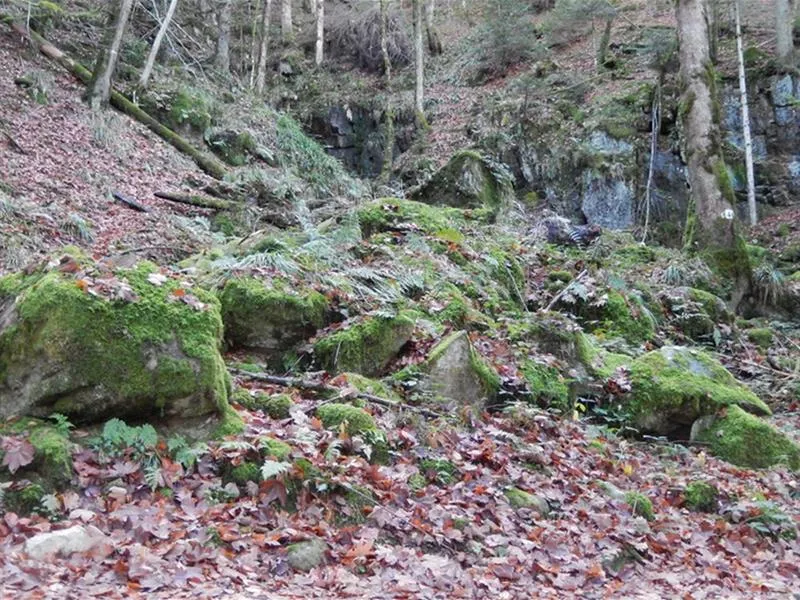
Cette forêt protégée par le Conservatoire des Sites Lorrains jouxte la cascade de Battion et s’est développée sur des éboulis grossiers de granite qui datent des dernières glaciations. L’aspect cathédral de ces lieux, la fraîcheur et la végétation basse composée de fougères et de Lunaires, leur confèrent une ambiance féerique. Une forêt à Lunaires : cet éboulis de ravin froid, exposé au nord et à l’ombre, est favorable à l’établissement d’une forêt d’intérêt européen d’érables sycomores où se développe la Lunaire vivace (dont la variété ornementale est mieux connue sous le nom de « Monnaie du pape »). La forêt de Battion est la plus grande forêt à Lunaires du massif vosgien. Une végétation spécifique : l’éboulis, créé par les alternances de gel et de dégel de la fin des périodes glaciaires, a été dans un premier temps colonisé par des mousses, des lichens et autre plantes pionnières. Une végétation d’arbuste comme le noisetier et le sureau à grappes a précédé l’érable sycomore, le tilleul à grandes feuilles, le frêne et l’orme des montagnes. Le sol est tapissé de plantes rares adaptées aux conditions fraîches comme la mercuriale vivace, l’euphorbe des bois ou la circée intermédiaire. A ce stade, l’erablaie est stable mais reste soumise aux perturbations naturelles (chablis, avalanches…) qui n’affectent pas l’habitat. Au contraire, les arbres morts profitent largement aux insectes et aux oiseaux. © Conservatoire des Sites Lorrains
English
This forest, protected by the Conservatoire des Sites Lorrains, borders the Battion waterfall and has developed on coarse granite scree slopes dating from the last glaciations. The cathedral aspect of these places, the freshness and the low vegetation made up of ferns and lunars, give them a fairy-tale atmosphere. A Lunar Forest: this cold ravine scree, exposed to the north and in the shade, is conducive to the establishment of a forest of European interest of sycamore maples where the perennial Lunar (whose ornamental variety is better known as the "Pope's Mint") grows. The forest of Battion is the largest lunar forest in the Vosges massif. A specific vegetation: the scree, created by the alternating freezing and thawing of the end of the ice ages, was initially colonised by mosses, lichens and other pioneer plants. Shrub vegetation such as hazelnut and elderberry preceded sycamore maple, basswood, ash and mountain elm. The soil is covered with rare plants adapted to cool conditions, such as perennial mercury, wood spurge, and intermediate circus. At this stage, the erablaie is stable but remains subject to natural disturbances (windfalls, avalanches…) which do not affect the habitat. On the contrary, the dead trees are of great benefit to insects and birds. Conservatoire des Sites Lorrains
Deutsch
Dieser vom Conservatoire des Sites Lorrains geschützte Wald grenzt an den Wasserfall von Battion und hat sich auf grobem Granitgeröll entwickelt, das aus den letzten Eiszeiten stammt. Das kathedralenartige Aussehen dieser Orte, die Kühle und die niedrige Vegetation aus Farnen und Lunarien verleihen ihnen eine märchenhafte Atmosphäre. Ein Lunaria-Wald: Dieses kalte, nach Norden ausgerichtete und schattige Schluchtgeröll ist günstig für die Entstehung eines Bergahornwaldes von europäischem Interesse, in dem die mehrjährige Lunaria gedeiht (deren Ziersorte besser als "Papstmünze" bekannt ist). Der Wald von Battion ist der größte Lunaire-Wald in den Vogesen. Eine spezifische Vegetation: Die Geröllhalde, die durch den Wechsel von Frost und Tauwetter am Ende der Eiszeiten entstanden ist, wurde zunächst von Moosen, Flechten und anderen Pionierpflanzen besiedelt. Strauchvegetation wie Haselnuss und Traubenholunder wuchsen vor Bergahorn, Winterlinde, Esche und Bergulme. Der Boden ist mit seltenen, an kühle Bedingungen angepassten Pflanzen wie der mehrjährigen Mercurialia, der Wald-Wolfsmilch oder der Zwischenfrüchte-Zirke bedeckt. In diesem Stadium ist der Erabwald stabil, unterliegt aber weiterhin natürlichen Störungen (Windwurf, Lawinen …), die den Lebensraum nicht beeinträchtigen. Im Gegenteil, die toten Bäume kommen Insekten und Vögeln in hohem Maße zugute. conservatoire des Sites Lorrains
Dutch
Dit bos, beschermd door het Conservatoire des Sites Lorrains, grenst aan de waterval van Battion en is ontstaan op grove granietrotsen uit de laatste ijstijd. Het kathedraalachtige aspect van deze plaatsen, de frisheid en de lage vegetatie bestaande uit varens en Lunaria, geven ze een betoverende sfeer. Een Lunar-bos: deze koude, noordelijk gelegen, beschaduwde helling is gunstig voor de vestiging van een bos van Europees belang van esdoorns waar de vaste plant Lunar (waarvan de siervariëteit beter bekend is als "Pope's coin") gedijt. Het Battionbos is het grootste Maanbos in de Vogezen. Een specifieke vegetatie: de steenslag, ontstaan door het afwisselend vriezen en dooien aan het einde van de ijstijden, werd aanvankelijk gekoloniseerd door mossen, korstmossen en andere pioniersplanten. Struikgewas zoals hazelaar en vlierbes ging vooraf aan esdoorn, linde, es en bergiep. De grond is bedekt met zeldzame planten die zijn aangepast aan koele omstandigheden, zoals vaste planten, houtwolfsmelk en intermediair circus. In dit stadium is de erablaie stabiel maar blijft hij onderhevig aan natuurlijke verstoringen (windvlagen, lawines, enz.) die de habitat niet aantasten. Integendeel, de dode bomen zijn van groot nut voor insecten en vogels. conservatoire des Sites Lorrains
Español
Este bosque, protegido por el Conservatoire des Sites Lorrains, linda con la cascada de Battion y se ha desarrollado sobre un pedregal de granito grueso que data de la última glaciación. El aspecto catedralicio de estos lugares, el frescor y la vegetación baja compuesta por helechos y Lunaria, les confieren una atmósfera mágica. Un bosque lunar: este pedregal frío, orientado al norte y sombreado, es propicio para el establecimiento de un bosque de interés europeo de arces sicómoros en el que prospera la Lunar perenne (cuya variedad ornamental es más conocida como "moneda del Papa"). El bosque de Battion es el mayor bosque lunar de los Vosgos. Una vegetación específica: el pedregal, creado por la alternancia de heladas y deshielos del final de las glaciaciones, fue colonizado inicialmente por musgos, líquenes y otras plantas pioneras. La vegetación arbustiva, como el avellano y el saúco, ha precedido al sicomoro, el tilo, el fresno y el olmo de montaña. El suelo está cubierto de plantas raras adaptadas a condiciones frías, como la mercurial perenne, la euforbia de madera y el circo intermedio. En esta fase, el erablaie es estable, pero sigue estando sujeto a las perturbaciones naturales (vientos, avalanchas, etc.) que no afectan al hábitat. Por el contrario, los árboles muertos son muy beneficiosos para los insectos y las aves. conservatorio de los Sitios de Lorena
Italiano
Questa foresta, protetta dal Conservatoire des Sites Lorrains, confina con la cascata del Battion e si è sviluppata su ghiaioni granitici grossolani risalenti all'ultima era glaciale. L'aspetto da cattedrale di questi luoghi, la frescura e la bassa vegetazione composta da felci e Lunaria, conferiscono loro un'atmosfera magica. Un bosco lunare: questo ghiaione freddo, esposto a nord e ombroso è favorevole all'insediamento di un bosco di interesse europeo di aceri platani in cui prospera la perenne lunare (la cui varietà ornamentale è meglio conosciuta come "moneta del Papa"). La foresta del Battion è la più grande foresta lunare dei Vosgi. Una vegetazione specifica: i ghiaioni, creati dall'alternanza di gelo e disgelo della fine delle ere glaciali, sono stati inizialmente colonizzati da muschi, licheni e altre piante pioniere. La vegetazione arbustiva, come il nocciolo e il sambuco, ha preceduto il platano, il tiglio, il frassino e l'olmo di montagna. Il terreno è ricoperto da piante rare adattate a condizioni fresche, come la mercuriale perenne, l'euforbia dei boschi e il circo intermedio. In questa fase, l'erablaie è stabile ma rimane soggetta a disturbi naturali (cadute di vento, valanghe, ecc.) che non influiscono sull'habitat. Al contrario, gli alberi morti sono di grande utilità per insetti e uccelli. conservatorio dei siti lorenesi
Sentier de la cascade de Battion, 88120 Rochesson
Crédits: BIT VAGNEY