Ancienne usine tissage Godchaux – Balan
Description
English
Deutsch
Dutch
Español
Italiano
Description
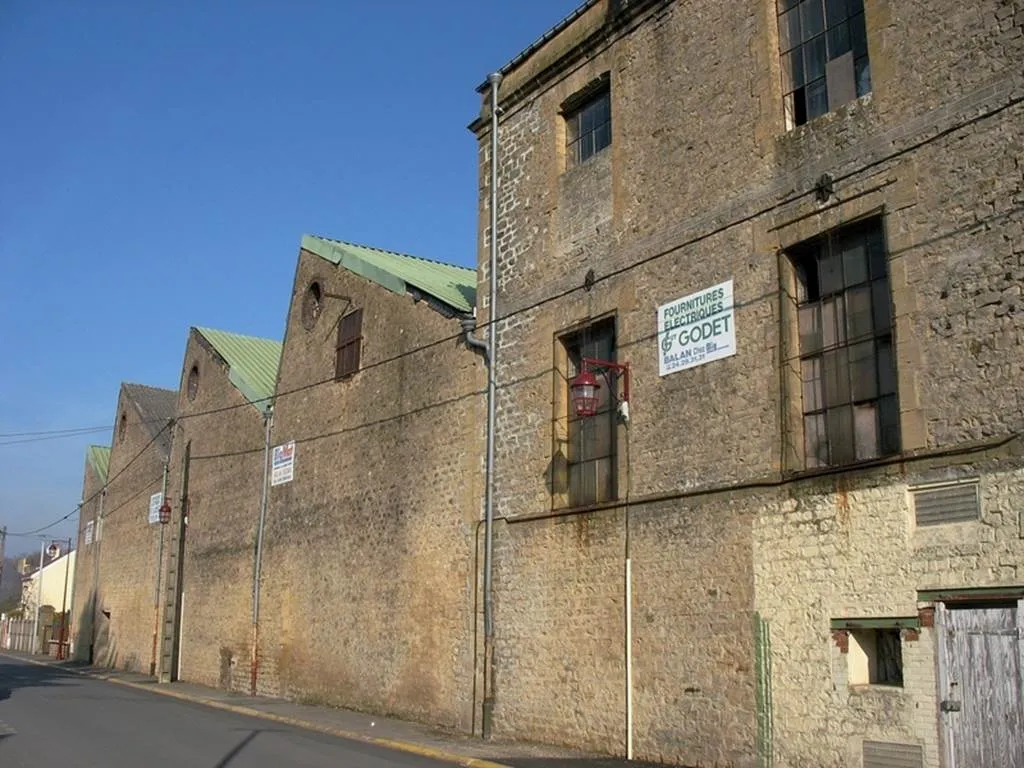
Ernest Godchaux, fils d´industriels luxembourgeois, crée les Tissages Mécaniques Godchaux à Balan au début du 20e siècle. A son décès en 1931, son gendre Alexandre Bighetti reprend l´entreprise, jusqu´à sa mort en 1965. Les bâtiments datent de la première moitié du 20e siècle et sont actuellement occupés, entre autres, par un entrepôt commercial. Le site s´ouvre au nord par un ensemble de quatre travées d´ateliers de fabrication à toiture en shed recouverte de tôle ou ciment amiante. Puis lui est accolé un long bâtiment partiellement démoli à l´est s´élevant sur deux étages carrés et un étage de comble avec toiture à deux pans et couverture d´ardoise. Enfin, un bâtiment se développe le long de la rue Poupart de Neuflize, dont les niveaux intérieurs sont en béton armé. Les murs sont principalement en moellon calcaire à chaînage en pierre de taille. A l´intérieur des ateliers la charpente en bois est apparente. Les premiers niveaux sont parfois soutenus par des poteaux de fonte.
English
Ernest Godchaux, son of Luxembourg industrialists, founded Tissages Mécaniques Godchaux in Balan at the beginning of the 20th century. On his death in 1931, his son-in-law Alexandre Bighetti took over the business, until his death in 1965. The buildings date from the first half of the 20th century and are currently occupied by a commercial warehouse, among other facilities. The site opens to the north with four bays of shed-roofed workshops covered in asbestos cement or sheet metal. Adjacent to this is a long, partially demolished building to the east, rising to two square storeys and an attic storey with a gable roof and slate covering. Finally, a building is built along rue Poupart de Neuflize, with reinforced concrete interior levels. The walls are mainly of limestone rubble with ashlar quoins. Inside the workshops, the wooden framework is visible. The first levels are sometimes supported by cast-iron posts.
Deutsch
Ernest Godchaux, Sohn luxemburgischer Industrieller, gründete Anfang des 20. Jahrhunderts die Firma Tissages Mécaniques Godchaux in Balan. Nach seinem Tod im Jahr 1931 übernahm sein Schwiegersohn Alexandre Bighetti das Unternehmen bis zu seinem Tod im Jahr 1965. Die Gebäude stammen aus der ersten Hälfte des 20. Jahrhunderts und werden derzeit unter anderem von einem Handelslager genutzt. Das Gelände öffnet sich im Norden mit einem vierspännigen Komplex von Fertigungshallen mit Sheddächern, die mit Blech oder Asbestzement bedeckt sind. Daran schließt sich im Osten ein langes, teilweise abgerissenes Gebäude an, das sich über zwei quadratische Stockwerke und ein Dachgeschoss mit Satteldach und Schiefereindeckung erstreckt. Schließlich entwickelt sich ein Gebäude entlang der Rue Poupart de Neuflize, dessen Innengeschosse aus Stahlbeton bestehen. Die Wände bestehen hauptsächlich aus Kalksteinquadern mit Bruchsteinkette. Im Inneren der Werkstätten ist das Holzgerüst sichtbar. Die ersten Ebenen werden manchmal von gusseisernen Pfosten gestützt.
Dutch
Ernest Godchaux, zoon van Luxemburgse industriëlen, richtte aan het begin van de 20e eeuw Tissages Mécaniques Godchaux op in Balan. Toen hij in 1931 overleed, nam zijn schoonzoon Alexandre Bighetti het bedrijf over. Hij ging door tot zijn dood in 1965. De gebouwen dateren uit de eerste helft van de 20e eeuw en worden momenteel onder andere gebruikt door een commerciële opslagplaats. Het terrein opent in het noorden met een groep van vier traveeën met werkplaatsen met sheddaken die bedekt zijn met plaatstaal of asbestcement. Dit wordt in het oosten gevolgd door een lang, gedeeltelijk afgebroken gebouw met twee vierkante verdiepingen en een zolderverdieping met een zadeldak en leien dakbedekking. Tot slot is er een gebouw langs de rue Poupart de Neuflize, met binnenverdiepingen van gewapend beton. De muren zijn voornamelijk van kalksteen met essenhouten kozijnen. Binnenin de werkplaatsen is het houten geraamte zichtbaar. De eerste niveaus worden soms ondersteund door gietijzeren palen.
Español
Ernest Godchaux, hijo de industriales luxemburgueses, fundó Tissages Mécaniques Godchaux en Balan a principios del siglo XX. A su muerte, en 1931, su yerno Alexandre Bighetti se hizo cargo del negocio, que continuó hasta su fallecimiento en 1965. Los edificios datan de la primera mitad del siglo XX y actualmente están ocupados, entre otras cosas, por un almacén comercial. El solar se abre al norte con un grupo de cuatro naves de talleres de fabricación con tejado de chapa o amianto-cemento. Adyacente a éste hay un edificio alargado, parcialmente demolido, al este, con dos plantas cuadradas y un ático con tejado a dos aguas y cubierta de pizarra. Por último, hay un edificio a lo largo de la rue Poupart de Neuflize, con niveles interiores de hormigón armado. Los muros son principalmente de mampostería de piedra caliza, con sillares. En el interior de los talleres, el entramado de madera es visible. Los primeros niveles están a veces sostenidos por postes de hierro fundido.
Italiano
Ernest Godchaux, figlio di industriali lussemburghesi, fondò la Tissages Mécaniques Godchaux a Balan all'inizio del XX secolo. Alla sua morte, nel 1931, il genero Alexandre Bighetti rilevò l'attività, che proseguì fino alla sua morte nel 1965. Gli edifici risalgono alla prima metà del XX secolo e sono attualmente occupati, tra l'altro, da un magazzino commerciale. Il sito si apre a nord con un gruppo di quattro campate di officine manifatturiere con tetto a shed e copertura in lamiera o cemento-amianto. Segue a est un lungo edificio, parzialmente demolito, a due piani quadrati e un piano sottotetto con tetto a capanna e copertura in ardesia. Infine, lungo rue Poupart de Neuflize si trova un edificio con livelli interni in cemento armato. I muri sono principalmente in calcare con i listelli in bugnato. All'interno dei laboratori è visibile l'intelaiatura in legno. I primi livelli sono talvolta sostenuti da pali in ghisa.
23 rue Poupart de Neuflize, 08200 Balan