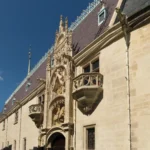
Le Palais ducal – Nevers
Description
English
Deutsch
Dutch
Español
Italiano
Description
Le Château actuel date de la seconde moitié du 15ème siècle à l'initiative de Jean de Clamecy. Après avoir changé de "propriétaires" durant plusieurs années, l'héritière du dernier Duc vend le château à la municipalité et au département en 1810. En 1850 le palais de Justice s'installe, et ce n'est qu'en 1980 que la municipalité se réapproprie le monument. Le Palais de Justice se déplace alors dans l'ancien Palais épiscopal.
Après avoir vu défiler nombre de ducs et de comtes, aujourd'hui, ce sont des conseillers municipaux et des jeunes mariés qui envahissent le Palais ducal. Il doit son nom a sa fonction de palais de justice pendant 130 ans. Jusqu'au coup de théâtre du maire Pierre Bérégovoy (1983-1993), qui réaménage ce lieu au nom de la vie culturelle et municipale. Un vent de modernité souffle dans le lieu qui a su gardé une belle atmosphère historique.
English
The present château dates back to the second half of the 15th century and was built by Jean de Clamecy. After changing "owners" over several years, the heiress of the last Duke sold the château to the municipality and the département in 1810. In 1850, the Palace of Justice moved in, and it wasn't until 1980 that the municipality reappropriated the monument. The Palais de Justice then moved to the former Episcopal Palace.
After seeing a number of dukes and counts come and go, today it is town councillors and newly-weds who invade the Palais ducal. It owes its name to the fact that it served as a court house for 130 years. Until the mayor Pierre Bérégovoy (1983-1993), who redeveloped the building in the name of cultural and municipal life. A breeze of modernity is blowing through the building, which has retained its beautiful historic atmosphere.
Deutsch
Das heutige Schloss stammt aus der zweiten Hälfte des 15. Jahrhunderts und geht auf die Initiative von Jean de Clamecy zurück. Nachdem die "Besitzer" mehrere Jahre lang gewechselt hatten, verkaufte die Erbin des letzten Herzogs das Schloss 1810 an die Stadtverwaltung und das Departement. Im Jahr 1850 zieht der Justizpalast ein, und erst 1980 eignet sich die Stadtverwaltung das Monument wieder an. Der Justizpalast zog daraufhin in den ehemaligen Bischofspalast um.
Nachdem viele Herzöge und Grafen durch den Palais ducal marschiert sind, sind es heute Stadträte und Brautpaare, die den Palais ducal erobern. Seinen Namen verdankt er seiner 130-jährigen Funktion als Justizpalast. Bis zum Theatercoup des Bürgermeisters Pierre Bérégovoy (1983-1993), der diesen Ort im Namen des kulturellen und städtischen Lebens umgestaltete. Ein moderner Wind weht durch den Ort, der sich eine schöne historische Atmosphäre bewahrt hat.
Dutch
Het huidige kasteel dateert uit de tweede helft van de 15e eeuw en werd gebouwd door Jean de Clamecy. Na verschillende jaren van "eigenaar" te zijn gewisseld, verkocht de erfgename van de laatste hertog het kasteel in 1810 aan de gemeente en het departement. In 1850 nam het Paleis van Justitie er zijn intrek en pas in 1980 eigende de gemeente zich het monument weer toe. Het Paleis van Justitie verhuisde toen naar het voormalige bisschoppelijke paleis.
Na een aantal hertogen en graven te hebben zien komen en gaan, zijn het tegenwoordig gemeenteraadsleden en pasgetrouwde stellen die het Hertogelijk Paleis binnenvallen. Het dankt zijn naam aan het feit dat het 130 jaar lang dienst deed als gerechtsgebouw. Tot burgemeester Pierre Bérégovoy (1983-1993), die het gebouw herinrichtte in naam van het culturele en gemeentelijke leven. Er waait een wind van moderniteit door het gebouw, dat zijn prachtige historische sfeer heeft behouden.
Español
El castillo actual data de la segunda mitad del siglo XV y fue construido por Jean de Clamecy. Tras cambiar de "propietario" durante varios años, la heredera del último duque vendió el castillo al municipio y al departamento en 1810. En 1850, el Palacio de Justicia se trasladó allí, y no fue hasta 1980 cuando el municipio volvió a apropiarse del monumento. El Palacio de Justicia se trasladó entonces al antiguo Palacio Episcopal.
Tras ver pasar a numerosos duques y condes, hoy son los concejales y los recién casados quienes invaden el Palacio ducal. Debe su nombre al hecho de que sirvió de palacio de justicia durante 130 años. Hasta el alcalde Pierre Bérégovoy (1983-1993), que remodeló el edificio en nombre de la vida cultural y municipal. Una brisa de modernidad sopla en el edificio, que ha conservado su hermoso ambiente histórico.
Italiano
L'attuale castello risale alla seconda metà del XV secolo e fu costruito da Jean de Clamecy. Dopo aver cambiato "proprietari" nel corso degli anni, l'erede dell'ultimo duca vendette il castello al comune e al dipartimento nel 1810. Nel 1850 vi si trasferì il Palazzo di Giustizia e solo nel 1980 il Comune si riappropriò del monumento. Il Palazzo di Giustizia si trasferì quindi nell'ex palazzo episcopale.
Dopo l'avvicendarsi di duchi e conti, oggi sono i consiglieri comunali e gli sposi ad invadere il Palazzo ducale. Deve il suo nome al fatto che per 130 anni è stato sede del tribunale. Fino al sindaco Pierre Bérégovoy (1983-1993), che ha riqualificato l'edificio in nome della vita culturale e comunale. Una brezza di modernità soffia nell'edificio, che ha conservato la sua bella atmosfera storica.
Equipements: Toilettes - Salle de réunion - Wifi, accès internet - Salle de réunion équipée
Rue Sabatier, 58000 Nevers