Oeuvre du lavoir de Blessey à Source-Seine – Source-Seine
Description
English
Deutsch
Dutch
Español
Italiano
Description
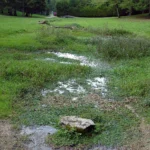
Le lavoir de Blessey est construit en 1835 à proximité des sources de la Seine. Sa particularité est due à son architecture en forme de demi-cercle.
Dans le cadre de la restauration du lavoir, l'artiste Rémy Zaugg propose de reconsidérer l'agencement de l'environnement du lavoir dans son ensemble. Il réaménage la circulation à l’image de l’architecture en semi-circularité. C’est un travail de nature essentiellement topographique, plaçant le lavoir au centre de ce nouvel environnement.
Le processus débute en 1997, avec les reprises et constructions de murs, les suppressions de bâtiments, la plantation d’arbres entre les trois croix pour la création d’un verger, et enfin la reconfiguration et remise en eau de l'étang. Une inscription sur le couronnement de la digue offre à voir des mots en lettres d’acier inox. Le lavoir est réintroduit dans le temps vécu du village. L’œuvre est achevée et inaugurée en 2007.
English
The wash house of Blessey was built in 1835 near the sources of the Seine. Its particularity is due to its semi-circular architecture
As part of the restoration of the washhouse, the artist Rémy Zaugg proposes to reconsider the layout of the washhouse environment as a whole. He rearranged the circulation in the image of the semi-circular architecture. The work is essentially topographical in nature, placing the washhouse at the centre of this new environment
The process began in 1997, with the reconstruction and construction of walls, the removal of buildings, the planting of trees between the three crosses to create an orchard, and finally the reconfiguration and re-watering of the pond. An inscription on the top of the dike offers words in stainless steel letters. The washhouse is reintroduced into the village's past. The work was completed and inaugurated in 2007.
Deutsch
Das Waschhaus von Blessey wurde 1835 in der Nähe der Seine-Quellen errichtet. Seine Besonderheit ist auf seine halbkreisförmige Architektur zurückzuführen.
Im Rahmen der Restaurierung des Waschhauses schlägt der Künstler Rémy Zaugg vor, die Gestaltung der gesamten Umgebung des Waschhauses neu zu überdenken. Er gestaltet die Zirkulation nach dem Vorbild der halbkreisförmigen Architektur neu. Es handelt sich um eine Arbeit, die im Wesentlichen topografischer Natur ist und das Waschhaus in den Mittelpunkt dieser neuen Umgebung stellt.
Der Prozess beginnt 1997 mit der Wiederherstellung und dem Bau von Mauern, der Entfernung von Gebäuden, der Anpflanzung von Bäumen zwischen den drei Kreuzen zur Schaffung eines Obstgartens und schließlich der Neugestaltung und Wiederbefüllung des Teichs. Eine Inschrift auf der Dammkrone bietet den Blick auf Worte in Edelstahlbuchstaben. Das Waschhaus wird wieder in die gelebte Zeit des Dorfes eingeführt. Das Werk wurde 2007 fertiggestellt und eingeweiht.
Dutch
Het washuis Blessey werd gebouwd in 1835 nabij de bronnen van de Seine. Zijn bijzonderheid is te danken aan zijn halfronde architectuur
In het kader van de restauratie van het washuis stelt de kunstenaar Rémy Zaugg voor om de inrichting van de omgeving van het washuis in zijn geheel te herzien. Hij herschikte de circulatie in het beeld van de halfronde architectuur. Het werk is hoofdzakelijk topografisch van aard en plaatst het washuis in het centrum van deze nieuwe omgeving
Het proces begon in 1997, met de reconstructie en bouw van muren, de verwijdering van gebouwen, de aanplant van bomen tussen de drie kruisen om een boomgaard te creëren, en ten slotte de herinrichting en herbewatering van de vijver. Een inscriptie op de top van de dijk biedt woorden in roestvrij stalen letters. Het washuis wordt opnieuw geïntroduceerd in het verleden van het dorp. Het werk werd voltooid en ingehuldigd in 2007.
Español
El lavadero de Blessey fue construido en 1835 cerca de las fuentes del Sena. Su particularidad se debe a su arquitectura semicircular
En el marco de la restauración del lavadero, el artista Rémy Zaugg propone reconsiderar la disposición del entorno del lavadero en su conjunto. Reorganizó la circulación a imagen de la arquitectura semicircular. La obra es esencialmente topográfica y sitúa el lavadero en el centro de este nuevo entorno
El proceso comenzó en 1997, con la reconstrucción y construcción de muros, la eliminación de edificios, la plantación de árboles entre las tres cruces para crear un huerto y, finalmente, la reconfiguración y el nuevo riego del estanque. Una inscripción en la parte superior del dique ofrece palabras en letras de acero inoxidable. El lavadero se reintroduce en el pasado del pueblo. La obra se terminó e inauguró en 2007.
Italiano
Il lavatoio di Blessey fu costruito nel 1835 vicino alle sorgenti della Senna. La sua particolarità è dovuta all'architettura semicircolare
Nell'ambito del restauro del lavatoio, l'artista Rémy Zaugg propone di riconsiderare la disposizione dell'ambiente del lavatoio nel suo complesso. Ha riorganizzato la circolazione a immagine dell'architettura semicircolare. L'opera è di natura essenzialmente topografica e pone il lavatoio al centro di questo nuovo ambiente
Il processo è iniziato nel 1997, con la ricostruzione e la costruzione di muri, la rimozione di edifici, la piantumazione di alberi tra le tre croci per creare un frutteto e, infine, la riconfigurazione e il riallagamento del laghetto. Un'iscrizione sulla sommità dell'argine propone parole in lettere d'acciaio inossidabile. Il lavatoio viene reintrodotto nel passato del villaggio. L'opera è stata completata e inaugurata nel 2007.
, 21690 Source-Seine