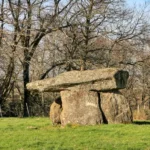
Menhir des Fichades – Fromental
Description
English
Deutsch
Dutch
Español
Italiano
Description
Dans les terrains alentours ont été retrouvées environ 3000 pièces d’industrie lithique (pierres taillées) démontrant une occupation humaine au Néolithique final (entre 2900 et 2150 avant J-C). Sa hauteur au-dessus du sol est de 3,55 m. Il a été fouillé en 1914 par Jean-André Périchon Bey, un Bessinaud. Il descendit à la profondeur de 1,50 m sans atteindre la base, ce qui porte sa hauteur totale à un peu plus de 5 m. Classé aux monuments historiques en 1945.
English
Around 3,000 pieces of lithic industry (cut stones) have been found in the surrounding terrain, demonstrating human occupation during the Late Neolithic (between 2,900 and 2,150 BC). Its height above ground is 3.55 m. It was excavated in 1914 by Jean-André Périchon Bey, a Bessinaud. He descended to a depth of 1.50 m without reaching the base, bringing its total height to just over 5 m. Listed as a historical monument in 1945.
Deutsch
Im umliegenden Gelände wurden ca. 3.000 steinzeitliche Funde gemacht, die auf eine menschliche Besiedlung im späten Neolithikum (zwischen 2900 und 2150 v. Chr.) hindeuten. Die Höhe über dem Boden beträgt 3,55 m. Er wurde 1914 von Jean-André Périchon Bey, einem Bessinaud, ausgegraben. Er stieg bis auf eine Tiefe von 1,50 m hinab, ohne die Basis zu erreichen, sodass seine Gesamthöhe etwas mehr als 5 m betrug. 1945 wurde er unter Denkmalschutz gestellt.
Dutch
In de omgeving zijn ongeveer 3.000 stukken lithische industrie (gebeeldhouwde stenen) gevonden, wat de menselijke bewoning tijdens het laatste neolithicum (tussen 2.900 en 2.150 v.Chr.) aantoont. De hoogte boven de grond is 3,55 m. Het werd in 1914 opgegraven door Jean-André Périchon Bey, een man uit Bessinaud. Hij daalde af tot een diepte van 1,50 m zonder de basis te bereiken, wat de totale hoogte op iets meer dan 5 m bracht. Geclassificeerd als historisch monument in 1945.
Español
En sus alrededores se han encontrado unas 3.000 piezas de industria lítica (piedras talladas), que demuestran la ocupación humana durante el Neolítico Final (entre el 2.900 y el 2.150 a.C.). Su altura sobre el suelo es de 3,55 m. Fue excavada en 1914 por Jean-André Périchon Bey, un hombre de Bessinaud. Descendió hasta una profundidad de 1,50 m sin llegar a la base, por lo que su altura total es de algo más de 5 m. Declarada monumento histórico en 1945.
Italiano
Nell'area circostante sono stati rinvenuti circa 3.000 pezzi di industria litica (pietre intagliate), che dimostrano l'occupazione umana durante il Neolitico finale (tra il 2.900 e il 2.150 a.C.). L'altezza dal suolo è di 3,55 m. Fu scavata nel 1914 da Jean-André Périchon Bey, un uomo di Bessinaud. Scese fino a una profondità di 1,50 m senza raggiungere la base, portando l'altezza totale a poco più di 5 metri. È stato dichiarato monumento storico nel 1945.