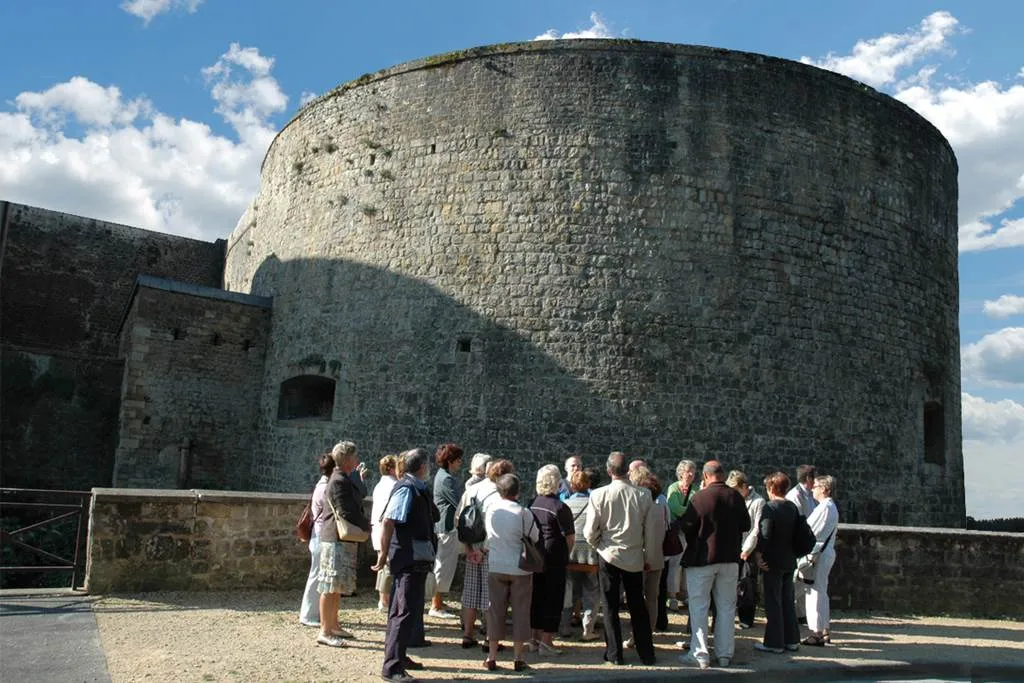
Fortifications de Mézières
Description
English
Deutsch
Dutch
Español
Italiano
Description
Logée dans un méandre de la Meuse, la ville est la première des deux cités à voir le jour. Mézières construit sa renommée marchande pendant tout le Moyen-âge dès l’exode des marchands liégeois à partir du XIIIe siècle.En 1521, Charles Quint tente d'entrer dans le Royaume de France avant d’être arrêté à Mézières par le célèbre Chevalier Bayard envoyé par le Roi François 1er. Le Roi commande alors le renforcement des protections de la ville avec l’édification des tours Milard et Du Roy (toujours visibles aujourd’hui). La ville s'affirme comme un lieu stratégique de défense du royaume à la frontière. La ville est honorée en 1570 et reçoit le mariage du Roi de France Charles IX qui épouse Elisabeth d’Autriche en l’actuelle Basilique. Au terme des guerres de religion, Mézières est partiellement détruite après l’installation de la ligue catholique française alors acculée par les protestants, laissant le champ libre à l’édification du projet de Charleville initié par Charles de Gonzague. Son avenir devient dès lors militaire (XVIIIe) puis administratif et notarial (XIXe). Dans chacune des pierres de Mézières est inscrit un moment de l’histoire de France. Le début du XXe siècle apporte de magnifiques constructions Art déco. Mézières est charmante pas son style composite, rayonnant et charmant.
English
Housed in a meander of the Meuse, the city is the first of the two cities to be built. Mézières built up its merchant fame throughout the Middle Ages with the exodus of Liège merchants from the 13th century onwards. 1521, Charles V attempted to enter the Kingdom of France before being arrested in Mézières by the famous Chevalier Bayard sent by King François I. The King then ordered the reinforcement of the city's protections with the construction of the Milard and Du Roy towers (still visible today). The city asserts itself as a strategic place of defence of the kingdom at the border. The city is honoured in 1570 and receives the marriage of the King of France Charles IX who marries Elizabeth of Austria in the current Basilica. At the end of the Wars of Religion, Mézières was partially destroyed after the installation of the French Catholic League, which was then cornered by the Protestants, leaving the way clear for the construction of the Charleville project initiated by Charles de Gonzague. Its future became military (18th century) then administrative and notarial (19th century). In each of the stones of Mézières is inscribed a moment in the history of France. The beginning of the 20th century brought magnificent Art Deco constructions. Mézières is charming by its composite style, radiant and charming.
Deutsch
Die in einer Schleife der Maas gelegene Stadt war die erste der beiden Städte, die entstand. Im Jahr 1521 versuchte Karl V., in das Königreich Frankreich einzudringen, bevor er in Mézières von dem berühmten Ritter Bayard aufgehalten wurde, der von König François I. geschickt worden war. Der König gab daraufhin den Auftrag, den Schutz der Stadt durch die Errichtung der Türme Milard und Du Roy (die heute noch zu sehen sind) zu verstärken. Die Stadt etablierte sich als strategischer Ort zur Verteidigung des Königreichs an der Grenze. Die Stadt wurde 1570 geehrt und empfing die Hochzeit des französischen Königs Karl IX., der Elisabeth von Österreich in der heutigen Basilika heiratete. Am Ende der Religionskriege wurde Mézières teilweise zerstört, nachdem die katholische Liga Frankreichs, die von den Protestanten in die Enge getrieben wurde, das Feld für die Errichtung des von Karl von Gonzaga initiierten Charleville-Projekts freigemacht hatte. Die Zukunft des Ortes wurde zunächst militärisch (18. Jh.), dann verwaltungstechnisch und notariell (19. Jh.). In jedem Stein von Mézières ist ein Moment der französischen Geschichte verankert. Der Beginn des 20. Jahrhunderts brachte wunderschöne Art-déco-Bauten hervor. Mézières bezaubert durch seinen zusammengesetzten, strahlenden und charmanten Stil.
Dutch
De stad ligt in een meander van de Maas en was de eerste van de twee steden die ontstond. Mézières bouwde zijn commerciële reputatie op gedurende de Middeleeuwen, te beginnen met de uittocht van de Luikse kooplieden in de 13e eeuw. De koning beval vervolgens de versterking van de bescherming van de stad met de bouw van de torens Milard en Du Roy (nu nog zichtbaar). De stad profileerde zich als een strategische plaats voor de verdediging van het koninkrijk aan de grens. In 1570 werd de stad vereerd met het huwelijk van de koning van Frankrijk, Karel IX, die in de huidige basiliek trouwde met Elisabeth van Oostenrijk. Aan het einde van de godsdienstoorlogen werd Mézières gedeeltelijk verwoest na de installatie van de Franse Katholieke Liga, die vervolgens in het nauw werd gedreven door de protestanten, waardoor het veld vrij kwam voor de bouw van het project van Charleville op initiatief van Charles de Gonzague. De toekomst werd vervolgens militair (18e eeuw) en vervolgens administratief en notarieel (19e eeuw). In elk van de stenen van Mézières staat een moment uit de geschiedenis van Frankrijk. Het begin van de 20e eeuw bracht prachtige Art Deco gebouwen. Mézières is charmant door zijn samengestelde, stralende en charmante stijl.
Español
Situada en un meandro del Mosa, la ciudad fue la primera de las dos en nacer. Mézières construyó su reputación comercial a lo largo de la Edad Media, a partir del éxodo de los mercaderes de Lieja en el siglo XIII. El rey ordenó entonces reforzar las protecciones de la ciudad con la construcción de las torres Milard y Du Roy (aún visibles hoy en día). La ciudad se impuso como lugar estratégico para la defensa del reino en la frontera. La ciudad fue honrada en 1570 y recibió el matrimonio del rey de Francia Carlos IX que se casó con Isabel de Austria en la actual basílica. Al final de las Guerras de Religión, Mézières fue parcialmente destruida tras la instalación de la Liga Católica Francesa, que fue arrinconada por los protestantes, dejando el campo libre para la construcción del proyecto de Charleville iniciado por Charles de Gonzague. Su futuro pasó a ser militar (siglo XVIII) y luego administrativo y notarial (siglo XIX). En cada una de las piedras de Mézières está inscrito un momento de la historia de Francia. El comienzo del siglo XX trajo consigo magníficos edificios Art Decó. Mézières es encantador por su estilo compuesto, radiante y encantador.
Italiano
Situata in un meandro della Mosa, la città è stata la prima delle due città a nascere. Mézières costruì la sua reputazione commerciale durante tutto il Medioevo, a partire dall'esodo dei mercanti da Liegi nel XIII secolo. Nel 1521, Carlo V tentò di entrare nel Regno di Francia prima di essere fermato a Mézières dal famoso Chevalier Bayard inviato dal re Francesco I. Il re ordinò quindi il rafforzamento delle protezioni della città con la costruzione delle torri Milard e Du Roy (ancora oggi visibili). La città si affermò come luogo strategico per la difesa del regno sul confine. La città fu onorata nel 1570 e ricevette il matrimonio del re di Francia Carlo IX che sposò Elisabetta d'Austria nell'attuale Basilica. Alla fine delle guerre di religione, Mézières fu parzialmente distrutta dopo l'insediamento della Lega cattolica francese, che fu poi messa all'angolo dai protestanti, lasciando il campo libero per la costruzione del progetto di Charleville avviato da Charles de Gonzague. Il suo futuro divenne quindi militare (XVIII secolo) e poi amministrativo e notarile (XIX secolo). In ognuna delle pietre di Mézières è inscritto un momento della storia della Francia. L'inizio del XX secolo ha portato magnifici edifici in stile Art Déco. Mézières è affascinante per il suo stile composito, radioso e affascinante.
Médiéval - Militaire
Promenade des Remparts, 08000 Charleville-Mézières