Fontaine de l'Hôtel de Ville – Aix-en-Provence
Description
English
Deutsch
Dutch
Español
Italiano
Description
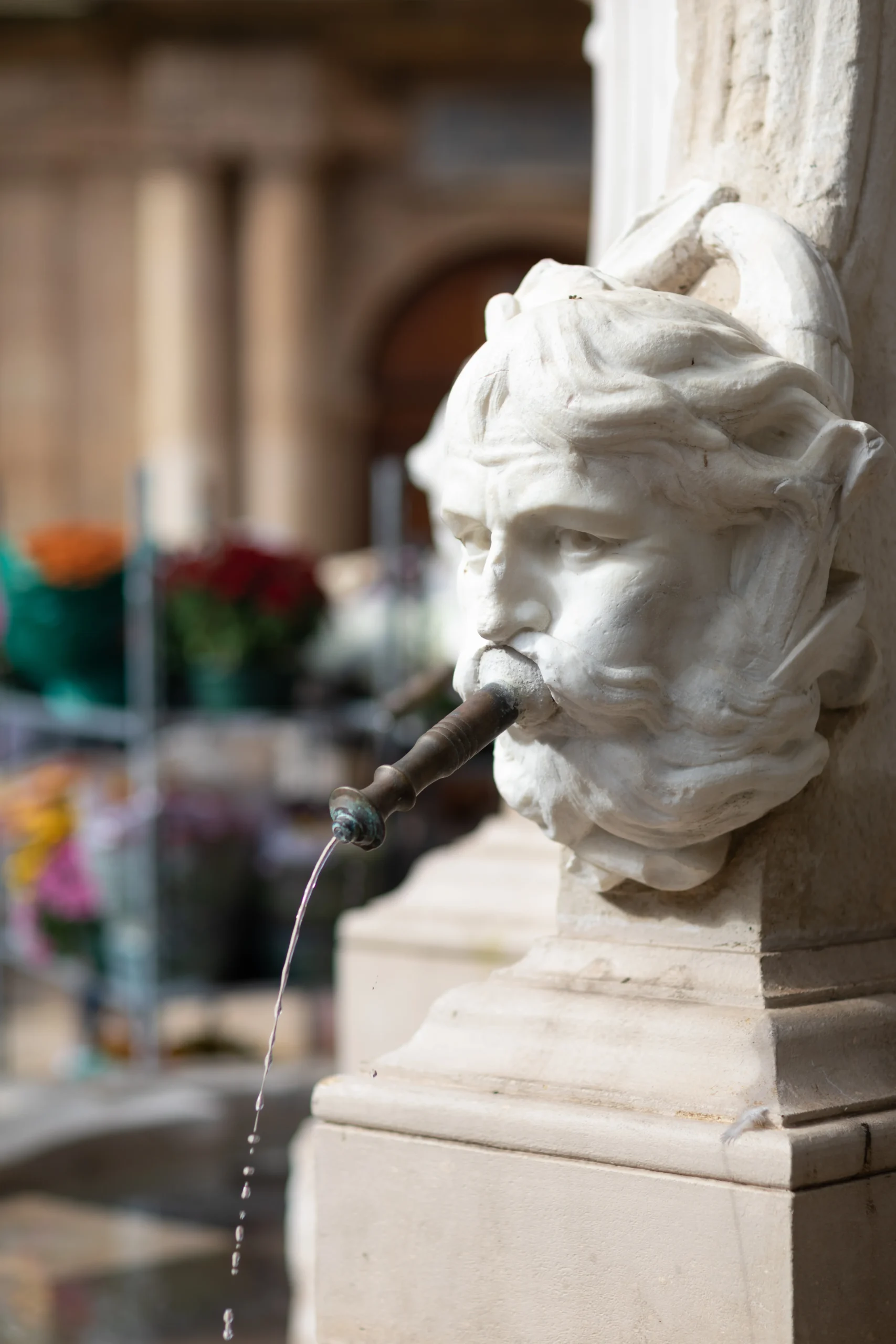
Le projet se concentrait principalement autour de l'hôtel de ville, Vallon fit bâtir des maisons bourgeoises à l'Est et la Halle au grains au sud. Au centre de la place ainsi créée, le plan pour une fontaine fut confié à Esprit Brun. L'artiste avignonnais, Jean Chastel est convoqué pour la réalisation des décorations de la fontaine. Le bassin circulaire abrite un piédestal cubique décoré à chaque coin de guirlandes et fleurons, avec également des mascarons, représentant des Divinités aquatiques d'où jaillit l'eau. Sur le piédestal se dresse une colonne antique en granit qui rappelle les temps romains et supporte un chapiteau corinthien en marbre, surplombé d'une sphère en pierre de Calissane ornée d'une branche de laurier, anciennement en or.
Des inscriptions figurent surs les quatre faces du piédestal : au nord, quelques lignes rappellent les travaux effectués sur un aqueduc romain pour amener l'eau à la source de Pinchinats à l'est, les inscriptions sont à la gloire du roi Louis XV et du duc de Villars au sud, à la gloire des consuls d'Aix à l'ouest, et en face de la mairie, l'inscription a été modifiée au gré des régimes politiques qui se sont succédées. La fontaine a été utilisée comme milieu pour la division en iscles de la ville d'Aix en Provence.
English
He had bourgeois houses built to the east and the Corn Exchange to the south. A fountain, designed by Esprit Brun, stands in the centre of the square formed by these buildings. The Avignon artist Jean Chastel was chosen to decorate the fountain. In the centre of the circular pond is a cube-shaped pedestal adorned with garlands and flowers at each corner, as well as gargoyles representing water gods and goddesses, from which the water flows. On the pedestal stands a classical granite column which recalls Roman times and supports a Corinthian marble capital this is topped with a sphere of Calissane stone adorned with a laurel branch, formerly made of gold. There are inscriptions on the four sides of the pedestal: on the north, a few lines recall the work done on a Roman aqueduct to bring water to the Pinchinats spring to the east, the inscriptions on the south praise King Louis XV and the Duke of Villars, on the west they praise the Consuls of Aix, and the inscription facing the town hall has been altered to suit the whims of successive political regimes.
Deutsch
Das Projekt konzentrierte sich hauptsächlich um das Rathaus herum. Vallon ließ Bürgerhäuser im Osten und die Getreidehalle im Süden errichten. In der Mitte des so entstandenen Platzes wurde Esprit Brun mit dem Entwurf für einen Brunnen beauftragt Der Künstler Jean Chastel aus Avignon wurde mit der Gestaltung des Brunnens beauftragt. Das runde Becken beherbergt ein kubisches Podest, das an jeder Ecke mit Girlanden und Fleurons geschmückt ist Auf dem Sockel steht eine antike Granitsäule, die an die römische Zeit erinnert und ein korinthisches Marmorkapitell trägt, über dem sich eine Kugel aus kalissanischem Stein mit einem Lorbeerzweig befindet, der früher aus Gold bestand.
Auf allen vier Seiten des Sockels befinden sich Inschriften: Im Norden erinnern einige Zeilen an die Arbeiten an einem römischen Aquädukt, um Wasser zur Quelle von Pinchinats zu leiten, im Osten sind die Inschriften zur Ehre von König Ludwig XV. und dem Herzog von Villars im Süden, zur Ehre der Konsuln von Aix im Westen und gegenüber dem Rathaus wurde die Inschrift je nach den aufeinander folgenden politischen Regimen geändert Der Brunnen wurde als Medium für die Einteilung der Stadt Aix en Provence in Inseln verwendet.
Dutch
Het project was voornamelijk geconcentreerd rond het stadhuis, met Vallon die burgerhuizen bouwde in het oosten en de Korenbeurs in het zuiden. In het midden van het plein werd het plan voor een fontein toevertrouwd aan Esprit Brun De kunstenaar Jean Chastel uit Avignon werd ingeschakeld om de fontein te versieren. Het ronde bassin bevat een kubusvormige sokkel die op elke hoek is versierd met guirlandes en fleurons, en mascarons die watergodinnen voorstellen waaruit water stroomt Op de sokkel staat een antieke granieten zuil die herinnert aan de Romeinse tijd en die een Korinthisch marmeren kapiteel draagt, met daarboven een bol in Calissan-steen, versierd met een lauwertak, vroeger in goud.
Op de vier zijden van de sokkel staan opschriften: in het noorden herinneren enkele regels aan de werkzaamheden aan een Romeins aquaduct om water naar de bron van Pinchinats te brengen, in het oosten zijn de opschriften ter ere van koning Lodewijk XV en de hertog van Villars, in het zuiden ter ere van de consuls van Aix, in het westen, en voor het stadhuis is de inscriptie aangepast aan de politieke regimes die volgden De fontein werd gebruikt voor de verdeling van de stad Aix en Provence in eilandjes.
Español
El proyecto se concentró principalmente en torno al ayuntamiento, con Vallon construyendo casas burguesas al este y la Corn Exchange al sur. En el centro de la plaza, el proyecto de una fuente fue confiado a Esprit Brun El artista de Avignon Jean Chastel fue llamado para crear la decoración de la fuente. La pila circular alberga un pedestal cúbico decorado en cada esquina con guirnaldas y florones, así como mascarones que representan divinidades acuáticas de las que brota el agua Sobre el pedestal se alza una antigua columna de granito que recuerda la época romana y que soporta un capitel corintio de mármol, rematado por una esfera de piedra de Calissan decorada con una rama de laurel, antiguamente en oro.
Las inscripciones aparecen en los cuatro lados del pedestal: al norte, unas líneas recuerdan las obras realizadas en un acueducto romano para llevar agua a la fuente de Pinchinats, al este, las inscripciones son a la gloria del rey Luis XV y del duque de Villars al sur, a la gloria de los cónsules de Aix al oeste, y delante del ayuntamiento, la inscripción ha sido modificada según los regímenes políticos que se han sucedido La fuente sirvió de soporte para la división de la ciudad de Aix en Provence en islotes.
Italiano
Il progetto si concentrava principalmente intorno al municipio, mentre Vallon costruiva case borghesi a est e il Corn Exchange a sud. Al centro della piazza, il progetto di una fontana fu affidato a Esprit Brun L'artista avignonese Jean Chastel fu chiamato a creare le decorazioni della fontana. Il bacino circolare ospita un piedistallo cubico decorato ad ogni angolo con ghirlande e fleuron, oltre a mascaroni che rappresentano divinità acquatiche da cui sgorga l'acqua Sul piedistallo si erge un'antica colonna in granito che rimanda all'epoca romana e che sostiene un capitello corinzio in marmo, sormontato da una sfera in pietra di Calissan decorata con un ramo di alloro, anticamente in oro.
Sui quattro lati del piedistallo compaiono delle iscrizioni: a nord, alcune righe ricordano i lavori eseguiti su un acquedotto romano per portare l'acqua alla sorgente di Pinchinats, a est, le iscrizioni sono a gloria del re Luigi XV e del duca di Villars, a sud, a gloria dei consoli di Aix, a ovest, e davanti al municipio, l'iscrizione è stata modificata in base ai regimi politici che si sono succeduti La fontana è stata utilizzata come mezzo per la divisione della città di Aix en Provence in isoli.
Classique
Classement: Monument Historique
Place De l'Hôtel de Ville, 13100 Aix-en-Provence
Crédits: Daniel Kapikian