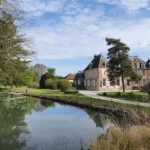
Église Saint-Rémi – Nettancourt
Description
English
Deutsch
Dutch
Español
Italiano
Description
Construite sur le rebord du plateau qui domine la vallée de la Chée, l'église est un édifice homogène de style Renaissance (le portail sud est daté de 1549) entouré du cimetière dont il est séparé par un chemin circulaire. L'église présente trois nefs, une abside à cinq pans et une tourelle d'escalier hors œuvre qui permet d'accéder aux combles. Elle est restaurée en 1708. L'église étant très délabrée au début du XIXe siècle, les réparations les plus urgentes sont effectuées grâce à une souscription des habitants. Après 1856, le marquis de Nettancourt contribue largement à sa restauration et il fait orner l'ancienne chapelle seigneuriale d'un décor héraldique. L'extérieur de l'église porte de nombreuses inscriptions gravées rappelant le nom des habitants.
English
Built on the edge of the plateau overlooking the Chée valley, the church is a homogeneous Renaissance-style edifice (the south portal is dated 1549) surrounded by the cemetery, from which it is separated by a circular path. The church has three naves, a five-sided apse and a turreted staircase leading to the attic. It was restored in 1708. By the early 19th century, the church was in a state of serious disrepair, and the most urgent repairs were carried out thanks to a local subscription campaign. After 1856, the Marquis de Nettancourt made a major contribution to its restoration, decorating the former seigniorial chapel with heraldic decoration. The exterior of the church bears numerous engraved inscriptions recalling the names of the inhabitants.
Deutsch
Die Kirche wurde auf dem Rand des Plateaus über dem Chée-Tal errichtet und ist ein homogenes Gebäude im Renaissancestil (das Südportal ist auf 1549 datiert), das vom Friedhof umgeben ist, von dem es durch einen Rundweg getrennt ist. Die Kirche besteht aus drei Schiffen, einer fünfseitigen Apsis und einem freistehenden Treppentürmchen, das den Zugang zum Dachgeschoss ermöglicht. Die Kirche wurde 1708 restauriert. Jahrhunderts war die Kirche sehr baufällig und die dringendsten Reparaturen wurden mithilfe einer Subskription der Einwohner durchgeführt. Nach 1856 leistete der Marquis de Nettancourt einen großen Beitrag zu ihrer Restaurierung und ließ die ehemalige Herrschaftskapelle mit einem heraldischen Dekor verzieren. Die Außenseite der Kirche trägt zahlreiche eingravierte Inschriften, die an die Namen der Einwohner erinnern.
Dutch
De kerk is gebouwd op de rand van het plateau dat uitkijkt over de vallei van de Chée. Het is een homogeen gebouw in renaissancestijl (het zuidportaal is gedateerd 1549), omringd door het kerkhof waarvan het wordt gescheiden door een rond pad. De kerk heeft drie schepen, een vijfhoekige apsis en een wenteltrap die toegang geeft tot de zolder. De kerk werd in 1708 gerestaureerd. Aan het begin van de 19e eeuw was de kerk in zeer slechte staat en de meest dringende reparaties werden uitgevoerd dankzij een plaatselijke bijdrage. Na 1856 leverde de markies van Nettancourt een belangrijke bijdrage aan de restauratie door de voormalige regentenkapel te versieren met heraldische versieringen. Aan de buitenkant van de kerk staan talrijke gegraveerde inscripties die herinneren aan de namen van de inwoners.
Español
Construida en el borde de la meseta que domina el valle de Chée, la iglesia es un edificio homogéneo de estilo renacentista (el portal sur está fechado en 1549) rodeado por el cementerio, del que está separado por un camino circular. La iglesia tiene tres naves, un ábside de cinco lados y una escalera torreada que da acceso al ático. Fue restaurada en 1708. A principios del siglo XIX, la iglesia se encontraba en muy mal estado y las reparaciones más urgentes se llevaron a cabo gracias a una suscripción local. A partir de 1856, el marqués de Nettancourt contribuyó en gran medida a su restauración, decorando la antigua capilla señorial con ornamentos heráldicos. El exterior de la iglesia presenta numerosas inscripciones grabadas que recuerdan los nombres de los habitantes.
Italiano
Costruita sul bordo dell'altopiano che domina la valle della Chée, la chiesa è un edificio omogeneo in stile rinascimentale (il portale sud è datato 1549) circondato dal cimitero, dal quale è separato da un percorso circolare. La chiesa ha tre navate, un'abside a cinque lati e una scala turrita che dà accesso al sottotetto. Fu restaurata nel 1708. All'inizio del XIX secolo, la chiesa era in pessimo stato di conservazione e le riparazioni più urgenti furono effettuate grazie a una sottoscrizione locale. Dopo il 1856, il marchese di Nettancourt contribuì in modo significativo al suo restauro, decorando l'antica cappella signorile con decorazioni araldiche. L'esterno della chiesa reca numerose iscrizioni incise che ricordano i nomi degli abitanti.
Médiéval
Classement: Monument Historique
16 rue de la Gare, 55800 Nettancourt