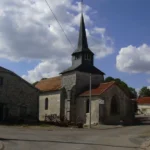
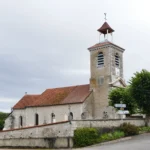
ÉGLISE SAINT-MICHEL DE BLAISE – Colombey les Deux Églises
Description
English
Deutsch
Dutch
Español
Italiano
Description
L'église Saint-Michel est mentionnée au 12e siècle (acte daté de 1174). C’est un édifice à plan en croix latine avec une abside polygonale percée de trois baies, voûté sur croisée d'ogives. Son choeur et ses transepts sont construits au 16e siècle avec voûtes pénétrantes et baies ogivales de style flamboyant. Sa nef, reconstruite entre 1780 et 1784, ne dispose pas de bas-côtés. Son Clocher, par lequel on accède via une tourelle située au sud, se trouve sur la croisée du transept. Il fut réalisé plus tardivement après les travaux de la nef, en 1834, par l'architecte Houlot de Dommartin-le-Saint-Père.
English
Saint-Michel church was first mentioned in the 12th century (document dated 1174). It has a Latin cross floor plan, with a polygonal apse pierced by three bays, and a ribbed vault. Its choir and transepts were built in the 16th century with penetrating vaults and ogival bays in the flamboyant style. The nave, rebuilt between 1780 and 1784, has no aisles. The bell tower, accessed via a turret to the south, stands on the transept crossing. It was built later, in 1834, by architect Houlot from Dommartin-le-Saint-Père.
Deutsch
Die Kirche Saint-Michel wurde im 12. Jahrhundert erwähnt (Urkunde aus dem Jahr 1174). Sie hat einen Grundriss in Form eines lateinischen Kreuzes, eine polygonale Apsis mit drei Öffnungen und ein Kreuzrippengewölbe. Der Chor und die Querschiffe wurden im 16. Jahrhundert mit durchdringenden Gewölben und spitzbogigen Buchten im Flamboyantstil erbaut. Das Kirchenschiff wurde zwischen 1780 und 1784 umgebaut und hat keine Seitenschiffe. Der Glockenturm, den man über ein Türmchen im Süden erreicht, befindet sich auf der Vierung des Querschiffs. Er wurde später nach den Arbeiten am Kirchenschiff im Jahr 1834 von dem Architekten Houlot aus Dommartin-le-Saint-Père errichtet.
Dutch
De kerk Saint-Michel wordt vermeld in de 12e eeuw (document gedateerd 1174). Ze heeft een plattegrond in Latijns kruis met een veelhoekige apsis doorboord met drie traveeën, gewelfd boven een geribd kruis. Het koor en de dwarsbeuken werden in de 16e eeuw gebouwd met doorborende gewelven en ogivale traveeën in flamboyante stijl. Het schip, herbouwd tussen 1780 en 1784, heeft geen zijbeuken. De klokkentoren, toegankelijk via een torentje aan de zuidkant, bevindt zich op de kruising van het dwarsschip. Hij werd later gebouwd, in 1834, door de architect Houlot uit Dommartin-le-Saint-Père.
Español
La iglesia de Saint-Michel se menciona en el siglo XII (documento fechado en 1174). Tiene planta de cruz latina con un ábside poligonal perforado por tres tramos, abovedado sobre una cruz de crucería. El coro y los transeptos se construyeron en el siglo XVI con bóvedas penetrantes y tramos ojivales de estilo flamígero. La nave, reconstruida entre 1780 y 1784, no tiene naves laterales. Su campanario, al que se accede por una torreta al sur, está situado en el crucero. Fue construido posteriormente, en 1834, por el arquitecto Houlot de Dommartin-le-Saint-Père.
Italiano
La chiesa di Saint-Michel è menzionata nel XII secolo (documento del 1174). Ha una pianta a croce latina con un'abside poligonale traforata da tre campate, con volta a crociera costolonata. Il coro e i transetti furono costruiti nel XVI secolo con volte a crociera e campate ogivali in stile fiammeggiante. La navata centrale, ricostruita tra il 1780 e il 1784, è priva di navate laterali. Il campanile, a cui si accede tramite una torretta a sud, si trova sull'incrocio del transetto. Fu costruito successivamente, nel 1834, dall'architetto Houlot di Dommartin-le-Saint-Père.
, 52330 Colombey les Deux Églises

Crédits: <table style="margin: 1.5em auto; width:60%; background-color:#CCCCCC; border:2px solid #aaaaaa; padding:1px;" cellspacing="10"> <tbody><tr>
<td><i><a href="https://upload.wikimedia.org/wikipedia/commons/8/84/%C3%89glise_Saint-Michel_de_Blaise_-_2.jpg" class="internal" title="Église Saint-Michel de Blaise - 2.jpg"><b>This illustration</b></a> <b>was made by</b> </i><b><a href="//commons.wikimedia.org/wiki/User:Peter17" title="User:Peter17">Peter Potrowl</a></b><i>.</i>
<p>Please credit this with : <b>© Peter Potrowl</b> in the immediate vicinity of the image. A link to my website <a rel="nofollow" class="external text" href="https://www.sitemai.eu">sitemai.eu</a> would be much appreciated but isn't mandatory.
</p><p>An email to
<span typeof="mw:File"><a href="//commons.wikimedia.org/wiki/File:UserIconMail.svg" class="mw-file-description"><img src="https://upload.wikimedia.org/wikipedia/commons/thumb/e/ea/UserIconMail.svg/24px-UserIconMail.svg.png" decoding="async" width="24" height="24" class="mw-file-element" srcset="https://upload.wikimedia.org/wikipedia/commons/thumb/e/ea/UserIconMail.svg/36px-UserIconMail.svg.png 1.5x, https://upload.wikimedia.org/wikipedia/commons/thumb/e/ea/UserIconMail.svg/48px-UserIconMail.svg.png 2x" data-file-width="700" data-file-height="700"></a></span>
<a href="//commons.wikimedia.org/wiki/Special:EmailUser/Peter17" title="Special:EmailUser/Peter17">Peter Potrowl</a> would be appreciated too.
</p><p>Do not copy this image illegally by ignoring the terms of the license below, as it is <b>not</b> in the public domain.
If you would like special permission to use, license, or purchase the image please contact me <span typeof="mw:File"><a href="//commons.wikimedia.org/wiki/File:UserIconMail.svg" class="mw-file-description"><img src="https://upload.wikimedia.org/wikipedia/commons/thumb/e/ea/UserIconMail.svg/24px-UserIconMail.svg.png" decoding="async" width="24" height="24" class="mw-file-element" srcset="https://upload.wikimedia.org/wikipedia/commons/thumb/e/ea/UserIconMail.svg/36px-UserIconMail.svg.png 1.5x, https://upload.wikimedia.org/wikipedia/commons/thumb/e/ea/UserIconMail.svg/48px-UserIconMail.svg.png 2x" data-file-width="700" data-file-height="700"></a></span><a href="//commons.wikimedia.org/wiki/Special:EmailUser/Peter17" title="Special:EmailUser/Peter17">Peter Potrowl</a> to negotiate terms.
</p><p>More free pictures in my <a rel="nofollow" class="external text" href="https://www.sitemai.eu">website</a>. Donations are accepted <a rel="nofollow" class="external text" href="https://paypal.me/Peter017">here</a> and <a rel="nofollow" class="external text" href="https://buymeacoffee.com/peter17">here</a>.
</p>
</td></tr></tbody></table>
Licence
Licence