Eglise Notre-Dame – Bagas
Description
English
Deutsch
Dutch
Español
Italiano
Description
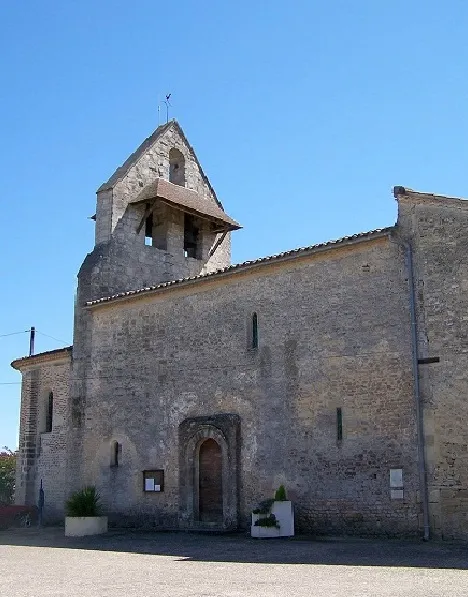
Pour construire cet édifice, les artisans se sont servi des vestiges d'une ancienne villa gallo-romaine. Les moellons du choeur sont ceux qui constituaient les murs de l'ancienne bâtisse et le bénitier a été élaboré à partir d'un chapiteau antique. L'édifice est voûté au XIIème siècle et le chevet est refait à la fin du XIVème. Le décor sculpté roman présente notamment Daniel dans la fosse aux lions et David tuant Goliath. Les murs de l'abside restent couverts de plusieurs peintures. L'une d'entre elles représente le diable traînant avec lui des personnages coupables d'avoir commis les sept péchés capitaux. ISMH 1961, peintures murales Cl. M.H. 1961.
English
To build this building, the craftsmen used the remains of an ancient Gallo-Roman villa. The choir's rubble is the same as that which formed the walls of the old building and the stoup was made from an ancient capital. The building was vaulted in the 12th century and the chevet was redone at the end of the 14th century. The Romanesque carved decoration shows Daniel in the lions' den and David killing Goliath. The walls of the apse remain covered with several paintings. One of them represents the devil dragging with him characters guilty of having committed the seven deadly sins. ISMH 1961, Cl. M.H. 1961 murals.
Deutsch
Für den Bau dieses Gebäudes verwendeten die Handwerker die Überreste einer alten gallo-römischen Villa. Die Bruchsteine des Chors stammen aus den Mauern des alten Gebäudes und das Weihwasserbecken wurde aus einem antiken Kapitell gefertigt. Das Gebäude wurde im 12. Jahrhundert gewölbt und das Kopfende wurde Ende des 14. Jahrhunderts erneuert. Die romanische Skulpturendekoration zeigt unter anderem Daniel in der Löwengrube und David, der Goliath tötet. Die Wände der Apsis sind weiterhin mit mehreren Malereien bedeckt. Eines davon zeigt den Teufel, der Personen mit sich zieht, die sich der sieben Todsünden schuldig gemacht haben. ISMH 1961, Wandmalereien Kl. M.H. 1961.
Dutch
Om dit gebouw te bouwen, gebruikten de ambachtslieden de resten van een oude Gallo-Romeinse villa. Het puin van het koor is hetzelfde als dat van de muren van het oude gebouw en de doopvont is gemaakt van een oud kapiteel. Het gebouw werd in de 12e eeuw gewelfd en het chevet werd aan het eind van de 14e eeuw herbouwd. De Romaanse gebeeldhouwde decoratie toont Daniël in de leeuwenkuil en David die Goliath doodt. De muren van de apsis zijn nog steeds bedekt met verschillende schilderingen. Een ervan stelt de duivel voor die personages meesleept die schuldig zijn aan de zeven hoofdzonden. ISMH 1961, muurschilderingen Cl. M.H. 1961.
Español
Para construir este edificio, los artesanos utilizaron los restos de una antigua villa galorromana. Los escombros del coro son los mismos que se utilizaron para formar los muros del antiguo edificio y la pila bautismal se hizo con un antiguo capitel. El edificio fue abovedado en el siglo XII y la cabecera fue reconstruida a finales del siglo XIV. La decoración románica esculpida muestra a Daniel en el foso de los leones y a David matando a Goliat. Las paredes del ábside aún están cubiertas con varias pinturas. Uno de ellos representa al diablo arrastrando consigo a personajes culpables de haber cometido los siete pecados capitales. ISMH 1961, pinturas murales Cl. M.H. 1961.
Italiano
Per costruire questo edificio, gli artigiani hanno utilizzato i resti di un'antica villa gallo-romana. Le macerie del coro sono le stesse utilizzate per formare i muri dell'antico edificio e il fonte battesimale è stato ricavato da un antico capitello. L'edificio fu costruito a volta nel XII secolo e il chevet fu ricostruito alla fine del XIV secolo. La decorazione scultorea romanica mostra Daniele nella tana del leone e Davide che uccide Golia. Le pareti dell'abside sono ancora coperte da diversi dipinti. Una di queste raffigura il diavolo che trascina con sé personaggi colpevoli di aver commesso i sette peccati capitali. ISMH 1961, dipinti murali Cl. M.H. 1961.