Eglise de l'Assomption – Arancou
Description
English
Deutsch
Dutch
Español
Italiano
Description
A 10km de Bidache et à deux pas du Béarn, bâtie sur un rocher, l’église d’Arancou est classée Monument Historique. Edifiée au XIIIe siècle, sa construction est liée aux chemins de Saint Jacques de Compostelle : Arancou est une étape importante du pèlerinage sur la voie de Tours.
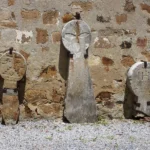
A l’origine rattachée à l’hôpital-prieuré « l’Epitau Nau » d’Arancou, elle est un témoin du passage de l’Art Roman à l’Art Gothique, la nef unique à trois travées voûtées se terminant par un chevet à cinq pans coupés. A l’entrée une très belle stèle discoïdale vous accueille. L’intérieur se démarque par un vitrail signé du maître-verrier palois Mauméjan, une cuve baptismale ornée, des chapiteaux sculptés et une mosaïque du chœur inspirée de l’église de Sorde. A voir à proximité le tryptique sculpté du gîte jacquaire, le lavoir-fontaine du lion, et le centre d’interprétation de la Grotte Bourouilla.
English
10km from Bidache and a stone's throw from Béarn, built on a rock, the church of Arancou is classified as a Historic Monument. Built in the 13th century, its construction is linked to the pilgrimage route to Santiago de Compostela: Arancou is an important stage of the pilgrimage on the way to Tours
Originally attached to the hospital-priory "l'Epitau Nau" of Arancou, it is a witness to the transition from Romanesque to Gothic Art, the single nave with three vaulted bays ending in a five-sided cut chevet. At the entrance a beautiful discoid stele welcomes you. The interior is distinguished by a stained glass window signed by the Palois master glassmaker Mauméjan, an ornate baptismal basin, sculpted capitals and a mosaic of the choir inspired by the church of Sorde. Nearby you can see the sculpted triptych of the Jacquaire gîte, the lion's wash-house-fountain, and the Bourouilla Cave inte
Deutsch
Die Kirche von Arancou, 10 km von Bidache entfernt und in der Nähe des Béarn, wurde auf einem Felsen erbaut und ist als historisches Monument klassifiziert. Jahrhundert errichtet und steht in Verbindung mit dem Jakobsweg: Arancou ist eine wichtige Etappe der Pilgerfahrt auf dem Weg nach Tours
Ursprünglich gehörte sie zum Krankenhaus-Priorat "Epitau Nau" in Arancou. Sie ist ein Zeugnis des Übergangs von der Romanik zur Gotik, wobei das einschiffige, dreijochige Gewölbe in einem fünffach gegliederten Kopfende endet. Am Eingang empfängt Sie eine sehr schöne Diskoidalstele. Das Innere besticht durch ein Glasfenster des Glasbläsermeisters Mauméjan aus Palais, ein verziertes Taufbecken, geschnitzte Kapitelle und ein Mosaik im Chor, das von der Kirche in Sorde inspiriert wurde. Sehenswert in der Nähe sind das geschnitzte Tryptichon der Herberge für Jakobspilger, der Waschplatz mit Löwenbrunnen
Dutch
Op 10 km van Bidache en vlakbij Béarn, gebouwd op een rots, is de kerk van Arancou geclassificeerd als Historisch Monument. Het is gebouwd in de 13e eeuw en houdt verband met de pelgrimsroutes naar Santiago de Compostela: Arancou is een belangrijke etappe op de pelgrimsroute naar Tours
Oorspronkelijk verbonden aan het ziekenhuis-priorium "l'Epitau Nau" van Arancou, is het een getuige van de overgang van Romaanse naar Gotische kunst, het enkele schip met drie gewelfde traveeën eindigt in een vijfhoekig chevet. Bij de ingang heet een prachtige discoïdale stele u welkom. Het interieur wordt gekenmerkt door een glas-in-loodraam getekend door de Palois meester glaskunstenaar Mauméjan, een sierlijke doopvont, gebeeldhouwde kapitelen en een mozaïek in het koor geïnspireerd op de kerk in Sorde. In de buurt zijn de gebeeldhouwde tryptiek van de Jacobean lodge, het washuis met de fontein van de l
Español
A 10 km de Bidache y cerca de Béarn, construida sobre una roca, la iglesia de Arancou está clasificada como monumento histórico. Construida en el siglo XIII, su construcción está vinculada a las rutas de peregrinación a Santiago de Compostela: Arancou es una etapa importante en la ruta de peregrinación a Tours
Anexa en su origen al hospital-prioral "l'Epitau Nau" de Arancou, es un testimonio de la transición del arte románico al gótico, la nave única de tres tramos abovedados termina en una cabecera de cinco lados. En la entrada, una hermosa estela discoidal le da la bienvenida. El interior se distingue por una vidriera firmada por el maestro vidriero palés Mauméjan, una pila bautismal ornamentada, capiteles esculpidos y un mosaico en el coro inspirado en la iglesia de Sorde. En los alrededores, podrá ver el tríptico esculpido de la logia jacobea, el lavadero de la fuente del león y el
Italiano
A 10 km da Bidache e vicino a Béarn, costruita su una roccia, la chiesa di Arancou è classificata come monumento storico. Costruita nel XIII secolo, la sua costruzione è legata ai percorsi di pellegrinaggio verso Santiago de Compostela: Arancou è una tappa importante del percorso di pellegrinaggio verso Tours
Originariamente annesso all'ospedale-priorato "l'Epitau Nau" di Arancou, è una testimonianza del passaggio dall'arte romanica a quella gotica, con un'unica navata a tre campate voltate che termina con un chevet a cinque lati. All'ingresso, una bella stele discoidale dà il benvenuto. L'interno è caratterizzato da una vetrata firmata dal maestro vetraio Palois Mauméjan, da un fonte battesimale ornato, da capitelli scolpiti e da un mosaico nel coro ispirato alla chiesa di Sorde. Nelle vicinanze, si possono ammirare i tentacoli scolpiti della loggia giacobina, il lavatoio con la fontana del leone e il centro di interpretazione della grotta di Bourouilla.