Château de Payré – La Peyratte
Description
English
Deutsch
Dutch
Español
Italiano
Description
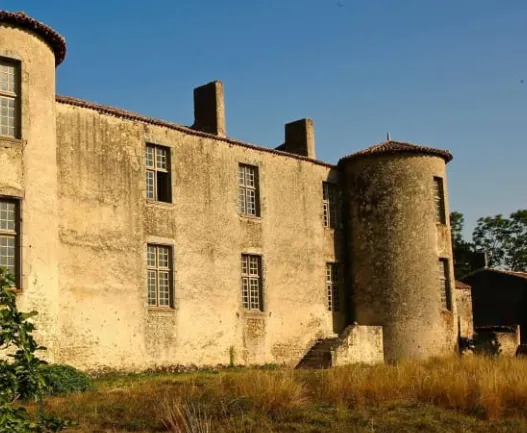
Le château est inclus dans un espace polygonal délimité par des bâtiments de ferme. Il date de la fin de la période médiévale (15e-16e siècle) et présente un caractère fortifié. Sa façade postérieure est cantonnée de deux tours rondes aux angles. La façade sur cour est percée d'une porte centrale surmontée d'un fronton mouluré. La chapelle est accolée au corps de logis. Il s'agit d'un édifice rectangulaire sous charpente moulurée du 14e siècle. Les restes du portail et de la baie orientale se distinguent dans la maçonnerie. Cette chapelle est décorée de peintures murales (14e siècle) peu lisibles d'où se détachent de grands personnages en pied (apôtres ? Martyre de saint Sébastien ?).
English
The castle is included in a polygonal space delimited by farm buildings. It dates from the end of the medieval period (15th-16th century) and has a fortified character. Its rear façade is flanked by two round towers at the corners. The courtyard façade has a central doorway topped by a moulded pediment. The chapel is attached to the main building. It is a rectangular building with a 14th century moulded roofing framework. The remains of the portal and the eastern bay can be seen in the masonry. This chapel is decorated with wall paintings (14th century) that are not very legible and from which stand out large standing figures (apostles? Martyrdom of Saint Sebastian?).
Deutsch
Die Burg ist in einen polygonalen Raum eingeschlossen, der von Wirtschaftsgebäuden begrenzt wird. Es stammt aus dem späten Mittelalter (15.-16. Jahrhundert) und weist einen befestigten Charakter auf. Die hintere Fassade wird von zwei Rundtürmen an den Ecken begrenzt. Die Fassade zum Hof wird von einem zentralen Tor durchbrochen, das von einem geformten Giebel gekrönt ist. Die Kapelle ist an das Hauptgebäude angebaut. Es handelt sich um ein rechteckiges Gebäude unter einem gekehlten Dachstuhl aus dem 14. Jahrhundert. Die Überreste des Portals und des östlichen Erkers sind im Mauerwerk erkennbar. Diese Kapelle ist mit schlecht lesbaren Wandmalereien (14. Jahrhundert) geschmückt, aus denen sich große Figuren in voller Länge herausheben (Apostel? Martyrium des heiligen Sebastian?).
Dutch
Het kasteel is ingesloten in een veelhoekig gebied begrensd door boerderijgebouwen. Het dateert uit de late middeleeuwen (15e-16e eeuw) en heeft een versterkt karakter. De achtergevel wordt geflankeerd door twee ronde torens op de hoeken. De binnenplaatsgevel heeft een centrale deuropening met daarop een geprofileerd fronton. De kapel is verbonden met het hoofdgebouw. Het is een rechthoekig gebouw met een 14e eeuwse lijst in het dak. De resten van het portaal en de oostelijke travee zijn te zien in het metselwerk. Deze kapel is versierd met muurschilderingen (14e eeuw), die moeilijk te lezen zijn en waaruit grote figuren ten voeten uit steken (apostelen? Martelaarschap van Sint Sebastiaan?).
Español
El castillo está encerrado en una zona poligonal delimitada por edificios agrícolas. Data de la época medieval tardía (siglos XV-XVI) y es de carácter fortificado. Su fachada trasera está flanqueada por dos torres redondas en las esquinas. La fachada del patio tiene una puerta central rematada por un frontón moldeado. La capilla está unida al edificio principal. Se trata de un edificio rectangular con una estructura de tejado moldeado del siglo XIV. En la mampostería se pueden ver los restos del portal y del vano oriental. Esta capilla está decorada con pinturas murales (siglo XIV), de difícil lectura, en las que destacan grandes figuras de cuerpo entero (¿apóstoles? ¿Martirio de San Sebastián?).
Italiano
Il castello è racchiuso in un'area poligonale delimitata da edifici agricoli. Risale al periodo tardo medievale (XV-XVI secolo) e ha un carattere fortificato. La facciata posteriore è fiancheggiata da due torri rotonde agli angoli. La facciata del cortile presenta un portale centrale sormontato da un frontone modanato. La cappella è annessa all'edificio principale. Si tratta di un edificio rettangolare con una cornice del tetto modanata del XIV secolo. Nella muratura sono visibili i resti del portale e della campata orientale. Questa cappella è decorata da pitture murali (XIV secolo), di difficile lettura, in cui spiccano grandi figure a figura intera (apostoli? martirio di San Sebastiano?).