Chapelle Saint-Exuper
Description
English
Deutsch
Dutch
Español
Italiano
Description
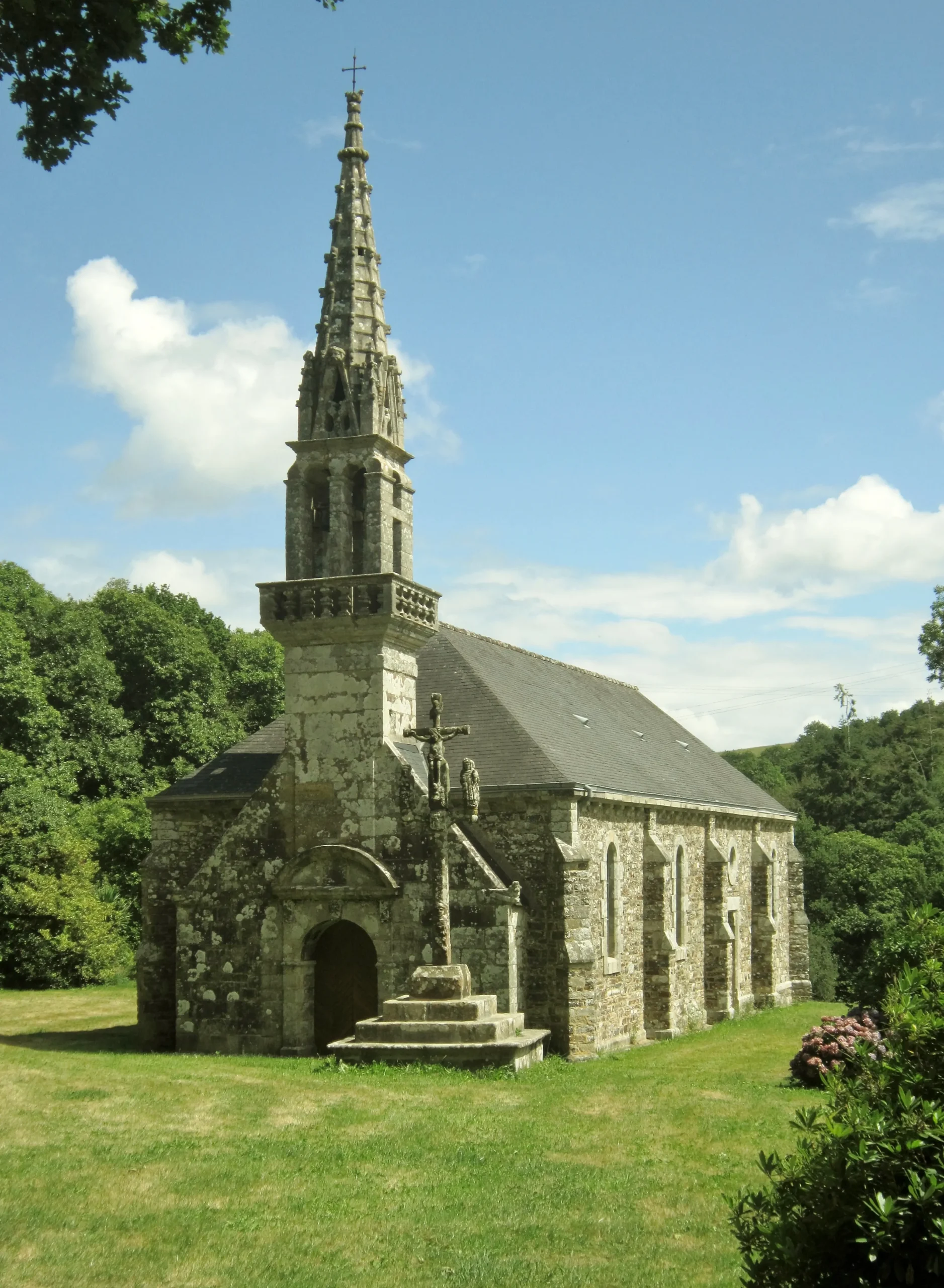
Chapelle de Saint-Exupère ou Sant-Dispar (construite entre 1640 et 1670) Exupère, saint du Vème siècle, est difficilement identifié, tantôt évêque de Bayeux, tantôt évêque de Toulouse . Le nom de Sant Dispar signifie « sans égal » en breton, mais aucune hagiographie ne le mentionne.
C’est au creux d’un vallon verdoyant que l’on découvre cette chapelle rectangulaire, qui a conservé son clocher ancien, ainsi que le pignon ouest. Pour financer la reconstruction partielle de la chapelle en 1892 , un des vitraux fut vendu et on le retrouve actuellement au Musée départemental breton à Quimper.
Un calvaire du XVIème et une fontaine de 1670 offrent une vue complète du lieu de dévotion .
[ D'après Anne Dietrich ]
English
Chapel of Saint-Exupère or Sant-Dispar (built between 1640 and 1670) Exupère, a 5th century saint, is difficult to identify. He was sometimes bishop of Bayeux, sometimes bishop of Toulouse. The name Sant Dispar means "without equal" in Breton, but no hagiography mentions it.
It is in the hollow of a green valley that one discovers this rectangular chapel, which has kept its old bell tower, as well as the western gable. To finance the partial reconstruction of the chapel in 1892, one of the stained glass windows was sold and is now in the Musée départemental breton in Quimper.
A calvary from the 16th century and a fountain from 1670 offer a complete view of the place of devotion.
[ According to Anne Dietrich ]
Deutsch
Kapelle von Saint-Exupère oder Sant-Dispar (erbaut zwischen 1640 und 1670) Exupère, ein Heiliger aus dem 5. Jahrhundert, ist schwer zu identifizieren, mal war er Bischof von Bayeux, mal Bischof von Toulouse . Der Name Sant Dispar bedeutet auf Bretonisch "ohne Gleichen", wird aber in keiner Hagiografie erwähnt.
In einem grünen Tal liegt diese rechteckige Kapelle, die ihren alten Glockenturm und den Westgiebel bewahrt hat. Um den teilweisen Wiederaufbau der Kapelle im Jahr 1892 zu finanzieren, wurde eines der Kirchenfenster verkauft, das heute im Musée départemental breton in Quimper zu sehen ist.
Ein Kalvarienberg aus dem 16. Jahrhundert und ein Brunnen aus dem Jahr 1670 bieten einen vollständigen Überblick über den Ort der Verehrung.
[ nach Anne Dietrich ]
Dutch
Cultureel erfgoed
Español
Capilla de Saint-Exupère o de Sant-Dispar (construida entre 1640 y 1670) Exupère, un santo del siglo V, es difícil de identificar, a veces obispo de Bayeux, a veces obispo de Toulouse. El nombre de Sant Dispar significa "sin igual" en bretón, pero ninguna hagiografía lo menciona.
Esta capilla rectangular, que conserva su antiguo campanario y el hastial oeste, está situada en un verde valle. Para financiar la reconstrucción parcial de la capilla en 1892, se vendió una de las vidrieras, que hoy se encuentra en el Museo Departamental Bretón de Quimper.
Un calvario del siglo XVI y una fuente de 1670 ofrecen una visión completa del lugar de devoción.
[Según Anne Dietrich]
Italiano
Cappella di Saint-Exupère o Sant-Dispar (costruita tra il 1640 e il 1670) È difficile identificare Exupère, un santo del V secolo, a volte vescovo di Bayeux, a volte vescovo di Tolosa. Il nome Sant Dispar significa "senza eguali" in bretone, ma nessuna agiografia lo cita.
Questa cappella rettangolare, che ha conservato l'antico campanile e il timpano occidentale, è situata in una valle verde. Per finanziare la parziale ricostruzione della cappella nel 1892, una delle vetrate fu venduta e oggi si trova nel Musée départemental breton di Quimper.
Un calvario del XVI secolo e una fontana del 1670 offrono una visione completa del luogo di devozione.
[ Secondo Anne Dietrich ]