Chapelle de Notre Dame de l'Aubépine – Ainhoa
Description
English
Deutsch
Dutch
Español
Italiano
Description
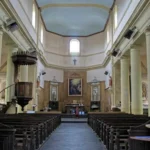
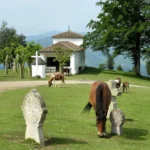
Sur les hauteurs du village, à 389 mètres d'altitude, le mont Atsulai abrite un petit sanctuaire dédié à Notre Dame de l’Aubépine et accessible après 45 minutes de marche. La chapelle et ses 26 stèles discoïdales et tabulaires, symboles de l'art funéraire basque, offre un magnifique panorama sur la vallée de Xareta, la Rhune et l'Océan..
Au XIXe siècle, le chanoine César Duvoisin et l'abbé Etchegoyen ont pu écrire de belles pages sur la chapelle, son histoire et ses pratiques mais c'est à M. l'abbé Olhagaray , curé d'Ainhoa de 1930 à 1938, que nous devons la seule étude qui lui ait été consacrée en langue basque. Les légendes et personnages mythiques dotent ce lieu d’un ensemble de croyances oscillant entre magie, religion et histoire.
English
On the heights of the village, at an altitude of 389 metres, Mount Atsulai is home to a small sanctuary dedicated to Our Lady of the Hawthorn, which can be reached after a 45-minute walk. The chapel and its 26 discoidal and tabular steles, symbols of Basque funerary art, offers a magnificent panorama of the Xareta valley, the Rhune and the ocean.
In the 19th century, Canon César Duvoisin and Abbot Etchegoyen wrote beautiful pages about the chapel, its history and its practices, but it is to Abbot Olhagaray, the parish priest of Ainhoa from 1930 to 1938, that we owe the only study devoted to it in the Basque language. Legends and mythical characters give this place a set of beliefs that oscillate between magic, religion and history.
Deutsch
Auf den Höhen des Dorfes, in 389 m Höhe, beherbergt der Berg Atsulai einen kleinen Schrein, der Unserer Lieben Frau vom Weißdorn gewidmet ist und nach einem 45-minütigen Spaziergang erreicht werden kann. Der Schrein mit seinen 26 diskusförmigen und tafelförmigen Stelen, die ein Symbol der baskischen Grabkunst sind, bietet einen herrlichen Panoramablick auf das Xareta-Tal, La Rhune und den Ozean.
Jahrhundert konnten der Kanoniker César Duvoisin und der Pfarrer Etchegoyen schöne Seiten über die Kapelle, ihre Geschichte und ihre Praktiken schreiben, doch die einzige Studie, die ihr in baskischer Sprache gewidmet wurde, verdanken wir dem Pfarrer Olhagaray , der von 1930 bis 1938 Pfarrer von Ainhoa war. Die Legenden und mythischen Figuren verleihen diesem Ort einen Glaubenskomplex, der zwischen Magie, Religion und Geschichte schwankt.
Dutch
Op de hoogten van het dorp, op een hoogte van 389 meter, herbergt de berg Atsulai een klein heiligdom gewijd aan Onze Lieve Vrouw van de Meidoorn, dat kan worden bereikt na een wandeling van 45 minuten. De kapel en haar 26 schijfvormige en tabulaire steles, symbolen van de Baskische grafkunst, bieden een prachtig panorama op de Xareta vallei, de Rhune en de oceaan.
In de 19e eeuw schreven kanunnik César Duvoisin en abt Etchegoyen prachtige pagina's over de kapel, haar geschiedenis en haar gebruiken, maar het is aan abt Olhagaray, pastoor van Ainhoa van 1930 tot 1938, dat we de enige studie in het Baskisch te danken hebben. Legenden en mythische figuren geven deze plaats een reeks overtuigingen die schommelen tussen magie, religie en geschiedenis.
Español
En las alturas del pueblo, a 389 metros de altitud, el monte Atsulai alberga un pequeño santuario dedicado a Nuestra Señora del Espino, al que se llega tras una caminata de 45 minutos. La capilla y sus 26 estelas discoidales y tabulares, símbolos del arte funerario vasco, ofrecen una magnífica vista del valle de Xareta, la Rhune y el océano.
En el siglo XIX, el canónigo César Duvoisin y el abad Etchegoyen escribieron hermosas páginas sobre la capilla, su historia y sus prácticas, pero es al abad Olhagaray, párroco de Ainhoa de 1930 a 1938, a quien debemos el único estudio dedicado a ella en euskera. Las leyendas y los personajes míticos dan a este lugar un conjunto de creencias que oscilan entre la magia, la religión y la historia.
Italiano
Sulle alture del paese, a 389 metri di altitudine, il monte Atsulai ospita un piccolo santuario dedicato alla Madonna del Biancospino, raggiungibile con una passeggiata di 45 minuti. La cappella e le sue 26 stele discoidali e tabulari, simboli dell'arte funeraria basca, offrono una magnifica vista sulla valle dello Xareta, sulla Rhune e sull'oceano.
Nel XIX secolo, il canonico César Duvoisin e l'abate Etchegoyen scrissero belle pagine sulla cappella, la sua storia e le sue pratiche, ma è all'abate Olhagaray, parroco di Ainhoa dal 1930 al 1938, che dobbiamo l'unico studio dedicato ad essa in lingua basca. Leggende e personaggi mitici conferiscono a questo luogo un insieme di credenze che oscillano tra magia, religione e storia.