CATHEDRALE SAINT-MAMMES – Langres
Description
English
Deutsch
Dutch
Español
Italiano
Description
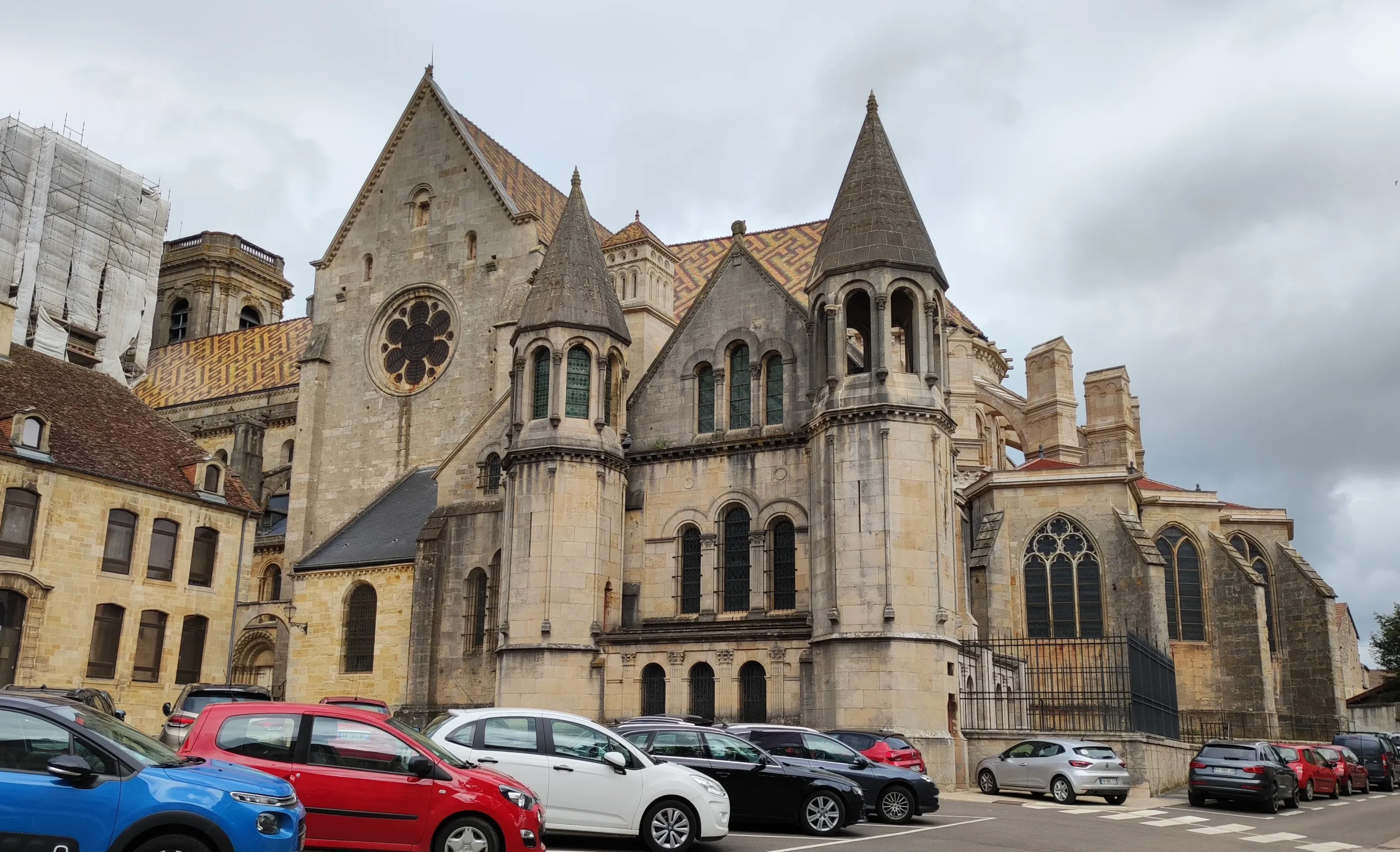
Bâtie à partir de 1150 et achevée à la fin du siècle, la cathédrale Saint-Mammès était celle d'un vaste diocèse situé entre Champagne et Bourgogne.
C'est le dernier grand édifice construit dans la lignée de l'abbatiale romane de Cluny édifiée à la fin du 11e siècle. Située au carrefour d'influences artistiques diverses, la cathédrale Saint-Mammès conjugue harmonieusement un décor et des volumes romans avec les premières innovations gothiques. L'emploi de la voûte sur croisées d'ogives, novateur dans la région, a permis de donner au vaisseau une largeur et un éclairage plus importants que dans les autres édifices clunisiens.
Reconstruite en 1768, l'imposante façade néo-classique se compose de deux tours encadrant un avant-corps sommé d'un fronton. Celui-ci est surmonté de deux statues monumentales représentant la Synagogue (à gauche) et l'Eglise (à droite). Chacun des trois niveaux est scandé par des colonnes ou des pilastres aux ordres dorique, ionique et corinthien. Durant la Révolution, certains éléments de décor ont été détournés de leur symbole initial. Ainsi, au-dessus du portail nord (à gauche), la mitre et la crosse épiscopales ont été transformées en bonnet phrygien et en faisceau de licteur.
Au fil de la visite, laissez-vous charmer par la chatoyante toiture du 19e s. réalisée en tuiles vernissées, les oeuvres Renaissance comme la chapelle d'Amoncourt et son pavement de Faïence, le bas-relief des reliques et les tapisseries de Saint-Mammès ou encore le grand orgue du 18e s… Groupe : Toute l'année sur demande. <img src="https://www.bienvenue-hautemarne.fr/wp-content/uploads/2023/08/icon-id-vizit.png">
Visite disponible sur l'application gratuite Id-Vizit !
Véritable compagnon personnel de voyage, Id-Vizit vous propose des parcours de visites personnalisés, ludiques et interactifs !
<a href="https://www.bienvenue-hautemarne.fr/visites-activites/id-vizit/">+ d'info sur Id-Vizit</a> Animation estivale : du 17 juillet au 21 août, auditions d'orgue, les dimanches à 17h, organisées par l'Ass. des Amis des Orgues. <iframe src="https://www.google.com/maps/embed?pb=!4v1715612645584!6m8!1m7!1sCAoSLEFGMVFpcE5pRzhsU05ZV2hzMzNObjJIZXl1elI5Z1Q1Q0o3ODkzZ3o4OHpl!2m2!1d47.864195650731!2d5.3351146812709!3f93.85820855301473!4f3.5756552839210514!5f0.7820865974627469" width="100%" height="450" frameborder="0" style="border:0" allowfullscreen></iframe> Pour la petite histoire :
La légende de saint Mammès raconte comment celui-ci devint le saint patron de la cathédrale et du diocèse à la place de saint Jean l'Évangéliste.
Vers 755, un pèlerin rapporta de Constantinople un os de la nuque de saint Mammès. A proximité de Langres, il voulut se reposer et suspendit à une branche la bourse contenant les reliques. Lorsqu'il désira la reprendre, il ne put la décrocher de l'arbre…
Il alla trouver l'évêque Vandier et lui compta le prodige ; le prélat, accompagné de son clergé et de nombreux fidèles, se rendit sur les lieux. Malgré ses efforts, les reliques refusèrent de se décrocher « quoy qu'elles ne tinssent qu'à un simple cordon de soie ».
C'est alors qu'un vénérable vieillard interpella l'évêque et lui suggéra de dédier la cathédrale à saint Mammès, en prétendant que saint Jean l'Évangéliste ne trouverait « pas mauvais qu'on honore ainsi à sa place son fils bien aimé qu'il a engendré au Seigneur par la parole de sa prédication ».
Le prélat appliqua le conseil et dédia aussitôt son église à ce saint.
La cérémonie était à peine terminée que les reliques tombèrent d'elles-mêmes et furent rapportées jusqu'à Langres en procession solennelle.
Le vieillard n'était autre que saint Jean l'Évangéliste lui-même…
English
Built from 1150 onwards and completed by the end of the century, Saint-Mammès cathedral was the cathedral of a vast diocese located between Champagne and Burgundy.
It was the last major building to follow in the footsteps of the Romanesque abbey church of Cluny, built at the end of the 11th century. Situated at the crossroads of various artistic influences, Saint-Mammès Cathedral harmoniously combines Romanesque decor and volumes with early Gothic innovations. The use of ribbed vaulting, an innovation in the region, gave the nave greater width and light than in other Cluniac buildings.
Rebuilt in 1768, the imposing neo-classical facade features two towers framing a pedimented forecourt. This is topped by two monumental statues representing the Synagogue (left) and the Church (right). Each of the three levels is punctuated by Doric, Ionic and Corinthian columns or pilasters. During the French Revolution, certain decorative elements were diverted from their original symbol. For example, above the north portal (left), the bishop's mitre and crozier were transformed into a Phrygian cap and a lictor's bundle.
During your visit, let yourself be charmed by the shimmering 19th c. glazed tile roof, Renaissance works such as the Amoncourt chapel with its earthenware pavement, the bas-relief of the relics and tapestries of Saint-Mammès, or the 18th c. great organ… Groups: All year round on request. <img src="https://www.bienvenue-hautemarne.fr/wp-content/uploads/2023/08/icon-id-vizit.png">
Visit available on the free Id-Vizit app!
A true personal travel companion, Id-Vizit offers personalized, fun and interactive tour itineraries!
<a href="https://www.bienvenue-hautemarne.fr/visites-activites/id-vizit/">more info on Id-Vizit</a> Summer entertainment: from July 17 to August 21, organ auditions, Sundays at 5pm, organized by the Ass. des Amis des Orgues. <iframe src="https://www.google.com/maps/embed?pb=!4v1715612645584!6m8!1m7!1sCAoSLEFGMVFpcE5pRzhsU05ZV2hzMzNObjJIZXl1elI5Z1Q1Q0o3ODkzZ3o4OHpl!2m2!1d47.864195650731!2d5.3351146812709!3f93.85820855301473!4f3.5756552839210514!5f0.7820865974627469" width="100%" height="450" frameborder="0" style="border:0" allowfullscreen></iframe> A little history:
The legend of Saint Mammès tells how he became the patron saint of the cathedral and the diocese, replacing Saint John the Evangelist.
Around 755, a pilgrim from Constantinople brought back a bone from the neck of Saint Mammès. Near Langres, he decided to rest and hung the purse containing the relics from a branch. When he wanted to take it back, he couldn't unhook it from the tree…
He went to Bishop Vandier and told him of the prodigy; the prelate, accompanied by his clergy and numerous faithful, went to the site. In spite of his efforts, the relics refused to come off "even though they held on to a simple silk cord".
It was then that a venerable old man approached the bishop and suggested that he dedicate the cathedral to Saint Mammès, claiming that Saint John the Evangelist would "not think it wrong to honor in his place his beloved son, whom he begat to the Lord by the word of his preaching".
The prelate acted on this advice and immediately dedicated his church to the saint.
The ceremony had scarcely been completed when the relics fell of their own accord and were carried back to Langres in solemn procession.
The old man was none other than Saint John the Evangelist himself…
Deutsch
Die Kathedrale Saint-Mammès wurde ab 1150 erbaut und Ende des Jahrhunderts fertiggestellt. Sie war die Kathedrale einer großen Diözese zwischen der Champagne und Burgund.
Sie ist das letzte große Bauwerk, das in der Tradition der romanischen Abteikirche von Cluny errichtet wurde, die Ende des 11. Die Kathedrale Saint-Mammès, die sich am Kreuzungspunkt verschiedener künstlerischer Einflüsse befindet, vereint auf harmonische Weise romanisches Dekor und Volumen mit den ersten gotischen Innovationen. Die Verwendung des Kreuzrippengewölbes, die in der Region innovativ war, ermöglichte es, dem Schiff mehr Breite und Licht zu verleihen als in den anderen kluniazensischen Gebäuden.
Die imposante neoklassizistische Fassade wurde 1768 wieder aufgebaut und besteht aus zwei Türmen, die einen Vorbau mit einem Giebel einrahmen. Dieser wird von zwei monumentalen Statuen überragt, die die Synagoge (links) und die Kirche (rechts) darstellen. Jede der drei Ebenen wird von Säulen oder Pilastern in dorischer, ionischer und korinthischer Ordnung skandiert. Während der Revolution wurden einige Dekorelemente von ihrem ursprünglichen Symbol abgelenkt. So wurden beispielsweise über dem Nordportal (links) die Mitra und der Bischofsstab in eine phrygische Mütze und ein Liktorenbündel umgewandelt.
Jh. aus glasierten Dachziegeln, Renaissance-Kunstwerke wie die Kapelle von Amoncourt mit ihrem Fayence-Fußboden, das Reliquienrelief und die Wandteppiche von Saint-Mammès sowie die große Orgel aus dem 18. Gruppe: Das ganze Jahr über auf Anfrage. <img src="https://www.bienvenue-hautemarne.fr/wp-content/uploads/2023/08/icon-id-vizit.png">
Besichtigung über die kostenlose App Id-Vizit verfügbar!
Id-Vizit ist ein echter persönlicher Reisebegleiter und bietet Ihnen personalisierte, spielerische und interaktive Rundgänge!
<a href="https://www.bienvenue-hautemarne.fr/visites-activites/id-vizit/">Mehr Infos zu Id-Vizit</a> Sommeranimation: Vom 17. Juli bis 21. August, Orgelvorspiele, sonntags um 17 Uhr, organisiert von der Ass. des Amis des Orgues. <iframe src="https://www.google.com/maps/embed?pb=!4v1715612645584!6m8!1m7!1sCAoSLEFGMVFpcE5pRzhsU05ZV2hzMzNObjJIZlXl1elI5Z1Q1Q1Q0o3ODkzZ3o4OHpl!2m2!1d47.864195650731!2d5.3351146812709!3f93.85820855301473!4f3.5756552839210514!5f0.7820865974627469" width="100%" height="450" frameborder="0" style="border:0" allowfullscreen></iframe> Zur kleinen Geschichte:
Die Legende des heiligen Mammès erzählt, wie dieser anstelle des heiligen Johannes des Evangelisten zum Schutzpatron der Kathedrale und der Diözese wurde.
Um 755 brachte ein Pilger aus Konstantinopel einen Nackenknochen des heiligen Mammès mit. In der Nähe von Langres wollte er sich ausruhen und hängte den Beutel mit den Reliquien an einen Ast. Als er sie wieder an sich nehmen wollte, konnte er sie nicht vom Baum lösen…
Er ging zu Bischof Vandier und berichtete ihm von dem Wunder; der Prälat begab sich mit seinem Klerus und vielen Gläubigen an den Ort des Geschehens. Trotz seiner Bemühungen weigerten sich die Reliquien, sich zu lösen, "quoy qu'elles ne tinssent qu'à un simple cordon de soie".
Da wandte sich ein ehrwürdiger alter Mann an den Bischof und schlug ihm vor, die Kathedrale dem heiligen Mammes zu widmen. Er behauptete, dass der heilige Johannes der Evangelist es "nicht schlecht finden würde, wenn man seinen geliebten Sohn, den er dem Herrn durch das Wort seiner Predigt gezeugt hat, an seiner Stelle ehrt".
Der Prälat befolgte den Rat und widmete seine Kirche sogleich diesem Heiligen.
Die Zeremonie war kaum beendet, als die Reliquien von selbst fielen und in einer feierlichen Prozession nach Langres zurückgebracht wurden.
Der alte Mann war kein anderer als Johannes der Evangelist selbst…
Dutch
De kathedraal van Saint-Mammès, gebouwd vanaf 1150 en voltooid aan het einde van de eeuw, was de kathedraal van een uitgestrekt bisdom tussen Champagne en Bourgondië.
Het was het laatste grote gebouw dat in de voetsporen trad van de Romaanse abdijkerk van Cluny, gebouwd aan het einde van de 11e eeuw. De kathedraal van Saint-Mammès ligt op het kruispunt van verschillende artistieke invloeden en combineert op harmonieuze wijze romaanse decoratie en volumes met vroeggotische innovaties. Het gebruik van ribgewelven, een innovatie in de regio, gaf het schip een grotere breedte en lichtinval dan in andere Cluniac-gebouwen.
De imposante neoklassieke gevel, herbouwd in 1768, bestaat uit twee torens die een voorplein met fronton omlijsten. Het fronton wordt bekroond door twee monumentale beelden die de Synagoge (links) en de Kerk (rechts) voorstellen. Elk van de drie niveaus wordt onderbroken door Dorische, Ionische en Korinthische zuilen of pilasters. Tijdens de Revolutie werden bepaalde decoratieve elementen van hun oorspronkelijke symbool afgeleid. Zo werden boven het noordportaal (links) de mijter en kromstaf van de bisschop veranderd in een Frygische kap en een bundel van een lictor.
Laat u tijdens uw bezoek betoveren door het glanzende dak met geglazuurde dakpannen uit de 19e eeuw, renaissancewerken zoals de kapel van Amoncourt met zijn aardewerken vloer, het bas-reliëf van de relikwieën en de wandtapijten van Saint-Mammès, en het grote orgel uit de 18e eeuw… Groepen: Het hele jaar door op aanvraag. <img src="https://www.bienvenue-hautemarne.fr/wp-content/uploads/2023/08/icon-id-vizit.png">
Bezoek beschikbaar op de gratis Id-Vizit app!
Id-Vizit is een echte persoonlijke reisgezel en biedt gepersonaliseerde, leuke en interactieve routes!
<a href="https://www.bienvenue-hautemarne.fr/visites-activites/id-vizit/">+ info over Id-Vizit</a> Zomeranimatie: van 17 juli tot 21 augustus, orgelaudities, zondag om 17.00 uur, georganiseerd door de Ass. des Amis des Orgues. <iframe src="https://www.google.com/maps/embed?pb=!4v1715612645584!6m8!1m7!1sCAoSLEFGMVFpcE5pRzhsU05ZV2hzMzNObjJIZXl1elI5Z1Q1Q0o3ODkzZ3o4OHpl!2m2!1d47.864195650731!2d5.3351146812709!3f93.85820855301473!4f3.5756552839210514!5f0.7820865974627469" width="100%" height="450" frameborder="0" style="border:0" allowfullscreen></iframe> Een beetje geschiedenis:
De legende van de heilige Mammès vertelt hoe hij de patroonheilige van de kathedraal en het bisdom werd in plaats van de heilige Johannes de Evangelist.
Rond 755 bracht een pelgrim een bot uit de nek van de heilige Mammès mee uit Constantinopel. In de buurt van Langres wilde hij uitrusten en hing de zak met de relikwieën aan een tak. Toen hij het terug wilde brengen, kreeg hij het niet van de boom…
Hij ging naar bisschop Vandier en vertelde hem van het wonder; de prelaat, vergezeld van zijn geestelijken en veel gelovigen, ging naar de plek. Ondanks zijn inspanningen weigerden de relikwieën naar beneden te komen "ook al werden ze bijeengehouden door een eenvoudig zijden koord".
Het was toen dat een eerbiedwaardige oude man de bisschop benaderde en hem voorstelde om de kathedraal aan Sint Mammès te wijden, bewerend dat Sint Johannes de Evangelist het niet verkeerd zou vinden "om in zijn plaats zijn geliefde zoon te eren die hij tot de Heer had verwekt door het woord van zijn prediking".
De prelaat volgde dit advies op en wijdde zijn kerk onmiddellijk aan deze heilige.
De plechtigheid was nauwelijks voorbij of de relikwieën vielen uit zichzelf en werden in een plechtige processie teruggedragen naar Langres.
De oude man was niemand minder dan Sint Jan de Evangelist zelf…
Español
Construida a partir de 1150 y terminada a finales de siglo, la catedral de Saint-Mammès era la catedral de una vasta diócesis situada entre Champaña y Borgoña.
Fue el último gran edificio que siguió los pasos de la iglesia abacial románica de Cluny, construida a finales del siglo XI. Situada en la encrucijada de diversas influencias artísticas, la catedral de Saint-Mammès combina armoniosamente la decoración y los volúmenes románicos con las innovaciones del gótico temprano. El uso de bóvedas de crucería, una innovación en la región, dio a la nave mayor anchura y luminosidad que en otros edificios cluniacenses.
Reconstruida en 1768, la imponente fachada neoclásica consta de dos torres que enmarcan un patio delantero con frontón. El frontón está coronado por dos estatuas monumentales que representan la Sinagoga (izquierda) y la Iglesia (derecha). Cada uno de los tres niveles está salpicado de columnas o pilastras dóricas, jónicas y corintias. Durante la Revolución, algunos elementos decorativos fueron desviados de su símbolo original. Por ejemplo, sobre el portal norte (izquierda), la mitra y el báculo del obispo se transformaron en un gorro frigio y un fardo de lictor.
Durante su visita, déjese seducir por el resplandeciente tejado de tejas vidriadas del siglo XIX, las obras renacentistas como la capilla de Amoncourt con su suelo de loza, el bajorrelieve de las reliquias y los tapices de Saint-Mammès, y el gran órgano del siglo XVIII… Grupos: todo el año previa petición. <img src="https://www.bienvenue-hautemarne.fr/wp-content/uploads/2023/08/icon-id-vizit.png">
Visita disponible en la aplicación gratuita Id-Vizit
Id-Vizit, un auténtico compañero de viaje personal, ofrece recorridos personalizados, divertidos e interactivos
<a href="https://www.bienvenue-hautemarne.fr/visites-activites/id-vizit/">+ info sobre Id-Vizit</a> Animaciones de verano: del 17 de julio al 21 de agosto, audiciones de órgano, domingos a las 17.00 h, organizadas por la Ass. des Amis des Orgues. <iframe src="https://www.google.com/maps/embed?pb=!4v1715612645584!6m8!1m7!1sCAoSLEFGMVFpcE5pRzhsU05ZV2hzMzNObjJIZXl1elI5Z1Q1Q0o3ODkzZ3o4OHpl!2m2!1d47.864195650731!2d5.3351146812709!3f93.85820855301473!4f3.5756552839210514!5f0.7820865974627469" width="100%" height="450" frameborder="0" style="border:0" allowfullscreen></iframe> Un poco de historia:
La leyenda de San Mamés cuenta cómo se convirtió en el patrón de la catedral y de la diócesis en lugar de San Juan Evangelista.
Alrededor del año 755, un peregrino trajo de Constantinopla un hueso del cuello de San Mammès. Cerca de Langres, quiso descansar y colgó de una rama la bolsa que contenía las reliquias. Cuando quiso llevárselo, no pudo bajarlo del árbol…
Fue a ver al obispo Vandier y le contó el milagro; el prelado, acompañado de su clero y de numerosos fieles, acudió al lugar. A pesar de sus esfuerzos, las reliquias se negaron a bajar "aunque estaban unidas por un simple cordón de seda".
Fue entonces cuando un venerable anciano se acercó al obispo y le sugirió que dedicara la catedral a San Mammès, alegando que San Juan Evangelista no encontraría "mal honrar en su lugar a su amado hijo, a quien había engendrado para el Señor con la palabra de su predicación".
El prelado siguió este consejo y dedicó inmediatamente su iglesia a este santo.
Apenas terminada la ceremonia, las reliquias cayeron por sí mismas y fueron llevadas a Langres en solemne procesión.
El anciano no era otro que el propio San Juan Evangelista…
Italiano
Costruita a partire dal 1150 e completata alla fine del secolo, la cattedrale di Saint-Mammès era la cattedrale di una vasta diocesi situata tra la Champagne e la Borgogna.
Fu l'ultimo grande edificio a seguire le orme della chiesa abbaziale romanica di Cluny, costruita alla fine dell'XI secolo. Situata al crocevia di diverse influenze artistiche, la cattedrale di Saint-Mammès combina armoniosamente la decorazione e i volumi romanici con le innovazioni del primo gotico. L'uso di volte a crociera, un'innovazione nella regione, conferisce alla navata maggiore ampiezza e luce rispetto ad altri edifici cluniacensi.
Ricostruita nel 1768, l'imponente facciata neoclassica è formata da due torri che incorniciano un piazzale frontonato. Il frontone è sormontato da due statue monumentali che rappresentano la Sinagoga (a sinistra) e la Chiesa (a destra). Ciascuno dei tre livelli è scandito da colonne o lesene doriche, ioniche e corinzie. Durante la Rivoluzione, alcuni elementi decorativi furono allontanati dal loro simbolo originale. Ad esempio, sopra il portale nord (a sinistra), la mitra e il pastorale del vescovo sono stati trasformati in un berretto frigio e in un fascio littorio.
Durante la visita, lasciatevi incantare dallo splendore del tetto di tegole smaltate del XIX secolo, dalle opere rinascimentali come la cappella Amoncourt con il suo pavimento in terracotta, il bassorilievo delle reliquie e gli arazzi di Saint-Mammès, e il grande organo del XVIII secolo… Gruppi: tutto l'anno su richiesta. <img src="https://www.bienvenue-hautemarne.fr/wp-content/uploads/2023/08/icon-id-vizit.png">
Visita disponibile sull'app gratuita Id-Vizit!
Vero e proprio compagno di viaggio personale, Id-Vizit offre itinerari personalizzati, divertenti e interattivi!
<a href="https://www.bienvenue-hautemarne.fr/visites-activites/id-vizit/">+ info su Id-Vizit</a> Animazione estiva: dal 17 luglio al 21 agosto, audizioni d'organo, domenica alle 17.00, a cura dell'Ass. des Amis des Orgues. <iframe src="https://www.google.com/maps/embed?pb=!4v1715612645584!6m8!1m7!1sCAoSLEFGMVFpcE5pRzhsU05ZV2hzMzNObjJIZXl1elI5Z1Q1Q0o3ODkzZ3o4OHpl!2m2!1d47.864195650731!2d5.3351146812709!3f93.85820855301473!4f3.5756552839210514!5f0.7820865974627469" width="100%" height="450" frameborder="0" style="border:0" allowfullscreen></iframe> Un po' di storia:
La leggenda di San Mammès racconta come sia diventato il patrono della cattedrale e della diocesi al posto di San Giovanni Evangelista.
Intorno al 755, un pellegrino riportò da Costantinopoli un osso del collo di San Mammès. Nei pressi di Langres, volendo riposare, appese a un ramo la borsa contenente le reliquie. Quando volle riprenderlo, non riuscì a staccarlo dall'albero…
Si recò dal vescovo Vandier e gli raccontò il miracolo; il prelato, accompagnato dal suo clero e da molti fedeli, si recò sul posto. Nonostante i suoi sforzi, le reliquie si rifiutarono di scendere "anche se erano tenute insieme da una semplice corda di seta".
Fu allora che un venerabile anziano si avvicinò al vescovo e gli suggerì di dedicare la cattedrale a San Mammès, sostenendo che San Giovanni Evangelista non avrebbe trovato "sbagliato onorare al suo posto il suo amato figlio che aveva generato al Signore con la parola della sua predicazione".
Il prelato seguì il consiglio e dedicò immediatamente la sua chiesa a questo santo.
La cerimonia era appena terminata quando le reliquie caddero spontaneamente e furono portate a Langres in una solenne processione.
Il vecchio non era altro che San Giovanni Evangelista in persona…
, 52200 Langres
Crédits: Angélique Roze