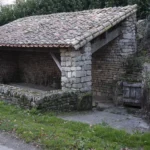
Site du Creux-Bleu et son lavoir – Villecomte
Description
English
Deutsch
Dutch
Español
Italiano
Description
Le Creux Bleu est un site de spéléologie sous-marine… et de pique-nique ! Cette résurgence qui se prolonge par un court canal se jetant dans l'Ignon offre une vision mystérieuse sur une grotte reliée au plus grand réseau souterrain de Bourgogne (Combe aux Prêtres de Francheville). Le creux doit son nom à la rare couleur de l'eau qui provient d'algues microscopiques caractéristiques des eaux souterraines. Le site a été aménagé dès le XIIe siècle par le seigneur Othon de Saulx afin d'alimenter en eau un moulin.
Le lavoir situé sur le canal tout près du pont menant au parking date du XIXe siècle. Il a la particularité de posséder un plancher mobile dont la position s'adapte aux variations du niveau de l'eau.
Les abords aménagés du Creux Bleu en font un agréable lieu de pique-nique. C'est aussi le point de départ d'un sentier balisé de 9,5km, le Sentier du Creux Bleu à Mortière. You will discover a unique natural site “le Creux Bleu” (blue hollow), a high place of the French Resistance and a natural heritage. "le Creux Bleu" comes from a subterranean river from Francheville. The site was fitted out in the 12th century and the hollow was explored for the first time in 1973. This blue color is due to the chemical properties of the stone or to the microscopic blue seaweeds on the rock.
English
The Creux Bleu is a site for underwater caving… and picnics! This resurgence, which is prolonged by a short canal flowing into the Ignon, offers a mysterious view of a cave connected to the largest underground network in Burgundy (Combe aux Prêtres de Francheville). The hollow owes its name to the rare colour of the water which comes from microscopic algae characteristic of underground waters. The site was built in the 12th century by Lord Othon de Saulx to supply water to a mill.
The washhouse located on the canal near the bridge leading to the car park dates from the 19th century. It has the particularity of having a mobile floor whose position adapts to the variations of the water level.
The landscaped surroundings of the Creux Bleu make it a pleasant place to picnic. It is also the starting point of a 9.5km marked trail, the Creux Bleu Trail in Mortière. You will discover a unique natural site "le Creux Bleu" (blue hollow), a high place of the French Resistance and a natural heritage. "le Creux Bleu" comes from a subterranean river from Francheville. The site was fitted out in the 12th century and the hollow was explored for the first time in 1973. This blue color is due to the chemical properties of the stone or to the microscopic blue seaweeds on the rock.
Deutsch
Der Creux Bleu ist ein Ort für Unterwasserhöhlenforschung … und für ein Picknick! Dieser Wiederaustritt, der in einen kurzen Kanal übergeht, der in den Ignon mündet, bietet einen geheimnisvollen Blick auf eine Höhle, die mit dem größten unterirdischen Netz Burgunds (Combe aux Prêtres de Francheville) verbunden ist. Die Höhle verdankt ihren Namen der seltenen Farbe des Wassers, die von mikroskopisch kleinen Algen herrührt, die für das Grundwasser charakteristisch sind. Die Stelle wurde bereits im 12. Jahrhundert vom Herrscher Otto von Saulx angelegt, um eine Mühle mit Wasser zu versorgen.
Das Waschhaus am Kanal in der Nähe der Brücke, die zum Parkplatz führt, stammt aus dem 19. Jahrhundert. Seine Besonderheit ist ein beweglicher Boden, dessen Position sich den Schwankungen des Wasserspiegels anpasst.
Die angelegte Umgebung des Creux Bleu macht ihn zu einem angenehmen Ort für ein Picknick. Er ist auch der Ausgangspunkt für einen 9,5 km langen markierten Wanderweg, den Sentier du Creux Bleu à Mortière. Sie werden eine einzigartige Naturstätte "le Creux Bleu" (blaue Höhle) entdecken, die ein wichtiger Ort des französischen Widerstands und ein Naturerbe ist. der "Creux Bleu" stammt aus einem unterirdischen Fluss in Francheville. Der Ort wurde im 12. Jahrhundert angelegt und der Hohlraum wurde 1973 zum ersten Mal erforscht. Die blaue Farbe ist auf die chemischen Eigenschaften des Steins oder auf die mikroskopisch kleinen blauen Seepocken auf dem Felsen zurückzuführen.
Dutch
De Creux Bleu is een site voor onderwater speleologie… en picknicks! Deze opleving, die wordt verlengd door een kort kanaal dat uitmondt in de Ignon, biedt een mysterieus uitzicht op een grot die verbonden is met het grootste ondergrondse netwerk van Bourgondië (Combe aux Prêtres de Francheville). Het hol dankt zijn naam aan de zeldzame kleur van het water, die afkomstig is van microscopische algen die kenmerkend zijn voor ondergrondse wateren. De site werd in de 12e eeuw gebouwd door Heer Othon de Saulx om water te leveren aan een molen.
Het washuis aan het kanaal bij de brug naar de parkeerplaats dateert uit de 19e eeuw. Het bijzondere is dat het een mobiele vloer heeft waarvan de positie zich aanpast aan schommelingen van het waterpeil.
De aangelegde omgeving van de Creux Bleu maakt het een aangename plek om te picknicken. Het is ook het vertrekpunt van een 9,5 km lang bewegwijzerd pad, het Creux Bleu pad in Mortière. U ontdekt een unieke natuurlijke site "le Creux Bleu" (blauwe holte), een hoogtepunt van het Franse verzet en een natuurlijk erfgoed. "le Creux Bleu" komt van een ondergrondse rivier uit Francheville. De site werd ingericht in de 12e eeuw en de holte werd voor het eerst verkend in 1973. Deze blauwe kleur is te danken aan de chemische eigenschappen van de steen of aan de microscopische blauwe zeewieren op de rots.
Español
El Creux Bleu es un sitio de espeleología submarina… ¡y de picnic! Este resurgimiento, prolongado por un corto canal que desemboca en el Ignon, ofrece una misteriosa vista de una cueva conectada a la mayor red subterránea de Borgoña (Combe aux Prêtres de Francheville). La hondonada debe su nombre al raro color del agua que proviene de las algas microscópicas características de las aguas subterráneas. El lugar fue construido en el siglo XII por el señor Othon de Saulx para abastecer de agua a un molino.
El lavadero situado en el canal, cerca del puente que lleva al aparcamiento, data del siglo XIX. Tiene la particularidad de contar con un suelo móvil cuya posición se adapta a las variaciones del nivel del agua.
El entorno paisajístico del Creux Bleu lo convierte en un lugar agradable para hacer un picnic. También es el punto de partida de un sendero señalizado de 9,5 km, el Sendero de Creux Bleu en Mortière. Descubrirá un paraje natural único, "le Creux Bleu" (la hondonada azul), un alto lugar de la Resistencia francesa y un patrimonio natural. "le Creux Bleu" proviene de un río subterráneo de Francheville. El lugar fue acondicionado en el siglo XII y la hondonada fue explorada por primera vez en 1973. Este color azul se debe a las propiedades químicas de la piedra o a las algas azules microscópicas de la roca.
Italiano
Il Creux Bleu è un sito di speleologia subacquea… e di picnic! Questa risorgenza, prolungata da un breve canale che sfocia nell'Ignon, offre una vista misteriosa su una grotta collegata alla più grande rete sotterranea della Borgogna (Combe aux Prêtres de Francheville). La cavità deve il suo nome al raro colore dell'acqua che deriva da microscopiche alghe caratteristiche delle acque sotterranee. Il sito fu costruito nel XII secolo da Lord Othon de Saulx per fornire acqua a un mulino.
Il lavatoio situato sul canale, vicino al ponte che conduce al parcheggio, risale al XIX secolo. Ha la particolarità di avere un pavimento mobile la cui posizione si adatta alle variazioni del livello dell'acqua.
L'ambiente paesaggistico del Creux Bleu lo rende un luogo piacevole per i picnic. È anche il punto di partenza di un sentiero segnalato di 9,5 km, il Sentiero del Creux Bleu in Mortière. Scoprirete un sito naturale unico, "le Creux Bleu" (la conca blu), un luogo di culto della Resistenza francese e un patrimonio naturale. "Le Creux Bleu" deriva da un fiume sotterraneo della Francheville. Il sito fu attrezzato nel XII secolo e la cavità fu esplorata per la prima volta nel 1973. Questo colore blu è dovuto alle proprietà chimiche della pietra o alle microscopiche alghe blu presenti sulla roccia.
Equipements: Aire de pique-nique - Espace jeux
3, rue du Moulin, 21120 Villecomte