Tour des abbés
Description
English
Deutsch
Dutch
Español
Italiano
Description
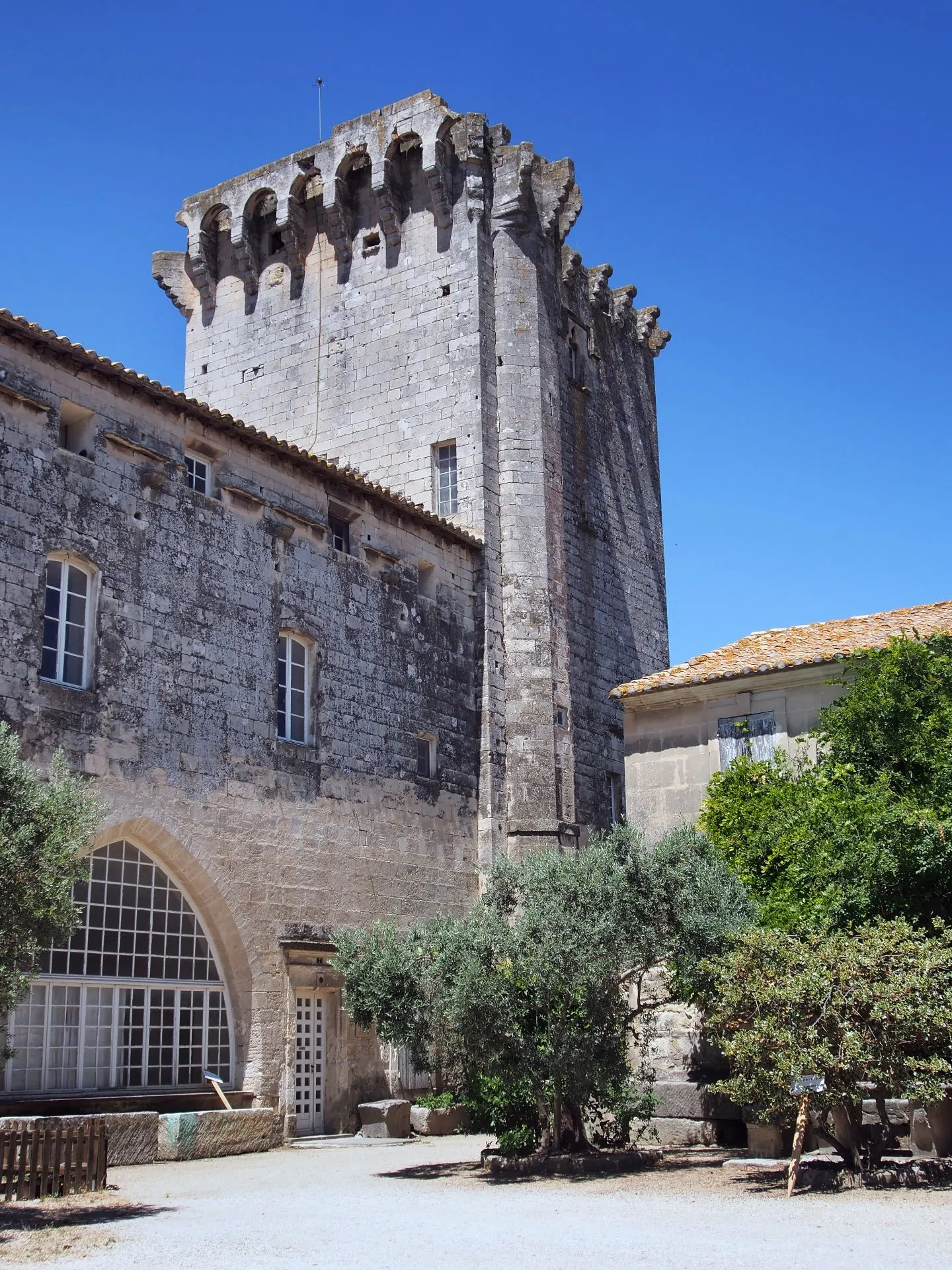
Elle aurait été élevée sur demande de l'abbé de Montmajour, Pierre de Canillac, entre 1348 et 1353. C'est une construction à la fois défensive et résidentielle : si la tour constitue un symbole de pouvoir et de puissance militaire qui a son importance en ces temps de guerre (les XIV° et XV° siècles sont en effet émaillés par une série de conflits, plus connus sous le nom de "Guerre de Cent Ans"), elle est combinée à d'autres constructions abritant le logis seigneurial ainsi qu'une salle d'apparat où l'on rendait la justice.
Les bâtiments qui lui sont accolés datent probablement du XIII°, ils sont néanmoins agrandis et fortifiés durant la seconde moitié du XIV°. Les modifications qu'ils subissent aux XV° et XVI° sont d'ordre mineur (modification des ouvertures…).
Avec la tour de Montmajour, elle fait partie des rares exemples de tours résidentielles pouvant être datées entre 1350 et 1360.Le blason de la famille de Canhilac était un lévrier, lequel figure aujourd'hui dans les armoiries de la ville de Fontvieille.
English
This Tower was erected at the request of the Abbey of Montmajour, Pierre de Canillac, between 1348 and 1353. It is both a defensive and residential construction; although the tower was an important symbol of power and military strength in those times of war (the 14th and 15th centuries were punctuated with a series of conflicts, better known as the Hundred Years' War). It was combined with other constructions which housed the seigniorial residence and a ceremonial room where justice was administered.
The adjoining buildings probably date from the 13th century, but were extended and fortified during the second half of the 14th century. They underwent minor modifications in the 15th and 16th centuries (modifications to the windows, etc.).
Together with Montmajour Tower, it is one of the few examples of residential towers which can be dated to between 1350 and 1360. The crest of the Canhilac family was a greyhound, which now forms part of the coats of arms of the town of Fontvieille.
This site is also used to house temporary exhibitions, primarily by the famous painted Carl Liner.
Deutsch
Sie soll auf Wunsch des Abts von Montmajour, Pierre de Canillac, zwischen 1348 und 1353 erbaut worden sein. Einerseits ein Verteidigungsbau, andererseits zum Wohnen gedacht: der Turm ist zwar ein Symbol der militärischen Macht, was in den damaligen Kriegszeiten (das 14. und 15. Jhd. ist voller Konflikte, besser bekannt unter der Bezeichnung "Hundertjähriger Krieg") wichtig war, er wird auch mit anderen Bauten kombiniert, die die herrschaftliche Wohnung sowie einen Prunksaal, in dem Recht gesprochen wurde, enthielten.
Die angrenzenden Bauten stammen vermutlich aus dem 13. Jhd. und wurden in der zweiten Hälfte de 14. Jhd. vergrößert und verstärkt. Im 15. und 16. Jhd. erfolgten kleinere Umbauten (Änderungen der Öffnungen usw.).
Mit dem Tour de Montmajour gehört sie zu den seltenen Exemplaren von Wohntürmen, die man zwischen 1350 und 1360 datieren kann. Das Wappen der Familie Canhilac war ein Windhund, den man heute in den Wappen der Stadt Fontvieille sehen kann.
Hier finden auch temporäre Ausstellungen statt, vorwiegend zum bekannten Maler Carl LINER.
Dutch
Het werd gebouwd op verzoek van de abt van Montmajour, Pierre de Canillac, tussen 1348 en 1353. Het is zowel een verdedigings- als een woongebouw: als de toren een symbool van macht en militaire kracht is, wat belangrijk is in deze tijden van oorlog (de 14e en 15e eeuw werden inderdaad gekenmerkt door een reeks conflicten, beter bekend als de "Honderdjarige Oorlog"), wordt hij gecombineerd met andere gebouwen waarin de woning van de heer is ondergebracht, evenals een ceremoniële ruimte waar recht werd gesproken.
De aangrenzende gebouwen dateren waarschijnlijk uit de 13e eeuw, maar werden in de tweede helft van de 14e eeuw uitgebreid en versterkt. De wijzigingen die zij in de 15e en 16e eeuw ondergingen waren gering (wijziging van openingen, enz.).
Samen met de toren van Montmajour is het een van de zeldzame voorbeelden van woontorens die tussen 1350 en 1360 gedateerd kunnen worden. Het wapen van de familie Canhilac was een windhond, die nu deel uitmaakt van het wapen van de stad Fontvieille.
Español
Habría sido levantada a petición del abad de Montmajour, Pierre de Canillac, entre 1348 y 1353. Es una construcción a la vez defensiva y residencial: si la torre constituye un símbolo de poder y de potencia militar que tiene su importancia en estos tiempos de guerra (los siglos XIV y XV están efectivamente tocados por una serie de conflictos, más conocidos bajo el nombre de "Guerra de los cien años"), está combinada con otras construcciones que albergan la residencia señorial así como una sala de gala donde se hacía justicia.
Los edificios que están pegados a ella datan probablemente del siglo XIII, sin embargo fueron ampliados y fortificados durante la segunda mitad del siglo XIV. Las modificaciones que sufren en los siglos XV y XVI son de orden menor (modificación de las aberturas, etc.).
Con la torre de Montmajour, forma parte de los pocos ejemplos de torres residenciales que pueden datarse entre 1350 y 1360. El escudo de la familia de Canhilac era un galgo, y este figura actualmente en los escudos de la ciudad de Fontvieille.
Este lugar también está dedicado a exposiciones temporales principalmente dedicadas al famoso pintor Carl LINER.
Italiano
Sarebbe stata eretta su richiesta dell’abate di Montmajour, Pierre de Canillac, tra il 1348 e il 1353. Si tratta di una costruzione difensiva e, nel contempo, residenziale: se la torre costituisce un simbolo di potere e di potenza militare che s'impone per l'importanza assunta in quei tempi di guerra (il XIV e il XV secolo sono, in effetti, intercalati da una serie di conflitti, più noti con il nome di "Guerra dei Cent’anni"), l'edificio stesso è combinato con altre costruzioni che ospitano l’alloggio signorile, nonché una sala di gala dove si amministrava la giustizia.
Gli edifici adiacenti risalgono probabilmente al XIII secolo; furono, tuttavia, ingranditi e fortificati durante la seconda metà del XIV secolo. Le modifiche che subirono nel XV e nel XVI secolo sono di ordine minore (modifica delle aperture…).
Insieme alla torre di Montmajour, appartiene ai rari esempi di torri residenziali che possono essere datate tra il 1350 e il 1360. Il blasone della famiglia di Canhilac era un levriero, il quale appare oggi negli stemmi della città di Fontvieille.
Questo luogo è altresì destinato a mostre temporanee, principalmente dedicate al rinomato pittore Carl LINER.
Gothique
Avenue Frédéric Mistral, 13990 Fontvieille
Crédits: Bureau d'Information Touristique Fontvieille