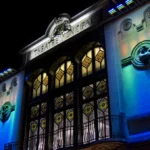
Théâtre de Tulle – Tulle
Description
English
Deutsch
Dutch
Español
Italiano
Description
Inauguré en 1899, le Théâtre de Tulle est un élégant théâtre à l’italienne, typique de la fin du XIXe siècle. Il se distingue par sa façade néoclassique, sobre dans sa composition mais riche dans ses matériaux : un savant mélange de grès local, de briques rouges, de calcaire, de céramiques colorées et de vitraux, qui en fait un exemple rare d’architecture polychrome à Tulle. Cette façade, à la fois symétrique et expressive, reflète les ambitions culturelles de la Troisième République. Véritable prouesse technique pour l’époque, le théâtre fut l’un des premiers en France à être construit en ciment armé, selon les principes innovants de l’architecte Anatole de Baudot. L’intérieur conserve une salle en fer à cheval, avec balcons, loges, plafonds peints et velours rouge, dans une atmosphère chaleureuse et raffinée. Restauré, il accueille tout au long de l’année une programmation culturelle.
English
Inaugurated in 1899, the Théâtre de Tulle is an elegant Italian-style theater, typical of the late 19th century. It is distinguished by its neoclassical facade, sober in composition but rich in materials: a skilful blend of local sandstone, red brick, limestone, colored ceramics and stained glass, making it a rare example of polychrome architecture in Tulle. The symmetrical, expressive façade reflects the cultural ambitions of the Third Republic. A true technical feat for its time, the theater was one of the first in France to be built in reinforced concrete, according to the innovative principles of architect Anatole de Baudot. The interior features a horseshoe-shaped auditorium, with balconies, boxes, painted ceilings and red velvet, in a warm, refined atmosphere. Now restored, it hosts a year-round cultural program.
Deutsch
Das 1899 eröffnete Théâtre de Tulle ist ein elegantes Theater im italienischen Stil, das für das Ende des 19. Jahrhunderts typisch ist. Es zeichnet sich durch seine neoklassizistische Fassade aus, die schlicht in ihrer Komposition, aber reich in ihren Materialien ist: eine geschickte Mischung aus lokalem Sandstein, roten Ziegeln, Kalkstein, bunten Keramiken und Glasfenstern, die es zu einem seltenen Beispiel für mehrfarbige Architektur in Tulle macht. Die symmetrische und zugleich ausdrucksstarke Fassade spiegelt die kulturellen Ambitionen der Dritten Republik wider. Das Theater war für seine Zeit eine technische Meisterleistung und eines der ersten in Frankreich, das nach den innovativen Prinzipien des Architekten Anatole de Baudot aus Stahlzement gebaut wurde. Im Inneren ist ein hufeisenförmiger Saal mit Balkonen, Logen, bemalten Decken und rotem Samt erhalten geblieben, der eine warme und raffinierte Atmosphäre bietet. Nach der Restaurierung findet hier das ganze Jahr über ein kulturelles Programm statt.
Dutch
Het Théâtre de Tulle werd geopend in 1899 en is een elegant theater in Italiaanse stijl, typisch voor het einde van de 19e eeuw. Het onderscheidt zich door zijn neoklassieke gevel, sober in zijn compositie maar rijk in zijn materialen: een kundige mix van lokale zandsteen, rode baksteen, kalksteen, gekleurd keramiek en glas-in-lood, waardoor het een zeldzaam voorbeeld is van polychrome architectuur in Tulle. De gevel is zowel symmetrisch als expressief en weerspiegelt de culturele ambities van de Derde Republiek. Het theater was een echt technisch hoogstandje voor die tijd: het was een van de eerste in Frankrijk dat gebouwd werd in gewapend beton, volgens de innovatieve principes van architect Anatole de Baudot. Het interieur bestaat uit een hoefijzervormig auditorium, met balkons, loges, beschilderde plafonds en rood fluweel, wat een warme, verfijnde sfeer creëert. Nu gerestaureerd, worden er het hele jaar door culturele evenementen georganiseerd.
Español
Inaugurado en 1899, el Théâtre de Tulle es un elegante teatro de estilo italiano, típico de finales del siglo XIX. Se distingue por su fachada neoclásica, sobria en su composición pero rica en sus materiales: una hábil mezcla de arenisca local, ladrillo rojo, piedra caliza, cerámica de colores y vidrieras, que lo convierten en un raro ejemplo de arquitectura policroma en Tulle. La fachada, a la vez simétrica y expresiva, refleja las ambiciones culturales de la Tercera República. Auténtica proeza técnica para su época, el teatro fue uno de los primeros de Francia en construirse en hormigón armado, según los innovadores principios del arquitecto Anatole de Baudot. El interior, con una sala en forma de herradura, balcones, palcos, techos pintados y terciopelo rojo, crea un ambiente cálido y refinado. Actualmente restaurado, acoge un programa de actos culturales durante todo el año.
Italiano
Inaugurato nel 1899, il Théâtre de Tulle è un elegante teatro in stile italiano, tipico della fine del XIX secolo. Si distingue per la sua facciata neoclassica, sobria nella composizione ma ricca nei materiali: una sapiente miscela di arenaria locale, mattoni rossi, pietra calcarea, ceramiche colorate e vetri colorati, che ne fanno un raro esempio di architettura policroma a Tulle. La facciata, simmetrica ed espressiva, riflette le ambizioni culturali della Terza Repubblica. Vera e propria prodezza tecnica per l'epoca, il teatro è stato uno dei primi in Francia a essere costruito in cemento armato, secondo i principi innovativi dell'architetto Anatole de Baudot. L'interno è caratterizzato da una sala a ferro di cavallo, con balconate, palchi, soffitti dipinti e velluto rosso, che creano un'atmosfera calda e raffinata. Ora è stato restaurato e ospita un programma di eventi culturali durante tutto l'anno.
En ville
8 Quai de la République, 19000 Tulle

Crédits: OT Tulle en Corrèze
Licence
Licence