Place de la Comédie – Metz
Description
English
Deutsch
Dutch
Español
Italiano
Description
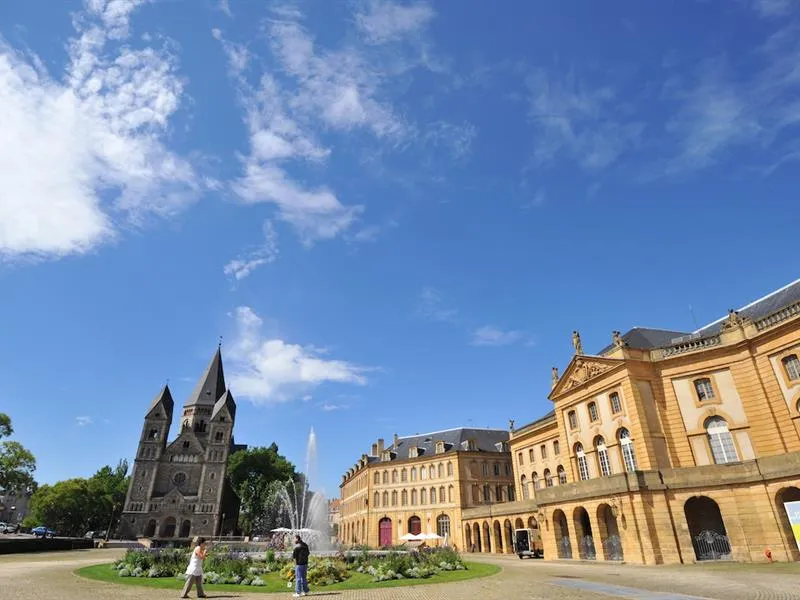
Elégante place classique (1738-52), ordonnée autour de l'Opéra-Théâtre, le plus ancien de France en activité. Le Temple protestant de style néo-roman rhénan a été construit à l'époque de l'annexion allemande, de 1901 à 1904, par l'architecte Wahn, à l'emplacement du jardin d'Amour. Il s'inspire de la cathédrale de Spire. Le soir, le chevet du Temple Neuf, illuminé, vient se refléter dans la Moselle, et est particulièrement romantique.
English
Elegant classical square (1738-52), ordered around the Opera-Theatre, the oldest in France in activity. The Protestant Temple in Rhineland neo-Romanesque style was built at the time of the German annexation, from 1901 to 1904, by the architect Wahn, on the site of the Garden of Love. It was inspired by the cathedral of Speyer. In the evening, the bedside of the Temple Neuf, illuminated, is reflected in the Moselle and is particularly romantic.
Deutsch
Eleganter klassizistischer Platz (1738-52), geordnet um das Opern- und Schauspielhaus, das älteste in Betrieb befindliche Theater Frankreichs. Der protestantische Tempel im rheinischen neuromanischen Stil wurde zur Zeit der deutschen Annexion von 1901 bis 1904 von dem Architekten Wahn an der Stelle des Jardin d'Amour errichtet. Er wurde von der Kathedrale von Speyer inspiriert. Am Abend spiegelt sich der beleuchtete Kopf des Temple Neuf in der Mosel und wirkt besonders romantisch.
Dutch
Elegant klassiek plein (1738-52), gelegen rond het Opera-theater, het oudste nog actieve theater in Frankrijk. De protestantse tempel in neoromaanse stijl werd gebouwd ten tijde van de Duitse annexatie, van 1901 tot 1904, door de architect Wahn, op de plaats van de Tuin der Liefde. Het is geïnspireerd op de kathedraal in Speyer. Het verlichte chevet van de Temple Neuf wordt 's avonds weerspiegeld in de Moezel en is bijzonder romantisch.
Español
Elegante plaza clásica (1738-52), dispuesta alrededor del Teatro de la Ópera, el más antiguo en activo de Francia. El Templo Protestante, de estilo neorrománico, fue construido en la época de la anexión alemana, de 1901 a 1904, por el arquitecto Wahn, en el emplazamiento del Jardín del Amor. Se inspiró en la catedral de Espira. Al anochecer, el chevet iluminado del Temple Neuf se refleja en el Mosela y resulta especialmente romántico.
Italiano
Elegante piazza classica (1738-52), disposta intorno all'Opera-Teatro, il più antico attivo in Francia. Il Tempio protestante, in stile neoromanico, fu costruito al momento dell'annessione tedesca, dal 1901 al 1904, dall'architetto Wahn, sul sito del Giardino dell'Amore. Si ispira alla cattedrale di Spira. Di sera, il chevet illuminato del Temple Neuf si riflette nella Mosella ed è particolarmente romantico.
Classique - Renaissance
Classement: Monument Historique
Place de la Comédie, 57000 Metz
Crédits: Philippe Gisselbrecht / Ville de Metz