Musée rural d'histoire locale
Description
English
Deutsch
Dutch
Español
Italiano
Description
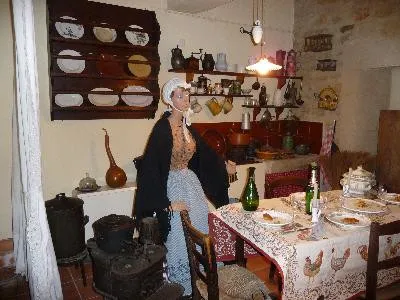
Le musée est situé dans l'ancienne chapelle Saint-Jean. Construite au XVIIème siècle, elle accueillait une confrérie de pénitents blancs. Le musée présente au rez-de-chaussée une collection d'objets et d'outillages de la vie agricole et artisanale traditionnelle et à l'étage une série de 24 ex-votos classés dont le plus ancien remonte à 1676, sur bois et toiles, provenant de la chapelle Notre-Dame de-Consolation et datant des XVIIe XVIIIe et XIXe siècles. Un espace à l'étage est dédié aux expositions temporaires relatives à la vie rurale et artisanale et à la présentation d'oeuvres artistiques.
Le musée met en vente ses publications notamment son dernier ouvrage d'investigation et de recherche sur Jouques paru en 2006 : "Jouques un village, son histoire".
Surface de l'exposition permanente : 105
Surface de l'exposition temporaire : 20
English
The museum is located in the former Saint-Jean chapel. Built in the 17th century, it was home to a brotherhood of white penitents. On the ground floor, the museum presents a collection of objects and tools from traditional agricultural and craft life and on the first floor a series of 24 classified ex-votos, the oldest of which dates back to 1676, on wood and canvas, from the Notre-Dame de-Consolation chapel and dating from the 17th, 18th and 19th centuries. An area on the first floor is dedicated to temporary exhibitions on rural and craft life and the presentation of artistic works.
The museum offers its publications for sale, in particular its latest work of investigation and research on Jouques, published in 2006: "Jouques un village, son histoire" (Jouques a village, its history).
Surface area of the permanent exhibition: 105
Surface area of the temporary exhibition: 20
Deutsch
Das Museum befindet sich in der ehemaligen Kapelle Saint-Jean. Sie wurde im 17. Jahrhundert erbaut und beherbergte eine Bruderschaft der weißen Büßer. Das Museum zeigt im Erdgeschoss eine Sammlung von Gegenständen und Werkzeugen aus dem traditionellen landwirtschaftlichen und handwerklichen Leben und im Obergeschoss eine Reihe von 24 denkmalgeschützten Ex-Votos, von denen das älteste aus dem Jahr 1676 stammt, auf Holz und Leinwand, die aus der Kapelle Notre-Dame de-Consolation stammen und aus dem 17. bis 18. und 19. Ein Raum im Obergeschoss ist für temporäre Ausstellungen über das ländliche Leben und das Handwerk sowie für die Präsentation von künstlerischen Werken vorgesehen.
Das Museum bietet seine Publikationen zum Verkauf an, insbesondere sein letztes Werk über Jouques, das 2006 erschienen ist: "Jouques un village, son histoire" (Jouques ein Dorf, seine Geschichte).
Fläche der Dauerausstellung: 105
Fläche der zeitweiligen Ausstellung: 20
Dutch
Het museum is gevestigd in de voormalige kapel Saint-Jean. Gebouwd in de 17e eeuw, was het de thuisbasis van een broederschap van witte boetelingen. Op de begane grond presenteert het museum een verzameling voorwerpen en werktuigen uit het traditionele landbouw- en ambachtsleven, en op de eerste verdieping een reeks van 24 geclassificeerde ex-voto's, waarvan de oudste dateert uit 1676, op hout en doek, afkomstig uit de kapel Notre-Dame de-Consolation en daterend uit de 17e, 18e en 19e eeuw. Een ruimte op de eerste verdieping is gewijd aan tijdelijke tentoonstellingen over het landelijke en ambachtelijke leven en aan de presentatie van kunstwerken.
Het museum verkoopt zijn publicaties, met name het laatste onderzoekswerk over Jouques, gepubliceerd in 2006: "Jouques un village, son histoire".
Oppervlakte van de permanente tentoonstelling: 105
Oppervlakte van de tijdelijke tentoonstelling : 20
Español
El museo se encuentra en la antigua capilla de Saint-Jean. Construida en el siglo XVII, albergaba una cofradía de penitentes blancos. En la planta baja, el museo presenta una colección de objetos y herramientas de la vida agrícola y artesanal tradicional, y en la primera planta, una serie de 24 exvotos clasificados, el más antiguo de los cuales data de 1676, en madera y lienzo, procedentes de la capilla de Notre-Dame de-Consolation y que datan de los siglos XVII, XVIII y XIX. Un espacio de la primera planta está dedicado a exposiciones temporales relacionadas con la vida rural y artesanal y a la presentación de obras artísticas.
El museo vende sus publicaciones, en particular su último trabajo de investigación y búsqueda sobre Jouques, publicado en 2006: "Jouques un village, son histoire".
Superficie de la exposición permanente: 105
Superficie de la exposición temporal : 20
Italiano
Il museo si trova nell'antica cappella di Saint-Jean. Costruito nel XVII secolo, ospitava una confraternita di penitenti bianchi. Al piano terra, il museo presenta una collezione di oggetti e strumenti della vita agricola e artigianale tradizionale e, al primo piano, una serie di 24 ex voto classificati, il più antico dei quali risale al 1676, su legno e tela, provenienti dalla cappella di Notre-Dame de-Consolation e risalenti ai secoli XVII, XVIII e XIX. Uno spazio al primo piano è dedicato alle mostre temporanee relative alla vita rurale e artigianale e alla presentazione di opere artistiche.
Il museo vende le sue pubblicazioni, in particolare l'ultimo lavoro di indagine e ricerca su Jouques, pubblicato nel 2006: "Jouques un village, son histoire".
Superficie della mostra permanente: 105
Superficie della mostra temporanea: 20
Quartier Historique - En ville
Clientèle: Groupes
Moyens de paiement: Espèce - Chèque
Equipements: Boutique - Parking - Documentation - plan - Parking autocar - Parking à proximité
76 Rue Grande, 13490 Jouques