Les Tours de Castillon – Paradou
Description
English
Deutsch
Dutch
Español
Italiano
Description
On y relève un premier oppidum à l'époque protohistorique suivi par un habitat à la période hellénistique. Les Romains y ont laissé quelques traces avant de le délaisser en partie.
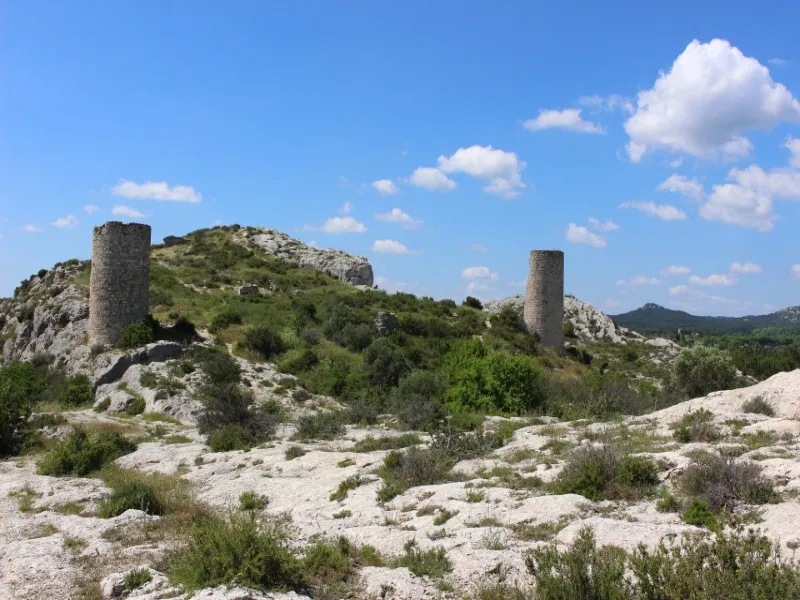
À partir du XIe s. le site acquiert une nouvelle importance quand les Seigneurs des Baux l'intègrent dans le système défensif de leur territoire. Le château s'appuie alors sur 4 tours dont trois restent visibles. Le lieu compte 40 foyers. Le seigneur des Baux y fait élever la chapelle castrale de Ste-Marie-de-Castillon.
Le site sera abandonné au XIVème sans trace de destruction, il servira de " carrière " pour l'extension du village de St-Martin-de-Castillon.
Des éléments de la fouille du site sont à voir dans le hall de la mairie du village.
English
There was an early oppidum in the Protohistoric period, followed by a settlement in the Hellenistic period. The Romans left a few traces here before abandoning it in part.
From the 11th century onwards, the site acquired a new importance when the Lords of Les Baux incorporated it into the defensive system of their territory. The castle was supported by 4 towers, three of which are still visible. There were 40 households. The lord of Les Baux had the castle chapel of Ste-Marie-de-Castillon built there.
The site was abandoned in the 14th century without any trace of destruction, and was used as a ‘quarry’ for the extension of the village of St-Martin-de-Castillon.
Elements of the excavation of the site can be seen in the hall of the village hall.
Deutsch
Es gibt ein erstes Oppidum aus frühgeschichtlicher Zeit, gefolgt von einer Siedlung aus der hellenistischen Zeit. Die Römer hinterließen hier einige Spuren, bevor sie den Ort teilweise wieder verließen.
Ab dem 11. Jh. erlangte der Ort eine neue Bedeutung, als die Herren von Les Baux ihn in das Verteidigungssystem ihres Territoriums einbauten. Die Burg stützte sich damals auf vier Türme, von denen drei noch sichtbar sind. Der Ort zählt 40 Haushalte. Der Herr von Les Baux lässt dort die Burgkapelle Ste-Marie-de-Castillon errichten.
Jahrhundert ohne Spuren der Zerstörung verlassen und als „Steinbruch“ für die Erweiterung des Dorfes St-Martin-de-Castillon genutzt.
Teile der Ausgrabungen sind in der Halle des Rathauses des Dorfes zu sehen.
Dutch
Er was een eerste oppidum in de Protohistorie, gevolgd door een nederzetting in de Hellenistische periode. De Romeinen lieten hier enkele sporen achter voordat ze het gedeeltelijk verlieten.
Vanaf de 11e eeuw kreeg de plek een nieuw belang toen de Heren van Les Baux het opnamen in het verdedigingssysteem van hun grondgebied. Het kasteel werd ondersteund door 4 torens, waarvan er nog drie zichtbaar zijn. Er waren 40 huishoudens. De kasteelheer van Les Baux liet er de kasteelkapel van Ste-Marie-de-Castillon bouwen.
De site werd in de 14e eeuw verlaten zonder enig spoor van vernieling en werd gebruikt als "steengroeve" voor de uitbreiding van het dorp St-Martin-de-Castillon.
Elementen van de opgravingen van de site zijn te zien in de hal van het dorpshuis.
Español
Hubo un primer oppidum en la época protohistórica, seguido de un asentamiento en el periodo helenístico. Los romanos dejaron aquí algunas huellas antes de abandonarlo en parte.
A partir del siglo XI, el lugar adquirió una nueva importancia cuando los señores de Les Baux lo incorporaron al sistema defensivo de su territorio. El castillo estaba sostenido por 4 torres, tres de las cuales aún son visibles. Contaba con 40 casas. El señor de Les Baux hizo construir allí la capilla del castillo de Ste-Marie-de-Castillon.
El emplazamiento fue abandonado en el siglo XIV sin dejar rastro de destrucción, y se utilizó como "cantera" para la ampliación del pueblo de St-Martin-de-Castillon.
En el vestíbulo del ayuntamiento pueden verse elementos de la excavación del yacimiento.
Italiano
Un primo oppidum risale all'epoca protostorica, seguito da un insediamento in epoca ellenistica. I Romani vi lasciarono alcune tracce prima di abbandonarlo in parte.
A partire dall'XI secolo, il sito acquisì una nuova importanza quando i signori di Les Baux lo incorporarono nel sistema difensivo del loro territorio. Il castello era sostenuto da 4 torri, tre delle quali sono ancora visibili. Vi erano 40 famiglie. Il signore di Les Baux vi fece costruire la cappella del castello di Ste-Marie-de-Castillon.
Il sito fu abbandonato nel XIV secolo senza alcuna traccia di distruzione e fu utilizzato come "cava" per l'ampliamento del villaggio di St-Martin-de-Castillon.
Elementi dello scavo del sito sono visibili nella sala del municipio.
, 13520 Paradou
Crédits: Mairie de Paradou