Le Cateau Military Cemetery – Le Cateau-Cambrésis
Description
English
Deutsch
Dutch
Español
Italiano
Description
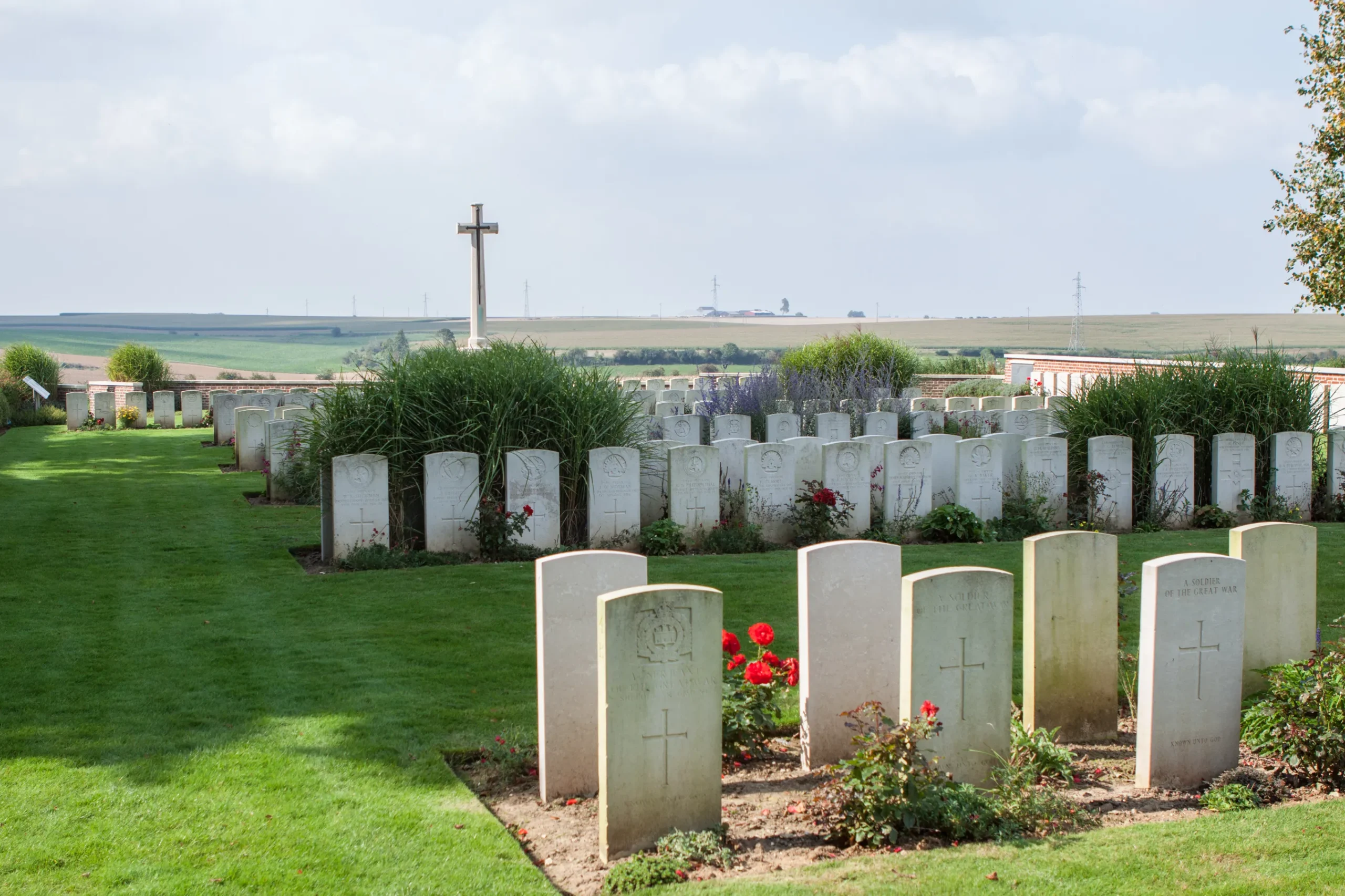
Le cimetière militaire a été implanté en février 1916, sur des parcelles de terrain séparées pour les soldats du Commonwealth et les morts allemands. Les parcelles de terrain de Commonwealth ont été conçues par Charles Holden. Soumise dès lors à l’occupation, Le Cateau devient pour les Allemands un important centre logistique et hospitalier, non loin du front. Ils créent un cimetière militaire pour inhumer leurs soldats tués lors de la prise de la cité et ceux qui, dans les hôpitaux de la ville, décèdent des suites de leurs blessures. Et, pour inhumer les restes de soldats britanniques tombés lors de cette bataille du Cateau, ils aménagent un carré dans le cimetière communal. Placé aujourd’hui sous la responsabilité de la Commonwealth War Graves Commission, Le Cateau Communal Cemetery abrite les tombes de 150 soldats. La capacité de ce carré étant limitée, les Allemands décident en 1916 d’ouvrir, dans leur propre cimetière, un espace destiné à enterrer les dépouilles des militaires britanniques retrouvées dans les environs. Devenu Le Cateau Military Cemetery, il abrite 698 tombes de soldats du Commonwealth dont certains ont été enterrés là après la reprise de la cité par les Ecossais, en octobre 1918. Quant à la partie allemande, elle a été agrandie après l’Armistice afin d’accueillir les corps de soldats venant de 53 lieux d’inhumation du secteur. Depuis, 5 381 soldats allemands reposent dans cette nécropole aux côtés de 34 prisonniers de guerre russes. Un mémorial en forme de pyramide y est érigé, « à la mémoire des braves soldats français et allemands morts pour leur patrie 1914-1918 ». Il y a également 11 soldats Français, inhumés dans une tombe commune, située dans l’ossuaire allemand. Ils ont été tués entre le 6 et le 26 octobre 1918.
Sources : http://www.cheminsdememoire-nordpasdecalais.fr/ Le Cateau and the country to the west were the scene of the battle fought by II Corps on 26 August 1914 against a greatly superior German force. The town remained in German hands from that date until the evening of 10 October 1918, when it was rushed by the 5th Connaught Rangers, but not cleared until a week later. Le Cateau had been a German railhead and an important hospital centre, and the military cemetery was laid out in February 1916, with separate plots for the Commonwealth and German dead. It contains the graves of over 5,000 German soldiers, in part burials made during the occupation, the rest brought in from other German cemeteries after the Armistice. A separate plot contains the graves of 34 Russian prisoners of war. The Commonwealth plots contain 698 burials and commemorations of the First World War. 187 of the burials are unidentified but there are special memorials to 20 casualties known or believed to be buried among them. The majority of the graves in Plots I, III, IV and V are those of Commonwealth dead buried by the Germans, mainly from the battleground of 1914. All of the graves in Plot II, eight of which were brought in after the Armistice, date from October and November 1918. Plot III also contains two German graves. The Commonwealth plots were designed by Charles Holden.
www.cwgc.org/
English
The military cemetery was established in February 1916, on separate plots for Commonwealth soldiers and the German dead. The Commonwealth plots were designed by Charles Holden. Under occupation, Le Cateau became an important logistical and hospital center for the Germans, not far from the front. They created a military cemetery to bury their soldiers killed during the capture of the town and those who died in the town?s hospitals from their wounds. And to bury the remains of British soldiers who fell in the battle of Le Cateau, they set up a plot in the communal cemetery. Today under the responsibility of the Commonwealth War Graves Commission, Le Cateau Communal Cemetery contains the graves of 150 soldiers. As the capacity of this cemetery was limited, the Germans decided in 1916 to open a space in their own cemetery to bury the remains of British servicemen found in the area. Now known as Le Cateau Military Cemetery, it contains 698 graves of Commonwealth soldiers, some of whom were buried there after the city was retaken by the Scots in October 1918. The German section was enlarged after the Armistice to accommodate the bodies of soldiers from 53 burial sites in the area. Since then, 5,381 German soldiers have been laid to rest here, alongside 34 Russian POWs. A pyramid-shaped memorial has been erected here, "in memory of the brave French and German soldiers who died for their country 1914-1918". There are also 11 French soldiers, buried in a common grave in the German ossuary. They were killed between October 6 and 26, 1918.
Sources: http://www.cheminsdememoire-nordpasdecalais.fr/ Le Cateau and the country to the west were the scene of the battle fought by II Corps on 26 August 1914 against a greatly superior German force. The town remained in German hands from that date until the evening of 10 October 1918, when it was rushed by the 5th Connaught Rangers, but not cleared until a week later. Le Cateau had been a German railhead and an important hospital center, and the military cemetery was laid out in February 1916, with separate plots for the Commonwealth and German dead. It contains the graves of over 5,000 German soldiers, in part burials made during the occupation, the rest brought in from other German cemeteries after the Armistice. A separate plot contains the graves of 34 Russian prisoners of war. The Commonwealth plots contain 698 burials and commemorations of the First World War. 187 of the burials are unidentified but there are special memorials to 20 casualties known or believed to be buried among them. The majority of the graves in Plots I, III, IV and V are those of Commonwealth dead buried by the Germans, mainly from the battleground of 1914. All of the graves in Plot II, eight of which were brought in after the Armistice, date from October and November 1918. Plot III also contains two German graves. The Commonwealth plots were designed by Charles Holden.
www.cwgc.org/
Deutsch
Der Militärfriedhof wurde im Februar 1916 auf getrennten Parzellen für Commonwealth-Soldaten und deutsche Gefallene angelegt. Die Commonwealth-Grundstücke wurden von Charles Holden entworfen. Le Cateau unterlag von da an der Besatzung und wurde für die Deutschen zu einem wichtigen Logistik- und Krankenhauszentrum unweit der Front. Sie legten einen Militärfriedhof an, um ihre Soldaten zu bestatten, die bei der Eroberung der Stadt getötet wurden und die in den Krankenhäusern der Stadt an den Folgen ihrer Verletzungen starben. Um die sterblichen Überreste der britischen Soldaten, die in der Schlacht von Le Cateau gefallen waren, zu beerdigen, richteten sie ein Grabfeld auf dem Gemeindefriedhof ein. Der Cateau Communal Cemetery, der heute von der Commonwealth War Graves Commission verwaltet wird, beherbergt die Gräber von 150 Soldaten. Da die Kapazität des Friedhofs begrenzt war, beschlossen die Deutschen 1916, auf ihrem eigenen Friedhof einen Bereich für die Bestattung von britischen Soldaten einzurichten, die in der Umgebung gefunden wurden. Der Le Cateau Military Cemetery beherbergt 698 Gräber von Soldaten des Commonwealth, von denen einige nach der Rückeroberung der Stadt durch die Schotten im Oktober 1918 dort beerdigt wurden. Der deutsche Teil des Friedhofs wurde nach dem Waffenstillstand erweitert, um die Leichen von Soldaten aus 53 verschiedenen Orten in der Umgebung aufnehmen zu können. Seitdem liegen 5.381 deutsche Soldaten neben 34 russischen Kriegsgefangenen in der Nekropole. Hier wurde ein pyramidenförmiges Denkmal errichtet, "zum Gedenken an die tapferen französischen und deutschen Soldaten, die für ihr Vaterland 1914-1918 starben". Es gibt auch 11 französische Soldaten, die in einem Gemeinschaftsgrab im deutschen Beinhaus beigesetzt wurden. Sie wurden zwischen dem 6. und 26. Oktober 1918 getötet.
Quellen: http://www.cheminsdememoire-nordpasdecalais.fr/ Le Cateau und das Land im Westen waren der Schauplatz der Schlacht, die am 26. August 1914 vom II. Korps gegen eine weit überlegene deutsche Streitmacht geschlagen wurde. Die Stadt blieb von diesem Zeitpunkt an bis zum Abend des 10. Oktober 1918 in deutscher Hand, als sie von den 5th Connaught Rangers durchsucht, aber erst eine Woche später geräumt wurde. Le Cateau war ein deutscher Eisenbahnknotenpunkt und ein wichtiges Krankenhaus gewesen, und der Soldatenfriedhof wurde im Februar 1916 angelegt, mit separaten Plots für die Commonwealth-Leute und die deutschen Toten. Er enthält die Gräber von über 5.000 deutschen Soldaten, zum Teil während der Besetzung vorgenommene Bestattungen, der Rest wurde nach dem Waffenstillstand von anderen deutschen Friedhöfen herangeführt. Ein separater Plot enthält die Gräber von 34 russischen Kriegsgefangenen. The Commonwealth plots contain 698 Burials and Commemorations of the First World War. 187 der Burials sind unidentifiziert, aber es gibt spezielle Gedenkstätten für 20 Opfer, die unter ihnen bekannt oder believed to be buried. Die meisten Gräber in den Plots I, III, IV und V gehören zu den von den Deutschen beigesetzten Toten aus dem Commonwealth, vor allem aus dem Schlachtfeld von 1914. Alle Gräber in Plot II, von denen acht nach dem Waffenstillstand eingebracht wurden, stammen aus den Monaten Oktober und November 1918. Plot III enthält auch zwei deutsche Grabsteine. Die Commonwealth-Plots wurden von Charles Holden entworfen.
www.cwgc.org/
Dutch
De militaire begraafplaats werd in februari 1916 aangelegd met aparte percelen voor soldaten uit het Gemenebest en Duitse doden. De Commonwealth plots werden ontworpen door Charles Holden. Tijdens de bezetting werd Le Cateau een belangrijk logistiek en hospitaalcentrum voor de Duitsers, niet ver van het front. Ze richtten een militaire begraafplaats in om hun soldaten te begraven die sneuvelden tijdens de inname van de stad en diegenen die stierven in de ziekenhuizen van de stad als gevolg van hun verwondingen. En om de stoffelijke resten van de Britse soldaten die sneuvelden in de slag om Le Cateau te begraven, richtten ze een perceel in op de gemeentelijke begraafplaats. Vandaag de dag bevat de gemeentelijke begraafplaats van Le Cateau, onder de verantwoordelijkheid van de Commonwealth War Graves Commission, de graven van 150 soldaten. Omdat de capaciteit van deze begraafplaats beperkt was, besloten de Duitsers in 1916 om een ruimte te openen op hun eigen begraafplaats om de stoffelijke resten van Britse soldaten te begraven die in het gebied gevonden waren. Nu ligt hier de militaire begraafplaats Le Cateau met 698 graven van soldaten uit het Gemenebest. Sommigen van hen werden hier begraven nadat de stad in oktober 1918 door de Schotten werd heroverd. Het Duitse gedeelte werd na de wapenstilstand uitgebreid om de lichamen van soldaten van 53 begraafplaatsen in de omgeving te herbergen. Sindsdien zijn hier 5.381 Duitse soldaten begraven, samen met 34 Russische krijgsgevangenen. Er is een gedenkteken in de vorm van een piramide opgericht "ter nagedachtenis aan de dappere Franse en Duitse soldaten die stierven voor hun land 1914-1918". Er liggen ook 11 Franse soldaten begraven in een gemeenschappelijk graf in het Duitse ossuarium. Ze werden gedood tussen 6 en 26 oktober 1918.
Bronnen: http://www.cheminsdememoire-nordpasdecalais.fr/ Le Cateau en het land ten westen ervan waren het toneel van de strijd die het IIe Korps op 26 augustus 1914 leverde tegen een sterk overmachtige Duitse troepenmacht. De stad bleef vanaf die datum in Duitse handen tot de avond van 10 oktober 1918, toen het werd aangevallen door de 5th Connaught Rangers, maar pas een week later werd ontruimd. Le Cateau was een Duits spoorweghoofdkwartier en een belangrijk hospitaalcentrum. De militaire begraafplaats werd in februari 1916 aangelegd met aparte percelen voor de doden van het Gemenebest en de Duitse doden. Ze bevat de graven van meer dan 5.000 Duitse soldaten, deels begravingen tijdens de bezetting, de rest kwam van andere Duitse begraafplaatsen na de wapenstilstand. Een apart perceel bevat de graven van 34 Russische krijgsgevangenen. De Commonwealth plots bevatten 698 graven en herdenkingen uit de Eerste Wereldoorlog. 187 van de graven zijn niet geïdentificeerd, maar er zijn speciale gedenktekens voor 20 slachtoffers van wie bekend is of vermoed wordt dat ze onder hen begraven liggen. De meeste graven in Plot I, III, IV en V zijn die van doden uit het Gemenebest die door de Duitsers begraven werden, voornamelijk van het slagveld van 1914. Alle graven in perceel II, waarvan er acht na de wapenstilstand werden bijgezet, dateren uit oktober en november 1918. Plot III bevat ook twee Duitse graven. De Commonwealth plots werden ontworpen door Charles Holden.
www.cwgc.org/
Español
El cementerio militar se estableció en febrero de 1916, con parcelas separadas para los soldados de la Commonwealth y los muertos alemanes. Las parcelas de la Commonwealth fueron diseñadas por Charles Holden. Bajo la ocupación, Le Cateau se convirtió en un importante centro logístico y hospitalario para los alemanes, no muy lejos del frente. Crearon un cementerio militar para enterrar a sus soldados muertos durante la toma de la ciudad y a los que fallecieron en los hospitales de la ciudad a consecuencia de sus heridas. Y para enterrar los restos de los soldados británicos caídos en la batalla de Le Cateau, crearon una parcela en el cementerio municipal. Hoy en día, bajo la responsabilidad de la Comisión de Tumbas de Guerra de la Commonwealth, el cementerio municipal de Le Cateau contiene las tumbas de 150 soldados. Como la capacidad de este cementerio era limitada, los alemanes decidieron en 1916 abrir un espacio en su propio cementerio para enterrar los restos de los soldados británicos encontrados en la zona. El actual cementerio militar de Le Cateau contiene 698 tumbas de soldados de la Commonwealth, algunos de los cuales fueron enterrados allí tras la retoma de la ciudad por los escoceses en octubre de 1918. La sección alemana se amplió tras el Armisticio para albergar los cuerpos de los soldados de 53 cementerios de la zona. Desde entonces, han descansado aquí 5.381 soldados alemanes y 34 prisioneros de guerra rusos. Se ha erigido un monumento en forma de pirámide "en memoria de los valientes soldados franceses y alemanes que murieron por su país en 1914-1918". También hay 11 soldados franceses enterrados en una fosa común en el osario alemán. Murieron entre el 6 y el 26 de octubre de 1918.
Fuentes: http://www.cheminsdememoire-nordpasdecalais.fr/ Le Cateau y el país al oeste fueron el escenario de la batalla librada por el II Cuerpo el 26 de agosto de 1914 contra una fuerza alemana muy superior. La ciudad permaneció en manos alemanas desde esa fecha hasta la noche del 10 de octubre de 1918, cuando fue tomada por el 5º Connaught Rangers, pero no fue despejada hasta una semana más tarde. Le Cateau había sido una cabeza de ferrocarril alemana y un importante centro hospitalario, y el cementerio militar se construyó en febrero de 1916, con parcelas separadas para los muertos de la Commonwealth y los alemanes. Contiene las tumbas de más de 5.000 soldados alemanes, en parte enterramientos realizados durante la ocupación y el resto traídos de otros cementerios alemanes tras el Armisticio. Una parcela separada contiene las tumbas de 34 prisioneros de guerra rusos. Las parcelas de la Commonwealth contienen 698 entierros y conmemoraciones de la Primera Guerra Mundial. 187 de los entierros no están identificados, pero hay monumentos conmemorativos especiales para 20 bajas que se sabe o se cree que están enterradas entre ellos. La mayoría de las tumbas de las Parcelas I, III, IV y V son de muertos de la Commonwealth enterrados por los alemanes, principalmente del campo de batalla de 1914. Todas las tumbas de la parcela II, ocho de las cuales fueron traídas después del armisticio, datan de octubre y noviembre de 1918. La parcela III también contiene dos tumbas alemanas. Las parcelas de la Commonwealth fueron diseñadas por Charles Holden.
www.cwgc.org/
Italiano
Il cimitero militare fu istituito nel febbraio 1916, con lotti separati per i soldati del Commonwealth e per i morti tedeschi. I lotti del Commonwealth furono progettati da Charles Holden. Durante l'occupazione, Le Cateau divenne un importante centro logistico e ospedaliero per i tedeschi, non lontano dal fronte. Essi crearono un cimitero militare per seppellire i loro soldati uccisi durante la cattura della città e quelli che morirono negli ospedali della città a causa delle loro ferite. E per seppellire i resti dei soldati britannici caduti nella battaglia di Le Cateau, crearono un lotto nel cimitero comunale. Oggi, sotto la responsabilità della Commonwealth War Graves Commission, il cimitero comunale di Le Cateau contiene le tombe di 150 soldati. Poiché la capacità di questo cimitero era limitata, nel 1916 i tedeschi decisero di aprire uno spazio nel loro cimitero per seppellire i resti dei soldati britannici trovati nella zona. Oggi il cimitero militare di Le Cateau contiene 698 tombe di soldati del Commonwealth, alcuni dei quali furono sepolti qui dopo la riconquista della città da parte degli scozzesi nell'ottobre 1918. La sezione tedesca fu ampliata dopo l'Armistizio per accogliere i corpi dei soldati provenienti da 53 luoghi di sepoltura della zona. Da allora, qui hanno riposato 5.381 soldati tedeschi e 34 prigionieri di guerra russi. Vi è stato eretto un monumento a forma di piramide, "in memoria dei coraggiosi soldati francesi e tedeschi morti per il loro Paese nel 1914-1918". Ci sono anche 11 soldati francesi sepolti in una tomba comune nell'ossario tedesco. Sono stati uccisi tra il 6 e il 26 ottobre 1918.
Fonti: http://www.cheminsdememoire-nordpasdecalais.fr/ Le Cateau e il paese a ovest furono teatro della battaglia combattuta dal II Corpo il 26 agosto 1914 contro una forza tedesca nettamente superiore. La città rimase in mano tedesca da quella data fino alla sera del 10 ottobre 1918, quando fu conquistata dal 5° Connaught Rangers, ma fu sgomberata solo una settimana dopo. Le Cateau era stata una stazione ferroviaria tedesca e un importante centro ospedaliero; il cimitero militare fu allestito nel febbraio 1916, con lotti separati per i morti del Commonwealth e per quelli tedeschi. Contiene le tombe di oltre 5.000 soldati tedeschi, in parte inumati durante l'occupazione e in parte portati da altri cimiteri tedeschi dopo l'armistizio. Un lotto separato contiene le tombe di 34 prigionieri di guerra russi. I lotti del Commonwealth contengono 698 sepolture e commemorazioni della Prima Guerra Mondiale. 187 delle sepolture non sono state identificate, ma ci sono memoriali speciali per 20 caduti di cui si sa o si crede che siano sepolti tra loro. La maggior parte delle tombe nelle parcelle I, III, IV e V è costituita da morti del Commonwealth sepolti dai tedeschi, principalmente dai campi di battaglia del 1914. Tutte le tombe del lotto II, otto delle quali sono state portate dopo l'armistizio, risalgono all'ottobre e al novembre 1918. Anche il lotto III contiene due tombe tedesche. I lotti del Commonwealth sono stati progettati da Charles Holden.
www.cwgc.org/
D932, 59360 Le Cateau-Cambrésis