Eglise Sainte-Foy – Sainte-Foy
Description
English
Deutsch
Dutch
Español
Italiano
Description
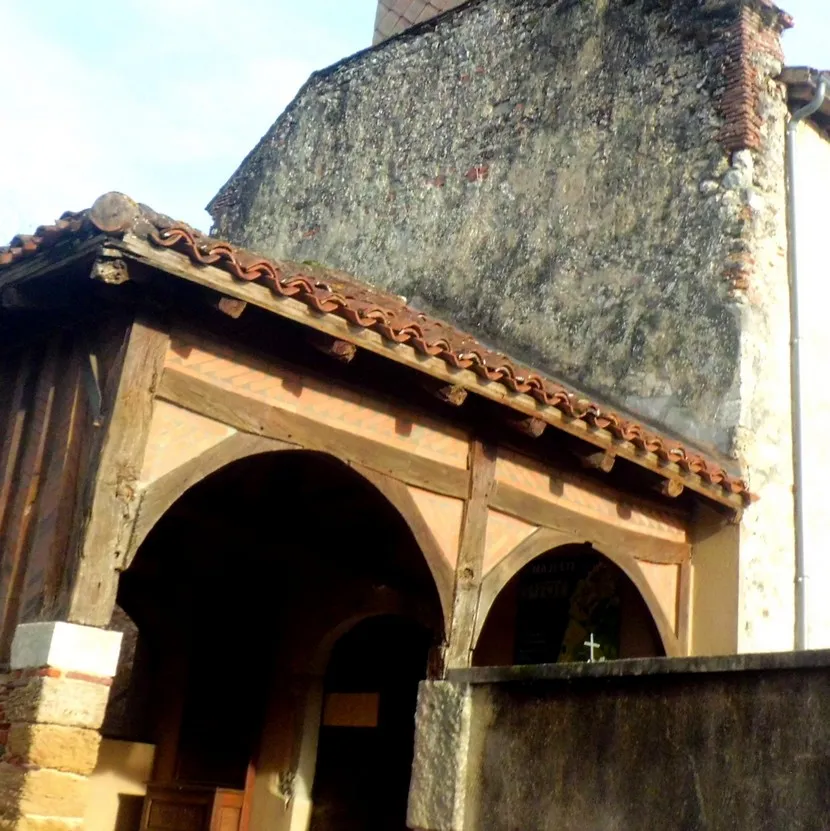
A Sainte Foy, au cœur du bourg non loin de l’étang classé, se dresse l’église. Construite au 11e, elle conserve les caractéristiques des églises romanes du Marsan : un chevet plat voûté en berceau associé à une nef plus large et haute, mais seulement charpentée.
A l’époque moderne, un mur de séparation vient transformer le chevet en sacristie, le maître autel prenant place dans une niche. Les baies sont élargies et deux piliers sont bâtis pour soutenir la tribune et un petit clocher. A l’intérieur des éléments du décor rappellent le martyre de Sainte Foy, patronne de l’église. Autre élément remarquable : le tabernacle et son Eche Homo. Sous le pittoresque porche en colombages a pris place le Monument aux Morts. Ce grand bas-relief de bois ciré représente la République, coiffée d’un bonnet phrygien. A proximité, la source Sainte Quitterie guérissait les maux de tête.
English
In Sainte Foy, in the heart of the village not far from the listed pond, stands the church. Built in the 11th century, it retains the characteristics of the Romanesque churches of Marsan: a flat chevet with barrel vaulting associated with a wider and higher nave, but only carpentry.
In modern times, a dividing wall transforms the chevet into a sacristy, with the high altar taking its place in a niche. The bays are widened and two pillars are built to support the tribune and a small bell tower. Inside, elements of the decoration recall the martyrdom of Saint Foy, patron saint of the church. Another remarkable element is the tabernacle and its Eche Homo. Under the picturesque half-timbered porch the Monument to the Dead has taken place. This large bas-relief of waxed wood represents the Republic, wearing a Phrygian cap. Nearby, the Sainte Quitterie spring cured headaches.
Deutsch
In Sainte Foy, im Herzen des Ortes unweit des unter Naturschutz stehenden Teichs, steht die Kirche. Sie wurde im 11. Jahrhundert erbaut und weist die typischen Merkmale der romanischen Kirchen im Marsan-Gebiet auf: ein flaches, tonnengewölbtes Kopfende und ein breiteres, hohes, aber nur gezimmertes Kirchenschiff.
In der Neuzeit wurde der Kopfteil durch eine Trennwand in eine Sakristei umgewandelt, wobei der Hauptaltar in einer Nische Platz fand. Die Fenster wurden verbreitert und zwei Säulen errichtet, um die Tribüne und einen kleinen Glockenturm zu stützen. Im Inneren der Kirche erinnern Elemente des Dekors an das Martyrium der Heiligen Foy, der Schutzpatronin der Kirche. Ein weiteres bemerkenswertes Element ist der Tabernakel mit seinem Eche Homo. Unter dem malerischen Vorbau aus Fachwerk hat das Kriegerdenkmal seinen Platz gefunden. Dieses große Basrelief aus gewachstem Holz stellt d
Dutch
In Sainte Foy, in het hart van het dorp niet ver van de geklasseerde vijver, staat de kerk. Gebouwd in de 11e eeuw, behoudt het de kenmerken van de Romaanse kerken van Marsan: een plat tongewelf in combinatie met een breder en hoger schip, maar alleen timmerwerk.
In de moderne tijd verandert een scheidingswand het chevet in een sacristie, met het hoofdaltaar in een nis. De traveeën werden verbreed en er werden twee pilaren gebouwd ter ondersteuning van de galerij en een kleine klokkentoren. Binnen herinneren elementen van de decoratie aan het martelaarschap van de heilige Foy, patroonheilige van de kerk. Een ander opmerkelijk element is het tabernakel en zijn Eche Homo. Onder het schilderachtige vakwerkportaal staat het Oorlogsmonument. Dit grote bas-reliëf van gewaxt hout stelt de Republiek voor, met een Frygische kap. Vlakbij genas de Sainte Quitterie bron hoofdpijn.
Español
En Sainte Foy, en el corazón del pueblo, no lejos del estanque protegido, se encuentra la iglesia. Construida en el siglo XI, conserva las características de las iglesias románicas de Marsan: una cabecera plana con bóveda de cañón asociada a una nave más ancha y alta, pero sólo de carpintería.
En los tiempos modernos, una pared divisoria transforma la cabecera en una sacristía, con el altar mayor en un nicho. Se ampliaron los tramos y se construyeron dos pilares para sostener la galería y un pequeño campanario. En el interior, los elementos de la decoración recuerdan el martirio de Santa Foy, patrona de la iglesia. Otro elemento destacable es el tabernáculo y su Eche Homo. Bajo el pintoresco pórtico de entramado de madera se encuentra el Monumento a la Guerra. Este gran bajorrelieve de madera encerada representa a la República, con un gorro frigio. Cerca de allí, el manantial de Sainte
Italiano
A Sainte Foy, nel cuore del villaggio, non lontano dallo stagno, si trova la chiesa. Costruita nell'XI secolo, conserva le caratteristiche delle chiese romaniche di Marsan: una volta a botte piatta associata a una navata più ampia e più alta, ma solo in carpenteria.
In epoca moderna, una parete divisoria trasforma il chevet in una sacrestia, con l'altare maggiore collocato in una nicchia. Le campate furono allargate e furono costruiti due pilastri per sostenere la galleria e un piccolo campanile. All'interno, alcuni elementi della decorazione ricordano il martirio di San Foy, patrono della chiesa. Un altro elemento notevole è il tabernacolo e il suo Eche Homo. Sotto il pittoresco portico a graticcio si trova il monumento ai caduti. Questo grande bassorilievo in legno cerato rappresenta la Repubblica, che indossa un berretto frigio. Nelle vicinanze, la sorgente Sainte Quitterie curava il mal di testa.