ÉGLISE SAINTE-COLOMBE DE BUCHEY – Rizaucourt-Buchey
Description
English
Deutsch
Dutch
Español
Italiano
Description
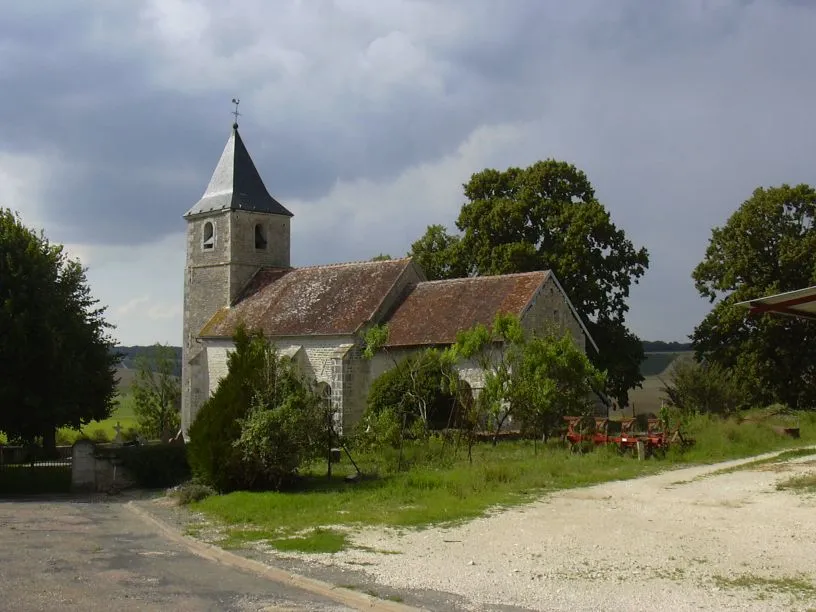
L’église est construite selon un plan allongé de trois travées voûté d'arêtes.
Le chœur, du 12e siècle, est à chevet plat flanqué d'une sacristie au nord. La nef, recontruite au début du 19e siècle, est percée de six baies en plein cintre, le sanctuaire comporte deux baies. Le clocher, luis aussi reconstruit au début du 19e siècle, est couvert en alors que ce sont des tuiles plates qui ont été utilisées pour la nef et le chœur.
A noter que le clocher ayant subi un incendie à la fin du 19e siècle, certains éléments de sa reconstruction sont encore visibles.
English
The church is built on an elongated three-bay plan with cross vaulting.
The 12th-century choir has a flat chevet flanked by a sacristy to the north. The nave, rebuilt in the early 19th century, is pierced by six round-arched bays, while the sanctuary has two bays. The belfry, also rebuilt in the early 19th century, is covered in plain tiles, whereas the nave and choir were covered in flat tiles.
It should be noted that the bell tower suffered a fire at the end of the 19th century, and certain elements of its reconstruction are still visible.
Deutsch
Die Kirche hat einen langgestreckten Grundriss mit drei Jochen und Kreuzgewölbe.
Der Chor aus dem 12. Jahrhundert hat ein flaches Kopfende, das im Norden von einer Sakristei flankiert wird. Das Anfang des 19. Jahrhunderts umgebaute Kirchenschiff hat sechs Rundbogenöffnungen, das Sanktuarium zwei Öffnungen. Der Glockenturm, der ebenfalls Anfang des 19. Jahrhunderts wieder aufgebaut wurde, ist mit Dachziegeln gedeckt, während für das Kirchenschiff und den Chor flache Dachziegel verwendet wurden.
Da der Glockenturm Ende des 19. Jahrhunderts einem Brand zum Opfer fiel, sind einige Elemente des Wiederaufbaus noch sichtbar.
Dutch
De kerk is gebouwd op een langwerpige plattegrond met drie traveeën met kruisgewelven.
Het 12e-eeuwse koor heeft een plat gewelf geflankeerd door een sacristie aan de noordkant. Het schip, herbouwd in het begin van de 19e eeuw, heeft zes rondboogvensters en het heiligdom heeft twee vensters. De klokkentoren, ook herbouwd in het begin van de 19e eeuw, is bedekt met leem, terwijl voor het schip en het koor platte tegels werden gebruikt.
De klokkentoren werd aan het eind van de 19e eeuw door brand getroffen en bepaalde elementen van de reconstructie zijn nog steeds zichtbaar.
Español
La iglesia es de planta alargada con tres tramos de bóveda de crucería.
El coro, del siglo XII, tiene una cabecera plana flanqueada por una sacristía al norte. La nave, reconstruida a principios del siglo XIX, tiene seis ventanas de arco de medio punto, y el presbiterio, dos ventanas. El campanario, también reconstruido a principios del siglo XIX, está cubierto de arcilla, mientras que en la nave y el coro se utilizaron tejas planas.
Cabe señalar que el campanario sufrió un incendio a finales del siglo XIX, y algunos elementos de su reconstrucción aún son visibles.
Italiano
La chiesa è costruita su una pianta allungata con tre campate a crociera.
Il coro, risalente al XII secolo, ha una volta piatta ed è affiancato da una sacrestia a nord. La navata, ricostruita all'inizio del XIX secolo, presenta sei finestre ad arco a tutto sesto, mentre il santuario ha due finestre. Il campanile, anch'esso ricostruito all'inizio del XIX secolo, è rivestito di argilla, mentre per la navata e il coro sono state utilizzate tegole piatte.
Va notato che il campanile subì un incendio alla fine del XIX secolo e alcuni elementi della sua ricostruzione sono ancora visibili.
, 52330 Rizaucourt-Buchey
Crédits: <table style="margin: 1.5em auto; width:60%; background-color:#CCCCCC; border:2px solid #aaaaaa; padding:1px;" cellspacing="10"> <tbody><tr>
<td><i><a href="https://upload.wikimedia.org/wikipedia/commons/5/5c/%C3%89glise_Sainte-Colombe_de_Rizaucourt-Buchey_-_1.jpg" class="internal" title="Église Sainte-Colombe de Rizaucourt-Buchey - 1.jpg"><b>This illustration</b></a> <b>was made by</b> </i><b><a href="//commons.wikimedia.org/wiki/User:Peter17" title="User:Peter17">Peter Potrowl</a></b><i>.</i>
<p>Please credit this with : <b>© Peter Potrowl</b> in the immediate vicinity of the image. A link to my website <a rel="nofollow" class="external text" href="https://www.sitemai.eu">sitemai.eu</a> would be much appreciated but isn't mandatory.
</p><p>An email to
<span typeof="mw:File"><a href="//commons.wikimedia.org/wiki/File:UserIconMail.svg" class="mw-file-description"><img src="https://upload.wikimedia.org/wikipedia/commons/thumb/e/ea/UserIconMail.svg/24px-UserIconMail.svg.png" decoding="async" width="24" height="24" class="mw-file-element" srcset="https://upload.wikimedia.org/wikipedia/commons/thumb/e/ea/UserIconMail.svg/36px-UserIconMail.svg.png 1.5x, https://upload.wikimedia.org/wikipedia/commons/thumb/e/ea/UserIconMail.svg/48px-UserIconMail.svg.png 2x" data-file-width="700" data-file-height="700"></a></span>
<a href="//commons.wikimedia.org/wiki/Special:EmailUser/Peter17" title="Special:EmailUser/Peter17">Peter Potrowl</a> would be appreciated too.
</p><p>Do not copy this image illegally by ignoring the terms of the license below, as it is <b>not</b> in the public domain.
If you would like special permission to use, license, or purchase the image please contact me <span typeof="mw:File"><a href="//commons.wikimedia.org/wiki/File:UserIconMail.svg" class="mw-file-description"><img src="https://upload.wikimedia.org/wikipedia/commons/thumb/e/ea/UserIconMail.svg/24px-UserIconMail.svg.png" decoding="async" width="24" height="24" class="mw-file-element" srcset="https://upload.wikimedia.org/wikipedia/commons/thumb/e/ea/UserIconMail.svg/36px-UserIconMail.svg.png 1.5x, https://upload.wikimedia.org/wikipedia/commons/thumb/e/ea/UserIconMail.svg/48px-UserIconMail.svg.png 2x" data-file-width="700" data-file-height="700"></a></span><a href="//commons.wikimedia.org/wiki/Special:EmailUser/Peter17" title="Special:EmailUser/Peter17">Peter Potrowl</a> to negotiate terms.
</p><p>More free pictures in my <a rel="nofollow" class="external text" href="https://www.sitemai.eu">website</a>. Donations are accepted <a rel="nofollow" class="external text" href="https://paypal.me/Peter017">here</a> and <a rel="nofollow" class="external text" href="https://buymeacoffee.com/peter17">here</a>.
</p>
</td></tr></tbody></table>
Licence
Licence