Église Saint Roch de Banc, Commune de Bertholène – Bertholène
Description
English
Deutsch
Dutch
Español
Italiano
Description
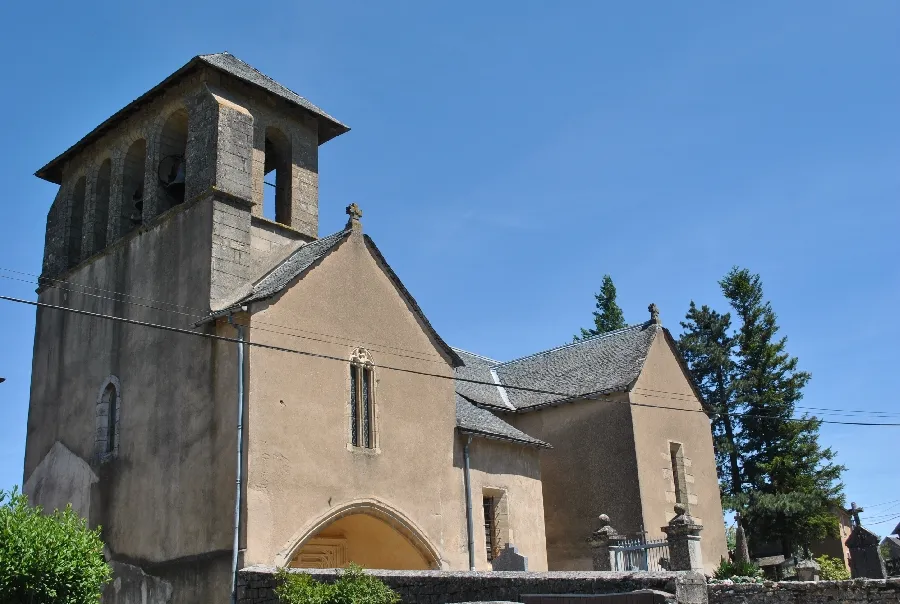
Petite église gothique en partie refaite.
Ouverte sur demande.
Elle était annexe d'Anglars.
Retable derrière le maître autel (18e) avec une pittoresque Vierge polychromée au dessus du tabernacle. Celle-ci est du 14e, mais a beaucoup de caractères romans.
Dans la chapelle de droite, retable en bois sculpté de Saint Roch. Le saint et son chien, dorés, contrastent avec l'ensemble qui a conservé la belle couleur du bois: le chien est admirable dans la naïveté de sa réalisation.
Puits ancien devant l'Eglise. Au carrefour, croix du 14e sculptée: "c'est la croix de justice qui aurait voisiné avec le pilori". Elle a 2 particularités: pas de croix derrière le Christ aux pieds écartés et les personnages assis des deux faces.
English
Small, partly renovated Gothic church.
Open on request.
Used to be an annex of Anglars.
Altarpiece behind the main altar (18th) with a picturesque polychrome Virgin Mary above the tabernacle. This one dates from the 14th century, but has many Romanesque features.
In the right-hand chapel, a carved wooden altarpiece of Saint Roch. The saint and his dog are gilded, contrasting with the rest of the altarpiece, which has retained the beautiful color of the wood: the dog is admirable in its naiveté.
Old well in front of the church. At the crossroads, a carved 14th-century cross: "this is the cross of justice that would have stood next to the pillory". It has 2 peculiarities: no cross behind the Christ with splayed feet and seated figures on both sides.
Deutsch
Kleine gotische Kirche, die teilweise neu gestaltet wurde.
Auf Anfrage geöffnet.
Sie war eine Nebenkirche von Anglars.
Altarbild hinter dem Hauptaltar (18. Jh.) mit einer malerischen polychromierten Madonna über dem Tabernakel. Diese stammt aus dem 14. Jahrhundert, weist aber viele romanische Merkmale auf.
In der rechten Kapelle befindet sich ein holzgeschnitztes Altarbild des Heiligen Rochus. Der Heilige und sein Hund sind vergoldet und bilden einen Kontrast zu dem Ensemble, das die schöne Farbe des Holzes bewahrt hat: Der Hund ist in seiner naiven Ausführung bewundernswert.
Alter Brunnen vor der Kirche. An der Kreuzung ein geschnitztes Kreuz aus dem 14. Jahrhundert: "Es handelt sich um das Justizkreuz, das neben dem Pranger gestanden haben soll". Es weist zwei Besonderheiten auf: kein Kreuz hinter Christus mit gespreizten Füßen und sitzende Figuren auf beiden Seiten.
Dutch
Kleine, gedeeltelijk gerestaureerde gotische kerk.
Open op verzoek.
Het werd bij Anglars gevoegd.
Altaarstuk achter het hoofdaltaar (18e eeuw) met een schilderachtige polychrome Maria boven het tabernakel. Het dateert uit de 14e eeuw, maar heeft veel Romaanse kenmerken.
In de rechterkapel bevindt zich een gebeeldhouwd houten altaarstuk van de heilige Roch. De heilige en zijn hond, verguld, contrasteren met de rest van het altaarstuk, dat de mooie kleur van het hout heeft behouden: de hond is bewonderenswaardig in zijn naïviteit.
Oude waterput voor de kerk. Op het kruispunt staat een gebeeldhouwd kruis uit de 14e eeuw: "dit is het kruis van gerechtigheid dat naast de schandpaal zou hebben gestaan". Het heeft 2 opvallende kenmerken: er staat geen kruis achter Christus, wiens voeten uitgestrekt zijn, en de figuren zitten aan beide kanten.
Español
Pequeña iglesia gótica parcialmente restaurada.
Abierta previa petición.
Fue anexionada a Anglars.
Retablo detrás del altar mayor (siglo XVIII) con una pintoresca Virgen María policromada sobre el sagrario. Data del siglo XIV, pero tiene muchos rasgos románicos.
En la capilla de la derecha hay un retablo de madera tallada de San Roque. El santo y su perro, dorados, contrastan con el resto del retablo, que ha conservado el bello color de la madera: el perro es admirable por su ingenuidad.
Antiguo pozo delante de la iglesia. En el cruce de caminos, una cruz esculpida del siglo XIV: "es la cruz de la justicia que habría estado junto a la picota". Presenta 2 rasgos distintivos: no hay cruz detrás del Cristo con los pies separados y las figuras están sentadas a ambos lados.
Italiano
Piccola chiesa gotica parzialmente restaurata.
Aperta su richiesta.
Era annessa ad Anglars.
Pala d'altare dietro l'altare principale (XVIII secolo) con una pittoresca Madonna policroma sopra il tabernacolo. Risale al XIV secolo, ma presenta molte caratteristiche romaniche.
Nella cappella di destra si trova una pala d'altare in legno intagliato raffigurante San Rocco. Il santo e il suo cane, dorati, contrastano con il resto della pala, che ha conservato il bel colore del legno: il cane è ammirevole nella sua ingenuità.
Vecchio pozzo davanti alla chiesa. All'incrocio, una croce scolpita del XIV secolo: "è la croce della giustizia che si trovava accanto alla gogna". Ha due caratteristiche distintive: non c'è la croce dietro il Cristo, i cui piedi sono distesi, e le figure sono sedute su entrambi i lati.
Equipements: Parking
, 12310 Bertholène
Crédits: Office de Tourisme des Causses à l'Aubrac