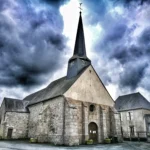
Église Saint-Pierre – Saint-Pierre-d'Exideuil
Description
English
Deutsch
Dutch
Español
Italiano
Description
L'église romane Saint-Pierre a été construite à partir de la fin du XIème siècle, sa longue et étroite nef est ornée d'une corniche à modillons sculptés. Elle se dresse au centre du vieux cimetière où on peut observer de surprenantes tombes à chevalets, disposées tels des dolmens. Le portail date de la fin du XIème siècle. Une peinture murale du XVIIIème siècle, représente le symbole du Saint-Esprit, entouré d'angelots. A ne pas manquer : l'abside semi-circulaire et ses modillons aux sujets obscènes.
Les férus d'architecture religieuse pourront également découvrir à proximité l'église Saint-Nicolas de Civray.
English
The Romanesque church of Saint-Pierre was built at the end of the 11th century. Its long and narrow nave is decorated with a cornice with sculpted modillions. It stands in the center of the old cemetery where one can observe surprising trestle tombs, arranged like dolmens. The portal dates from the end of the 11th century. An 18th century mural painting represents the symbol of the Holy Spirit, surrounded by cherubs. Not to be missed: the semi-circular apse and its modillions with obscene subjects
Those who are interested in religious architecture can also discover the Saint-Nicolas de Civray church nearby.
Deutsch
Die romanische Kirche Saint-Pierre wurde ab dem Ende des 11. Jahrhunderts erbaut. Ihr langes, schmales Kirchenschiff wird von einem Gesims mit geschnitzten Modillons geschmückt. Sie steht in der Mitte des alten Friedhofs, wo man überraschende Gräber mit Staffeleien beobachten kann, die wie Dolmen angeordnet sind. Das Portal stammt aus dem späten 11. Ein Wandgemälde aus dem 18. Jahrhundert stellt das Symbol des Heiligen Geistes dar, der von Engeln umgeben ist. Die halbrunde Apsis mit ihren Modulen mit obszönen Motiven sollte man sich nicht entgehen lassen
Wer sich für religiöse Architektur interessiert, kann auch die nahe gelegene Kirche Saint-Nicolas de Civray besichtigen.
Dutch
De Romaanse kerk Saint-Pierre werd aan het einde van de 11e eeuw gebouwd en heeft een lang en smal schip met een kroonlijst met gebeeldhouwde modillions. Het staat in het midden van de oude begraafplaats, waar men verrassende schraaggraven kan bekijken, gerangschikt als dolmens. Het portaal dateert van het einde van de 11e eeuw. Een 18e eeuwse muurschildering stelt het symbool van de Heilige Geest voor, omringd door cherubijnen. Niet te missen: de halfronde apsis met zijn modillions van obscene onderwerpen
Liefhebbers van religieuze architectuur kunnen ook de nabijgelegen kerk Saint-Nicolas de Civray ontdekken.
Español
La iglesia románica de Saint-Pierre fue construida a finales del siglo XI. Su larga y estrecha nave está adornada con una cornisa con modillones esculpidos. Se encuentra en el centro del antiguo cementerio, donde se pueden observar sorprendentes tumbas de caballete, dispuestas como dólmenes. El portal data de finales del siglo XI. Una pintura mural del siglo XVIII representa el símbolo del Espíritu Santo, rodeado de querubines. No hay que perderse: el ábside semicircular con sus modillones de temas obscenos
Los amantes de la arquitectura religiosa también pueden descubrir la iglesia de Saint-Nicolas de Civray en las cercanías.
Italiano
La chiesa romanica di Saint-Pierre, costruita alla fine dell'XI secolo, presenta una navata lunga e stretta, decorata da una cornice di modiglioni scolpiti. Si trova al centro del vecchio cimitero, dove si possono osservare sorprendenti tombe a cavalletto, disposte come dolmen. Il portale risale alla fine dell'XI secolo. Un dipinto murale del XVIII secolo rappresenta il simbolo dello Spirito Santo, circondato da cherubini. Da non perdere: l'abside semicircolare con i suoi milioni di soggetti osceni
Gli appassionati di architettura religiosa potranno inoltre scoprire la vicina chiesa di Saint-Nicolas de Civray.
2 rue de l'église, 86400 Saint-Pierre-d'Exideuil

Crédits: Père Igor
CC BY-SA 3.0
CC BY-SA 3.0