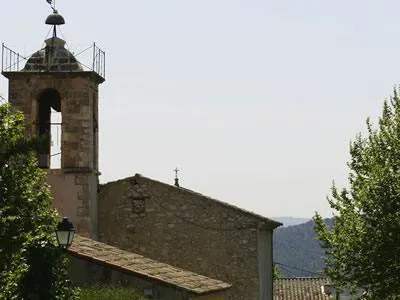
Eglise Saint-Michel – Coudoux
Description
English
Deutsch
Dutch
Español
Italiano
Description
Au XVIIIe siècle, Coudoux, hameau constitué deux siècles plus tôt et dépendant de Ventabren fut marqué par une volonté farouche de ses habitants de créer une véritable communauté autonome et une commune à part entière, qu'elle deviendra en…1950. L'église Saint-Michel est le symbole et l'acte fondateur de cette émancipation. En effet, c'est à l'issue d'un combat juridique déclenché en 1707 que les habitants du hameau purent enfin, en 1746, assister aux offices sans avoir à effectuer le trajet jusqu'à Ventabren. L'église se distingue par un clocher particulièrement original et à l'histoire tourmentée : il ne fut construit qu'en 1788, avec la participation
de la population tout entière, il réchappa d'abord à l'incendie de 1789 puis à la foudre en 1901. Il est surmonté d'une rampe en fer forgé, sorte de léger campanile et d'une girouette, formée par un ange soufflant dans une trompette. En façade, à côté d'une statue de Vierge à l'enfant, le cadran solaire porte l'inscription latine poétique Sic lucat lux vostra. Hoec ultima forsan (Que vos heures brillent comme celles-ci : celle que je marque est peut-être la dernière). La tradition veut, comme c'était le cas dans de nombreuses communes provençales, que les habitants soient dépositaires d'un santon qu'ils entretiennent et déposent dans la crèche de l'église pour la Noël puis le récupèrent le 2 février.
English
In the eighteenth century, Coudoux, a hamlet built two centuries earlier and dependent on Ventabren, was marked by a fierce determination by its inhabitants to create a genuine autonomous community and a full-fledged community, which it will become in 1950. Saint- Michel is the symbol and the founding act of this emancipation. Indeed, it was at the end of a legal struggle in 1707 that the inhabitants of the hamlet were able in 1746 to attend the offices without having to make the journey to Ventabren.The church is distinguished by a particularly original bell-tower and a tormented history. It was not built until 1788, with the participation of the entire population. At first it escaped from the fire of 1789 and then from lightning in 1901. It is surmounted by a wrought iron railing, a kind of light campanile and a weathercock, formed by an angel blowing in a trumpet. In front, next to a statue of Virgin and Child, the sundial bears the Latin poetic inscription Sic lucat lux vostra. Hoec ultima forsan (Let your hours shine like these: the one I mark is perhaps the last). The tradition, as was the case in many communes of Provence, is that the inhabitants are the custodians of a santon that they maintain and deposit in the nursery of the church for Christmas and then recover it on February 2.
Deutsch
Jahrhundert war Coudoux, ein zwei Jahrhunderte zuvor gegründeter Weiler, der von Ventabren abhing, von dem starken Willen seiner Bewohner geprägt, eine wirklich autonome Gemeinschaft und eine vollwertige Gemeinde zu gründen, die sie 1950 auch wurde Die Kirche Saint-Michel ist das Symbol und der Gründungsakt dieser Emanzipation. Nach einem 1707 begonnenen Rechtsstreit konnten die Bewohner des Weilers 1746 endlich die Gottesdienste besuchen, ohne den Weg nach Ventabren auf sich nehmen zu müssen Die Kirche zeichnet sich durch einen besonders originellen Glockenturm mit einer bewegten Geschichte aus: Er wurde erst 1788 unter Beteiligung der gesamten Bevölkerung gebaut
der gesamten Bevölkerung gebaut wurde, überstand er zunächst den Brand von 1789 und dann 1901 den Blitzeinschlag Auf dem Turm befindet sich ein schmiedeeisernes Geländer, eine Art leichter Glockenturm, und eine Wetterfahne, die von einem Engel gebildet wird, der in eine Trompete bläst An der Fassade befindet sich neben einer Statue der Jungfrau mit Kind eine Sonnenuhr mit der poetischen lateinischen Inschrift Sic lucat lux vostra Hoec ultima forsan (Mögen eure Stunden so hell leuchten wie diese: Die Stunde, die ich gerade markiere, ist vielleicht die letzte). Wie es in vielen provenzalischen Gemeinden der Fall war, ist es Tradition, dass die Einwohner einen Santon besitzen, den sie pflegen und an Weihnachten in die Krippe der Kirche legen und am 2. Februar wieder abholen.
Dutch
In de 18e eeuw werd Coudoux, een twee eeuwen eerder gevormd gehucht dat afhankelijk was van Ventabren, gekenmerkt door een sterke wens van zijn inwoners om een echte autonome gemeenschap en een volwaardige gemeente te vormen, wat het in 1950 werd De Sint-Michielskerk is het symbool en de stichtingsakte van deze emancipatie. Na een juridische strijd die in 1707 begon, konden de inwoners van het gehucht in 1746 eindelijk diensten bijwonen zonder naar Ventabren te hoeven reizen De kerk onderscheidt zich door een bijzonder originele klokkentoren met een bewogen geschiedenis: hij werd pas in 1788 gebouwd, met medewerking van de hele bevolking
het werd pas in 1788 gebouwd, met medewerking van de hele bevolking, en overleefde eerst de brand van 1789 en daarna de blikseminslag van 1901 Het wordt bekroond door een smeedijzeren hekwerk, een soort lichte klokkentoren en een windwijzer, gevormd door een engel die op een trompet blaast Op de gevel, naast een beeld van de Maagd met kind, draagt de zonnewijzer het poëtische Latijnse opschrift Sic lucat lux vostra Hoec ultima forsan (Mogen uw uren schijnen als deze: degene die ik markeer kan de laatste zijn). Traditioneel zijn de inwoners, zoals in vele Provençaalse gemeenten, bewaarders van een santon die zij met Kerstmis onderhouden en in de kerkbank leggen, en op 2 februari weer ophalen.
Español
En el siglo XVIII, Coudoux, una aldea formada dos siglos antes y dependiente de Ventabren, se vio marcada por un feroz deseo de sus habitantes de crear una comunidad verdaderamente autónoma y un municipio de pleno derecho, en el que se convirtió en 1950 La iglesia de Saint-Michel es el símbolo y el acto fundacional de esta emancipación. De hecho, fue tras una batalla legal iniciada en 1707 que los habitantes de la aldea pudieron finalmente, en 1746, asistir a los servicios sin tener que desplazarse a Ventabren La iglesia se distingue por un campanario especialmente original y con una historia turbulenta: no se construyó hasta 1788, con la participación de toda la población
se construyó en 1788, con la participación de toda la población, y sobrevivió al incendio de 1789 y a la caída de un rayo en 1901 Está coronada por una barandilla de hierro forjado, una especie de campanario ligero y una veleta, formada por un ángel que toca la trompeta En la fachada, junto a una estatua de la Virgen con el Niño, el reloj de sol lleva la poética inscripción latina Sic lucat lux vostra Hoec ultima forsan (Que tus horas brillen como éstas: la que estoy marcando puede ser la última). Tradicionalmente, como en muchos municipios provenzales, los habitantes son depositarios de un santón que mantienen y colocan en la cuna de la iglesia para la Navidad, y luego lo recogen el 2 de febrero.
Italiano
Nel XVIII secolo, Coudoux, una frazione formatasi due secoli prima e dipendente da Ventabren, è stata segnata da un'accesa volontà dei suoi abitanti di creare una vera e propria comunità autonoma e un comune a tutti gli effetti, che è diventato nel 1950 La chiesa di Saint-Michel è il simbolo e l'atto fondante di questa emancipazione. Infatti, dopo una battaglia legale iniziata nel 1707, nel 1746 gli abitanti della frazione poterono finalmente assistere alle funzioni religiose senza doversi recare a Ventabren La chiesa si distingue per un campanile particolarmente originale e dalla storia travagliata: fu costruito solo nel 1788, con la partecipazione di tutta la popolazione
fu costruito solo nel 1788, con la partecipazione di tutta la popolazione, e sopravvisse all'incendio del 1789 e al fulmine del 1901 È sormontato da una ringhiera in ferro battuto, da una sorta di campanile leggero e da una banderuola, formata da un angelo che suona la tromba Sulla facciata, accanto alla statua della Vergine e del Bambino, la meridiana reca la poetica iscrizione latina Sic lucat lux vostra Hoec ultima forsan (Che le vostre ore brillino come queste: quella che sto segnando potrebbe essere l'ultima). Tradizionalmente, come in molti comuni provenzali, gli abitanti sono custodi di un santon che mantengono e collocano nella culla della chiesa per Natale, per poi ritirarlo il 2 febbraio.
2 Rue Des 4 Termes, 13111 Coudoux