EGLISE SAINT MICHEL
Description
English
Deutsch
Dutch
Español
Italiano
Description
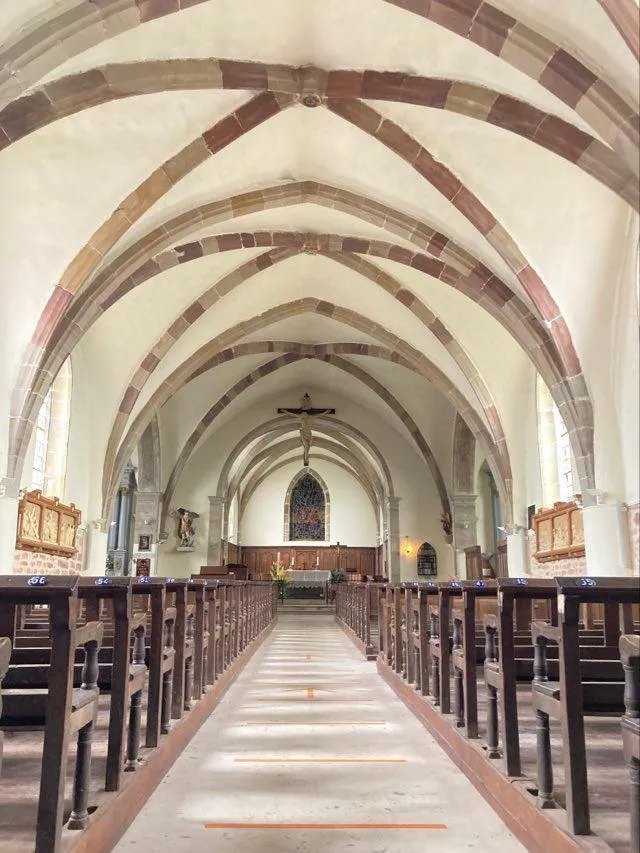
Construite sur un rocher, c'est une ancienne église prieurale, fondée à partir de 1090 par des Bénédictins dépendant de Luxeuil. Ne subsiste de cette époque de grandes arcades romanes sur le mur extérieur Sud. Devenu église paroissiale au XVI è siècle, elle fût alors agrandie. Le clocher, les autels latéraux et les boiseries du choeur datent du XVIII è. Elle renferme une remarquable mise au tombeau en bois polychrome, de style Rhénan, de la fin du XV è siècle, ainsi qu'un charmant tableau, autrefois miraculeux de Notre Dame dans 12 étoiles, fin XVIè et un beau St Michel, bois polychrome, XVIIè. Son orgue, récemment rénové, est de Nicolas Antoine Lété (1844). Beau vitrail moderne dans le choeur : symbole de la résurrection.
Derrière l'Eglise, en face du Monument aux Morts, on peut voir une ancienne porte cochère encadrée par deux piliers romans : c'était l'entrée et le dernier vestige du Prieuré Bénédictin.
English
Built on a rock, it is a former priory church, founded from 1090 by Benedictines depending on Luxeuil. Only large Romanesque arches on the south exterior wall remain from that period. It became a parish church in the 16th century and was then enlarged. The bell tower, the side altars and the woodwork of the choir date from the 18th century. It contains a remarkable Rhenish-style polychrome wooden tombstone from the end of the 15th century, as well as a charming painting, formerly miraculous, of Our Lady in 12 stars, from the end of the 16th century, and a beautiful polychrome wooden St. Michael from the 17th century. Its organ, recently renovated, is by Nicolas Antoine Lété (1844). Beautiful modern stained glass window in the choir: symbol of the resurrection.
Behind the church, in front of the war memorial, you can see an old door framed by two Romanesque pillars: it was the entrance and the last vestige of the Benedictine Priory.
Deutsch
Die auf einem Felsen errichtete Kirche ist eine ehemalige Prioratskirche, die ab 1090 von Benediktinern gegründet wurde, die von Luxeuil abhingen. Aus dieser Zeit sind nur noch die großen romanischen Arkaden an der südlichen Außenmauer erhalten. Im 16. Jahrhundert wurde sie zur Pfarrkirche und anschließend vergrößert. Der Glockenturm, die Seitenaltäre und die Holzvertäfelung des Chors stammen aus dem 18. Sie enthält eine bemerkenswerte Grablegung aus polychromem Holz im rheinischen Stil aus dem späten 15. Jahrhundert, sowie ein reizendes, einst wundersames Gemälde von Notre Dame in 12 Sternen, Ende des 16. Jahrhunderts, und einen schönen St. Michael, polychromes Holz, aus dem 17. Die kürzlich renovierte Orgel stammt von Nicolas Antoine Lété (1844). Schönes modernes Glasfenster im Chor: Symbol der Auferstehung.
Hinter der Kirche, gegenüber dem Kriegerdenkmal, kann man ein altes Tor sehen, das von zwei romanischen Pfeilern eingerahmt wird: Es war der Eingang und das letzte Überbleibsel des Benediktinerpriorats.
Dutch
Gebouwd op een rots, is het een voormalige priorij kerk, gesticht vanaf 1090 door Benedictijnen afhankelijk van Luxeuil. Alleen de grote romaanse arcades op de zuidelijke buitenmuur zijn uit die tijd overgebleven. Het werd een parochiekerk in de 16e eeuw en werd toen uitgebreid. De klokkentoren, de zijaltaren en het houtwerk van het koor dateren uit de 18e eeuw. Ze bevat een opmerkelijke polychrome houten grafsteen in Rijnlandse stijl uit het einde van de 15e eeuw, evenals een charmant schilderij, vroeger miraculeus, van Onze Lieve Vrouw met 12 sterren, uit het einde van de 16e eeuw, en een mooie polychrome houten Sint-Michaël uit de 17e eeuw. Het onlangs gerenoveerde orgel is van Nicolas Antoine Lété (1844). Prachtig modern gebrandschilderd raam in het koor: symbool van de opstanding.
Achter de kerk, tegenover het oorlogsmonument, ziet u een oude deuropening omlijst door twee romaanse zuilen: dit was de ingang en het laatste overblijfsel van de benedictijnse priorij.
Español
Construida sobre una roca, es una antigua iglesia prioral, fundada a partir de 1090 por benedictinos dependientes de Luxeuil. De esa época sólo se conservan las grandes arcadas románicas del muro exterior sur. Se convirtió en iglesia parroquial en el siglo XVI y fue ampliada posteriormente. El campanario, los altares laterales y la carpintería del coro datan del siglo XVIII. Contiene una notable lápida de madera policromada de estilo renano de finales del siglo XV, así como una encantadora pintura, antiguamente milagrosa, de Nuestra Señora en 12 estrellas, de finales del siglo XVI, y un hermoso San Miguel de madera policromada del siglo XVII. Su órgano, recientemente renovado, es obra de Nicolas Antoine Lété (1844). Hermosa vidriera moderna en el coro: símbolo de la resurrección.
Detrás de la iglesia, frente al Memorial de Guerra, se puede ver una antigua puerta enmarcada por dos pilares románicos: era la entrada y el último vestigio del priorato benedictino.
Italiano
Costruita su una roccia, è un'antica chiesa priorale, fondata a partire dal 1090 dai benedettini dipendenti da Luxeuil. Di quel periodo rimangono solo le grandi arcate romaniche sul muro esterno meridionale. Divenne chiesa parrocchiale nel XVI secolo e fu poi ampliata. Il campanile, gli altari laterali e la carpenteria del coro risalgono al XVIII secolo. Contiene una notevole lapide lignea policroma in stile renano della fine del XV secolo, nonché un affascinante dipinto, un tempo miracoloso, della Madonna con 12 stelle, della fine del XVI secolo, e un bel San Michele ligneo policromo del XVII secolo. L'organo, recentemente rinnovato, è di Nicolas Antoine Lété (1844). Bella vetrata moderna nel coro: simbolo della resurrezione.
Dietro la chiesa, di fronte al Monumento ai Caduti, si trova un'antica porta incorniciata da due pilastri romanici: era l'ingresso e l'ultima vestigia del Priorato benedettino.
Médiéval
Clientèle: Tout public - Groupes
Rue de l'église, 88410 Monthureux-sur-Saône
Crédits: Mairie Monthureux