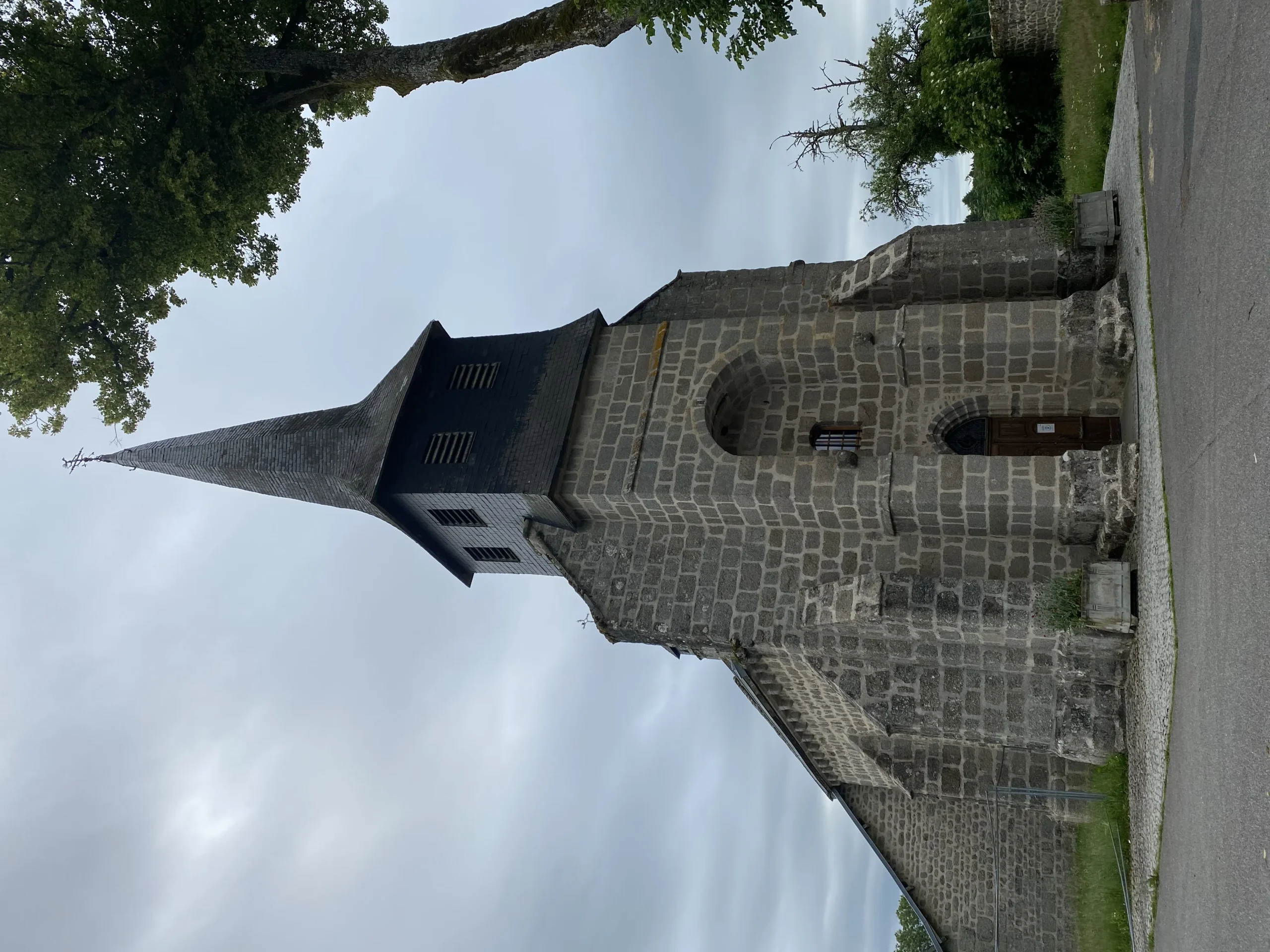
Eglise Saint-Martin – Flayat
Description
English
Deutsch
Dutch
Español
Italiano
Description
La nef à vaisseau unique comprend deux travées, un chœur à chevet plat, ouvert sur deux chapelles et un clocher porche. Un petit campanile est juché au niveau de l’ouverture en arc brisé à l’entrée du chœur. Une première construction avec les deux travées de la nef date du 13e ou 14e siècle. L’église est restaurée entre 1520 et 1527. Le clocher mur initial est remplacé par l’actuel clocher porche au 16e siècle. En 1528, le chœur est agrandi, les chapelles latérales ajoutées. Celle au Sud est dédiée à Saint Martin, celle au Nord à la Sainte Trinité. En 1728-1729 le chœur est agrandi et on construit des chapelles latérales. La chapelle Sud est construite par Sébastien Paschal, maître tailleur de Champagnat, et bénite le 30 octobre 1733. Les travaux sont réalisés grâce à l'initiative du curé Jean-Baptiste Michon. De nombreux objets sont conservés aux titres des Monuments Historiques.
English
The single-vessel nave comprises two bays, a choir with a flat chevet opening onto two chapels, and a porch belfry. A small bell tower sits at the level of the pointed-arch opening at the entrance to the choir. The first two-bay nave dates from the 13th or 14th century. The church was restored between 1520 and 1527. The original wall belfry was replaced by the present porch belfry in the 16th century. In 1528, the choir was enlarged and side chapels added. The one to the south was dedicated to Saint Martin, the one to the north to the Holy Trinity. In 1728-1729, the choir was enlarged and side chapels were added. The south chapel was built by Sébastien Paschal, a master cutter from Champagnat, and blessed on October 30, 1733. The work was carried out thanks to the initiative of parish priest Jean-Baptiste Michon. Numerous objects are preserved as Monuments Historiques.
Deutsch
Das einschiffige Kirchenschiff besteht aus zwei Jochen, einem Chor mit flachem Kopfende, der sich zu zwei Kapellen öffnet, und einem Glockenturm mit Vorhalle. Ein kleiner Glockenturm steht auf der Höhe der Spitzbogenöffnung am Eingang des Chors. Eine erste Konstruktion mit den beiden Jochen des Kirchenschiffs stammt aus dem 13. oder 14. Die Kirche wurde zwischen 1520 und 1527 restauriert. Der ursprüngliche Mauerturm wurde im 16. Jahrhundert durch den heutigen Glockenturm ersetzt. Im Jahr 1528 wurde der Chor vergrößert und die Seitenkapellen wurden hinzugefügt. Die südliche Kapelle ist dem Heiligen Martin gewidmet, die nördliche der Heiligen Dreifaltigkeit. 1728-1729 wird der Chor vergrößert und es werden Seitenkapellen gebaut. Die Südkapelle wird von Sébastien Paschal, einem Schneidermeister aus Champagnat, erbaut und am 30. Oktober 1733 gesegnet. Die Arbeiten werden dank der Initiative
Dutch
Het enkele schip heeft twee traveeën, een koor met een plat gewelf dat uitkomt op twee kapellen en een klokkentoren. Een kleine klokkentoren staat ter hoogte van de spitsboogopening bij de ingang van het koor. De eerste constructie met de twee traveeën van het schip dateert uit de 13e of 14e eeuw. De kerk werd gerestaureerd tussen 1520 en 1527. De oorspronkelijke klokkentoren werd in de 16e eeuw vervangen door de huidige klokkentoren. In 1528 werd het koor vergroot en werden zijkapellen toegevoegd. De zuidelijke was gewijd aan Sint Maarten en de noordelijke aan de Heilige Drie-eenheid. In 1728-1729 werd het koor vergroot en werden er zijkapellen gebouwd. De zuidelijke kapel werd gebouwd door Sébastien Paschal, een meester-kleermaker uit Champagnat, en gezegend op 30 oktober 1733. Het werk werd uitgevoerd dankzij het initiatief van de pastoor, Jean-Baptiste Michon. Talrijke voorwerpen zij
Español
La nave única tiene dos tramos, un coro con cabecera plana que da a dos capillas y un campanario porticado. Un pequeño campanario se alza a la altura del arco apuntado que se abre a la entrada del presbiterio. La primera construcción con los dos tramos de la nave data del siglo XIII o XIV. La iglesia fue restaurada entre 1520 y 1527. El campanario mural original fue sustituido por el actual campanario del pórtico en el siglo XVI. En 1528 se amplió el coro y se añadieron capillas laterales. La del sur se dedicó a San Martín y la del norte a la Santísima Trinidad. En 1728-1729, se amplió el coro y se construyeron capillas laterales. La capilla sur fue construida por Sébastien Paschal, maestro sastre de Champagnat, y bendecida el 30 de octubre de 1733. Las obras se llevaron a cabo gracias a la iniciativa del párroco, Jean-Baptiste Michon. Numerosos objetos se han conservado como Monumentos
Italiano
L'unica navata ha due campate, un coro con un'apertura piatta su due cappelle e un campanile a portico. Un piccolo campanile si trova all'altezza dell'apertura ad arco a sesto acuto all'ingresso del presbiterio. La prima costruzione con le due campate della navata risale al XIII o XIV secolo. La chiesa fu restaurata tra il 1520 e il 1527. Il campanile a muro originale fu sostituito dall'attuale campanile a portico nel XVI secolo. Nel 1528 fu ampliato il coro e furono aggiunte le cappelle laterali. Quella a sud fu dedicata a San Martino e quella a nord alla Santissima Trinità. Nel 1728-1729 il coro fu ampliato e furono costruite le cappelle laterali. La cappella sud fu costruita da Sébastien Paschal, un maestro sarto di Champagnat, e fu benedetta il 30 ottobre 1733. I lavori furono realizzati grazie all'iniziativa del parroco, Jean-Baptiste Michon. Numerosi oggetti sono stati conservati come Monumenti storici.