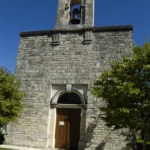
Eglise Saint-Jacques du Bourdet – Le Bourdet
Description
English
Deutsch
Dutch
Español
Italiano
Description
Suite aux libéralités du seigneur des lieux, l'église priorale est reconstruite en 1778 sur un nouveau terrain pour remplacer le vaste sanctuaire à demi ruiné (situé à l’emplacement du cimetière actuel). En 1863, la nouvelle cloche est bénie, puis, en 1868, l'église est dotée d’une abside néo-romane grâce au concours de la commune, du département et de l’Etat. Une réfection intérieure est opérée en 1980 (démolition du plafond laissant apparaître une belle charpente). Le sanctuaire est restauré de 1995 à 2009 (parvis, abside, charpente…). A voir : clocher-peigne à une baie, cuve en plomb dans les fonts baptismaux, autel néo-roman (tabernacle en forme d’église dont les tourelles évoquent Notre-Dame de Poitiers), vitraux dont celui de la fenêtre axiale est le seul à être historié (représentation du patron de l’église avec bâton, besace et chapeau de pèlerin).
Croix de cimetière (1875).
English
Following the generosity of the seigneur of the place, the priorial church was rebuilt in 1778 on a new plot to replace the vast half-ruined shrine (located on the site of the current cemetery). In 1863, the new bell was blessed, then in 1868, the church was endowed with a neo-Romanesque apse thanks to the assistance of the commune, the department and the state. An interior renovation was carried out in 1980 (demolition of the ceiling revealing a beautiful frame). The sanctuary is restored from 1995 to 2009 (forecourt, apse, frame…). To see: bell-tower-comb with a bay, lead vat in the baptismal font, neo-Romanesque altar (tabernacle in the shape of a church whose turrets evoke Notre-Dame de Poitiers), stained-glass windows of which that of the axial window is the only one to be historiated (representation of the patron of the church with a staff, a satchel and a pilgrim’s hat).
Deutsch
Aufgrund von Zuwendungen des Ortsherrn wurde die Prioratskirche 1778 auf einem neuen Grundstück wieder aufgebaut, um das große, halb verfallene Heiligtum (das sich an der Stelle des heutigen Friedhofs befand) zu ersetzen. Im Jahr 1863 wurde die neue Glocke geweiht und 1868 erhielt die Kirche dank der Unterstützung der Gemeinde, des Departements und des Staates eine neoromanische Apsis. Eine Innenrenovierung wurde 1980 durchgeführt (Abriss der Decke, wodurch ein schönes Gebälk zum Vorschein kam). Der Altarraum wurde von 1995 bis 2009 restauriert (Vorplatz, Apsis, Gebälk…). Sehenswert: einbogiger Glockenturm, Bleigefäß im Taufbecken, neuromanischer Altar (kirchenförmiger Tabernakel, dessen Türmchen an Notre-Dame de Poitiers erinnern), Glasfenster, von denen das des Achsenfensters das einzige mit Historienmalerei ist (Darstellung des Kirchenpatrons mit Stab, Umhängetasche und Pilgerhut
Dutch
Dankzij de vrijgevigheid van de plaatselijke heer werd de prioritaire kerk in 1778 herbouwd op een nieuwe plaats, ter vervanging van het grote, halfvergane heiligdom (gelegen op de plaats van het huidige kerkhof). In 1863 werd de nieuwe klok ingezegend en in 1868 kreeg de kerk een neoromaanse apsis, dankzij de steun van de gemeente, het departement en de staat. In 1980 werd het interieur gerenoveerd (sloop van het plafond waardoor een prachtig raamwerk zichtbaar werd). Het heiligdom werd van 1995 tot 2009 gerestaureerd (voorplein, apsis, omlijsting, enz.). Te zien: klokkentoren met één travee, loden bekken in de doopvont, neoromaans altaar (tabernakel in de vorm van een kerk met torentjes die doen denken aan Notre-Dame de Poitiers), gebrandschilderde ramen, waarvan dat in het axiale raam het enige is met een verhaal (voorstelling van de patroonheilige van de kerk met staf, zak en pelg
Español
A raíz de las liberalidades del señor del lugar, la iglesia Priorale fue reconstruida en 1778 en un nuevo terreno para reemplazar el vasto santuario semiarruinado (situado en el sitio del cementerio actual). En 1863, la nueva campana es bendecida, y en 1868, la iglesia está dotada de un ábside neorrománico gracias a la colaboración del municipio, del departamento y del Estado. En 1980 se realizó una reparación interior (demolición del techo que dejó una hermosa estructura). El santuario fue restaurado de 1995 a 2009 (atrio, ábside, carpintería…). A ver: campanario-peine a una bahía, cubeta de plomo en la pila bautismal, altar neorrománico (tabernáculo en forma de iglesia cuyas torretas evocan Notre-Dame de Poitiers), vidrieras cuya ventana axial es la única historiada (representación del patrón de la iglesia con bastón, alforja y sombrero de peregrino).
Cruz de cementerio (1875).
Italiano
In seguito alla generosità del signore locale, la chiesa priorale fu ricostruita nel 1778 su un nuovo sito per sostituire il vasto santuario semidiroccato (situato nel luogo dell'attuale cimitero). Nel 1863 fu benedetta la nuova campana e nel 1868 la chiesa fu dotata di un'abside neoromanica grazie al sostegno del comune, del dipartimento e dello Stato. Nel 1980 è stata effettuata una ristrutturazione interna (demolizione del soffitto che ha rivelato una bella struttura). Il santuario è stato restaurato dal 1995 al 2009 (sagrato, abside, struttura, ecc.). Da vedere: campanile a una campata, vasca in piombo del fonte battesimale, altare neoromanico (tabernacolo a forma di chiesa con torrette che ricordano Notre-Dame de Poitiers), vetrate, di cui quella della finestra assiale è l'unica con una storia (rappresentazione del santo patrono della chiesa con bastone, sacco e cappello da pellegrino).
Croce del cimitero (1875).
Dans le village
Accolée à l'école, 79210 Le Bourdet

Crédits: Mairie du Bourdet
Licence
Licence