ÉGLISE SAINT-AMÉ – Plombières-les-Bains
Description
English
Deutsch
Dutch
Español
Italiano
Description
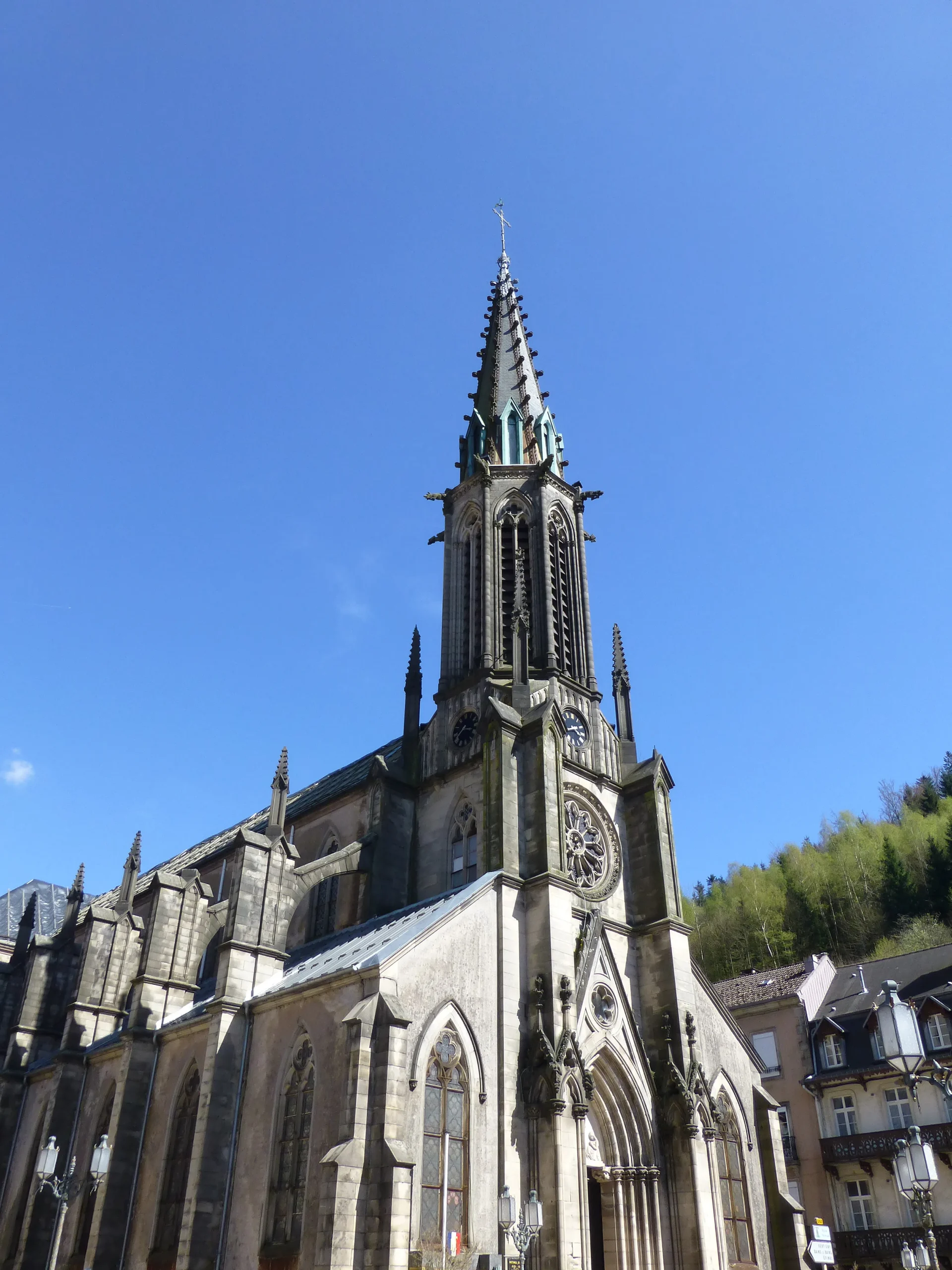
Inaugurée pour l’Assomption en 1860 et consacrée trois ans plus tard, l’église Saint-Amé est dédiée à Saint Amé de Remiremont, fondateur du Saint-Mont, et à Saint Blaise. L’aménagement intérieur de 1905 met en valeur son riche patrimoine. La première église, une chapelle du XIVe siècle, a été paroissiale pendant trois siècles. En 1729, une seconde église trop petite a été construite. En 1858, des travaux majeurs ont débuté selon Léon-Charles Grillot, puis revus par Eugène Viollet-le-Duc, avec le financement de Napoléon III. Achevée en 1863, l’église néogothique possède une flèche de 61 mètres surmontée d’une couronne impériale. Son mobilier, dont un orgue romantique de 1883 et une Vierge à l’oiseau du XVe siècle, est inscrit aux Monuments historiques depuis 1995.
English
Inaugurated for the Assumption in 1860 and consecrated three years later, Saint-Amé church is dedicated to Saint Amé de Remiremont, founder of the Saint-Mont, and to Saint Blaise. The 1905 interior design highlights the church?s rich heritage. The first church, a 14th-century chapel, was the parish church for three centuries. In 1729, a second church, too small, was built. In 1858, major work was begun by Léon-Charles Grillot, then revised by Eugène Viollet-le-Duc, with funding from Napoléon III. Completed in 1863, the neo-Gothic church features a 61-metre spire topped by an imperial crown. Its furnishings, including a Romantic organ from 1883 and a 15th-century Virgin and Bird, have been listed as a Monument Historique since 1995.
Deutsch
Die zu Mariä Himmelfahrt 1860 eingeweihte und drei Jahre später geweihte Kirche Saint-Amé ist dem Heiligen Amé von Remiremont, dem Gründer des Saint-Mont, und dem Heiligen Blaise gewidmet. Die Inneneinrichtung von 1905 hebt das reiche Erbe der Kirche hervor. Die erste Kirche, eine Kapelle aus dem 14. Jahrhundert, war drei Jahrhunderte lang Pfarrkirche. Im Jahr 1729 wurde eine zweite, zu kleine Kirche gebaut. Im Jahr 1858 begannen größere Bauarbeiten nach Léon-Charles Grillot, die später von Eugène Viollet-le-Duc mit der Finanzierung von Napoleon III. überarbeitet wurden. Die 1863 fertiggestellte neugotische Kirche besitzt eine 61 Meter hohe Turmspitze, die von einer Kaiserkrone gekrönt ist. Ihre Ausstattung, darunter eine romantische Orgel aus dem Jahr 1883 und eine Madonna mit Vogel aus dem 15.
Dutch
De kerk Saint-Amé, die in 1860 werd ingewijd voor Maria-Hemelvaart en drie jaar later werd ingewijd, is gewijd aan Saint-Amé de Remiremont, stichter van Saint-Mont, en aan Saint-Blaise. Het interieur werd in 1905 gerenoveerd om het rijke erfgoed te benadrukken. De eerste kerk, een kapel uit de 14e eeuw, was drie eeuwen lang de parochiekerk. In 1729 werd een tweede, te kleine kerk gebouwd. In 1858 werd begonnen met grote werkzaamheden door Léon-Charles Grillot, daarna herzien door Eugène Viollet-le-Duc, met geld van Napoleon III. De in 1863 voltooide neogotische kerk heeft een 61 meter hoge torenspits met daarop een keizerlijke kroon. Het meubilair, waaronder een romantisch orgel uit 1883 en een 15e-eeuwse Maagd met vogel, staat sinds 1995 op de monumentenlijst.
Español
Inaugurada para la Asunción en 1860 y consagrada tres años más tarde, la iglesia de Saint-Amé está dedicada a Santa Amé de Remiremont, fundadora de Saint-Mont, y a San Blas. El interior fue reformado en 1905 para realzar su rico patrimonio. La primera iglesia, una capilla del siglo XIV, fue la iglesia parroquial durante tres siglos. En 1729, se construyó una segunda iglesia, demasiado pequeña. En 1858, Léon-Charles Grillot comenzó las grandes obras, revisadas después por Eugène Viollet-le-Duc, con financiación de Napoleón III. Terminada en 1863, la iglesia neogótica tiene una aguja de 61 metros coronada por una corona imperial. Su mobiliario, que incluye un órgano romántico de 1883 y una Virgen y un Pájaro del siglo XV, está declarado Monumento Histórico desde 1995.
Italiano
Inaugurata per l'Assunzione nel 1860 e consacrata tre anni dopo, la chiesa di Saint-Amé è dedicata a Sant'Amé de Remiremont, fondatore di Saint-Mont, e a San Biagio. L'interno è stato ristrutturato nel 1905 per valorizzare il suo ricco patrimonio. La prima chiesa, una cappella del XIV secolo, è stata la chiesa parrocchiale per tre secoli. Nel 1729 fu costruita una seconda chiesa, troppo piccola. Nel 1858 furono avviati importanti lavori da Léon-Charles Grillot, poi rivisti da Eugène Viollet-le-Duc, con il finanziamento di Napoleone III. Completata nel 1863, la chiesa neogotica ha una guglia di 61 metri sormontata da una corona imperiale. I suoi arredi, tra cui un organo romantico del 1883 e una Vergine e un Uccello del XV secolo, sono stati classificati come monumenti storici dal 1995.
Néogothique
Clientèle: Tout public - Groupes
5 Place Napoléon III, 88370 Plombières-les-Bains
Crédits: Ji-Elle
CC BY-SA 3.0
CC BY-SA 3.0