Église Notre-Dame – Saint-Aubin-de-Branne
Description
English
Deutsch
Dutch
Español
Italiano
Description
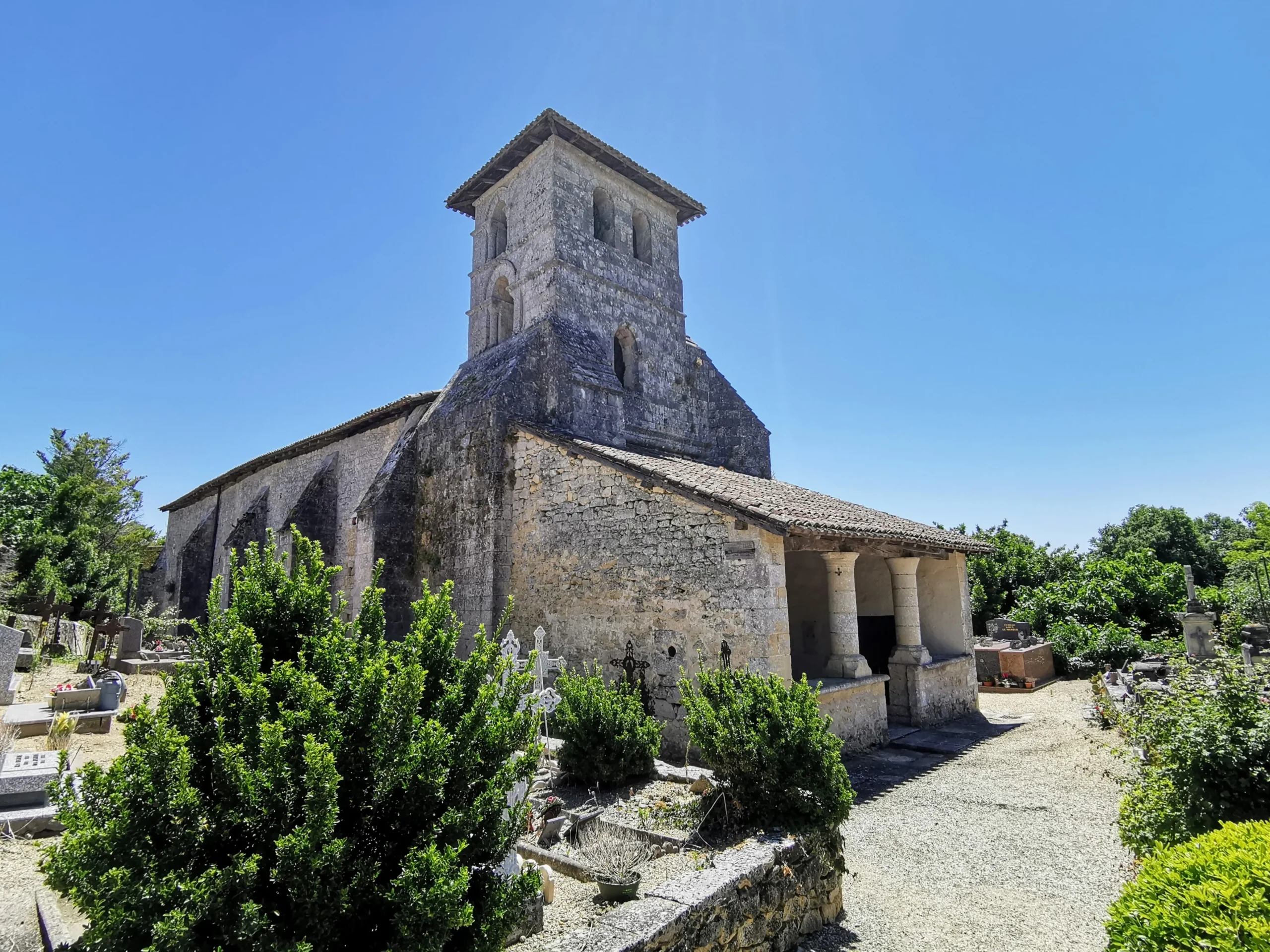
L'église Notre-Dame, qui est de style roman, possède un clocher qui date du XIIe siècle. Il a subi des modifications au cours du XIVe siècle et durant les Guerres de Religion.
Ce clocher ressemble à celui de l'église abbatiale Sainte-Croix de Bordeaux.
L'église possède cinq travées. La première, à l'ouest, fait office de soubassement pour le clocher. Quatre autres travées suivent, qui s'allongent de plus en plus en allant vers l'est (où l'édifice se termine par un chevet plat).
L'intérieur de l'église renferme aussi quelques éléments remarquables : des fragments de peinture murale (du XVIe siècle), une clef de voûte qui représente Dieu le Père bénissant, ou encore un ensemble composé du maître-autel et de son retable.
English
The Church of Our Lady, which is in Romanesque style, has a bell tower dating from the 12th century. It underwent modifications during the 14th century and during the Wars of Religion
This bell tower resembles that of the abbey church of Sainte-Croix in Bordeaux.
The church has five bays. The first, to the west, serves as the base for the bell tower. Four other bays follow, which get longer and longer as you go east (where the building ends with a flat chevet)
The interior of the church also contains some remarkable elements: fragments of mural painting (from the 16th century), a keystone representing God the Blessing Father, and a set consisting of the high altar and its altarpiece.
Deutsch
Die Kirche Notre-Dame ist im romanischen Stil erbaut und besitzt einen Glockenturm aus dem 12. Er wurde im 14. Jahrhundert und während der Religionskriege umgebaut
Der Glockenturm ähnelt dem der Abteikirche Sainte-Croix in Bordeaux.
Die Kirche besitzt fünf Joche. Die erste, im Westen, dient als Unterbau für den Glockenturm. Es folgen vier weitere Joche, die sich nach Osten hin (wo das Gebäude mit einem flachen Kopfende endet) immer weiter verlängern
Auch im Inneren der Kirche finden sich einige bemerkenswerte Elemente: Fragmente einer Wandmalerei (aus dem 16. Jahrhundert), ein Schlussstein, der Gottvater beim Segnen darstellt, oder ein Ensemble aus dem Hauptaltar und seinem Altaraufsatz.
Dutch
De kerk Notre-Dame, in romaanse stijl, heeft een klokkentoren uit de 12e eeuw. Het werd gewijzigd in de 14e eeuw en tijdens de godsdienstoorlogen
De klokkentoren lijkt op die van de abdijkerk Sainte-Croix in Bordeaux.
De kerk heeft vijf traveeën. De eerste, in het westen, dient als basis voor de klokkentoren. Er volgen nog vier traveeën, die naar het oosten toe steeds langer worden (waar het gebouw eindigt in een vlakke chevet)
Het interieur van de kerk bevat ook enkele opmerkelijke elementen: fragmenten van muurschilderingen (uit de 16e eeuw), een sluitsteen die de zegenende God de Vader voorstelt, en een decor bestaande uit het hoofdaltaar en het bijbehorende altaarstuk.
Español
La iglesia de Notre-Dame, de estilo románico, tiene un campanario que data del siglo XII. Se modificó durante el siglo XIV y durante las Guerras de Religión
El campanario se parece al de la iglesia abacial de Sainte-Croix en Burdeos.
La iglesia tiene cinco tramos. El primero, en el oeste, sirve de base para el campanario. Le siguen cuatro naves más, que se van alargando a medida que avanzan hacia el este (donde el edificio termina en un chevet plano)
El interior de la iglesia también contiene algunos elementos notables: fragmentos de pinturas murales (del siglo XVI), una piedra clave que representa a Dios Padre bendiciendo y un conjunto formado por el altar mayor y su retablo.
Italiano
La chiesa di Notre-Dame, di stile romanico, ha un campanile del XII secolo. Fu modificato nel corso del XIV secolo e durante le guerre di religione
Il campanile ricorda quello della chiesa abbaziale di Sainte-Croix a Bordeaux.
La chiesa ha cinque campate. Il primo, a ovest, funge da base per il campanile. Seguono altre quattro campate, che diventano sempre più lunghe man mano che si procede verso est (dove l'edificio termina in un chevet piatto)
Anche l'interno della chiesa contiene alcuni elementi degni di nota: frammenti di dipinti murali (del XVI secolo), una chiave di volta che rappresenta Dio Padre che benedice e un insieme costituito dall'altare maggiore e dalla sua pala.
Dans le vignoble - A la campagne - Dans le village
Classement: Monument Historique
Lieu Dit le Bourg, 33420 Saint-Aubin-de-Branne
Crédits: Emmanuel Gaye
Licence
Licence