Eglise de Saint-Gayrand – Grateloup-Saint-Gayrand
Description
English
Deutsch
Dutch
Español
Italiano
Description
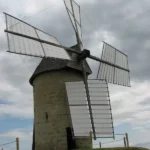
À 3 km au sud du village de Grateloup, sur un site dominant à l’ouest la Garonne et au sud le Lot, il ne reste plus de l’église de Saint-Gayrand que des ruines à ciel ouvert. Inscrites à l’inventaire des Monuments Historiques, elles témoignent de ce qui fut un impressionnant vaisseau de pierre, à l’origine roman (XIIème) puis gothique (XV et XVIème siècles).
À voir, le clocher carré avec sa tour d’escalier qui révèle la fortification de l’église de Saint-Gayrand et si vous avez l’œil observateur, plusieurs sculptures du portail gothique ayant traversé les siècles, dont une belle salamandre, une Vierge à l'Enfant et un Christ tenant un globe.
English
3 km south of the village of Grateloup, on a site overlooking the Garonne to the west and the Lot to the south, all that remains of the church of Saint-Gayrand are open-air ruins. Listed as Historic Monuments, they bear witness to what was once an impressive stone vessel, originally Romanesque (12th) then Gothic (15th and 16th centuries).
To be seen, the square bell tower with its stair tower which reveals the fortification of the church of Saint-Gayrand and if you have an observant eye, several sculptures of the Gothic portal that have crossed the centuries, including a beautiful salamander, a Virgin and Child and a Christ holding a globe.
Deutsch
3 km südlich des Dorfes Grateloup, an einem Ort, der im Westen die Garonne und im Süden den Lot überragt, sind von der Kirche Saint-Gayrand nur noch Ruinen unter freiem Himmel übrig geblieben. Sie wurden in das Verzeichnis der historischen Monumente aufgenommen und zeugen von einem beeindruckenden Steinschiff, das ursprünglich romanisch (12. Jh.) und später gotisch (15. und 16. Jh.) war.
Sehenswert ist der quadratische Glockenturm mit seinem Treppenturm, der die Befestigung der Kirche von Saint-Gayrand offenbart. Wenn Sie ein scharfes Auge haben, können Sie mehrere Skulpturen des gotischen Portals sehen, die die Jahrhunderte überdauert haben, darunter ein schöner Salamander, eine Jungfrau mit Kind und ein Christus, der eine Weltkugel hält.
Dutch
Op 3 km ten zuiden van het dorp Grateloup, op een plek met uitzicht op de Garonne in het westen en de Lot in het zuiden, zijn van de kerk van Saint-Gayrand alleen nog de open ruïnes over. Ze staan op de monumentenlijst en getuigen van wat ooit een indrukwekkend stenen schip was, oorspronkelijk Romaans (12e eeuw) en vervolgens gotisch (15e en 16e eeuw).
Te zien, de vierkante klokkentoren met zijn traptoren die de fortificatie van de kerk van Saint-Gayrand onthult en als u een oplettend oog heeft, verschillende beelden van het gotische portaal die de eeuwen hebben doorstaan, waaronder een mooie salamander, een Maagd en Kind en een Christus die een wereldbol vasthoudt.
Español
A 3 km al sur del pueblo de Grateloup, en un lugar que domina el Garona al oeste y el Lot al sur, lo único que queda de la iglesia de Saint-Gayrand son las ruinas abiertas. Catalogadas como Monumento Histórico, dan testimonio de lo que fue una impresionante nave de piedra, originalmente románica (siglo XII) y luego gótica (siglos XV y XVI).
Para ver, el campanario cuadrado con su torre escalonada que revela la fortificación de la iglesia de Saint-Gayrand y si tiene un ojo observador, varias esculturas del portal gótico que han atravesado los siglos, de las cuales una hermosa salamandra, una Virgen con el Niño y un Cristo que sostiene un globo.
Italiano
A 3 km a sud del villaggio di Grateloup, su un sito che domina la Garonna a ovest e il Lot a sud, della chiesa di Saint-Gayrand rimangono solo le rovine aperte. Classificate come Monumento Storico, testimoniano quello che un tempo era un imponente vascello di pietra, originariamente romanico (XII secolo) e poi gotico (XV e XVI secolo).
Da vedere, il campanile quadrato con la sua torre scalare che rivela la fortificazione della chiesa di Saint-Gayrand e, se avete un occhio attento, diverse sculture del portale gotico che hanno attraversato i secoli, tra cui una bella salamandra, una Vergine con il Bambino e un Cristo che regge un globo.
Classement: Monument Historique
L'Eglise, 47400 Grateloup-Saint-Gayrand

Crédits: © Grateloup-Saint-Gayran
Licence
Licence