Chapelle Sainte-Catherine – Hombourg-Haut
Description
English
Deutsch
Dutch
Español
Italiano
Description
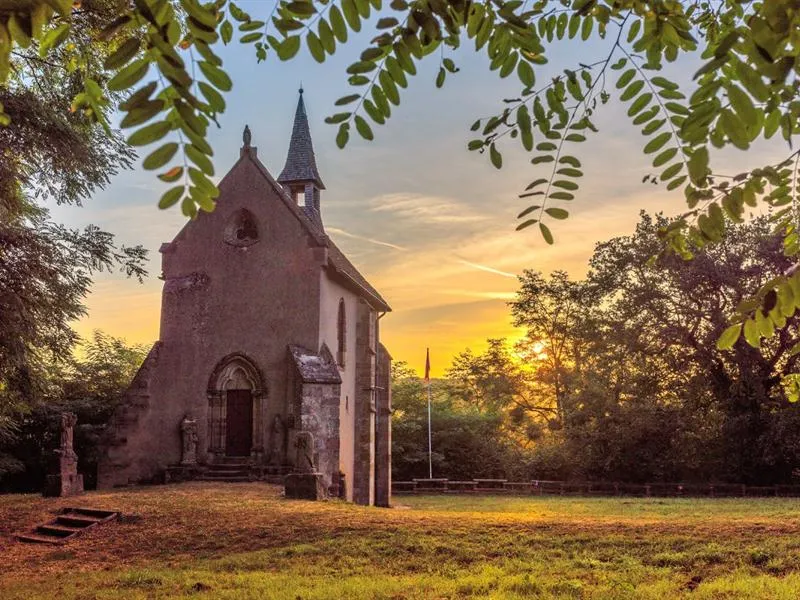
Du plus pur style gothique, la chapelle fut construite entre 1250 et 1270 à côté de sa maison, par le chevalier Simon de Hombourg à un usage domestique et privé, dans le périmètre de Ritterburg, écart fortifié du château.
Autour de la chapelle se trouvaient les bâtiments du Ritterbourg ou Château des chevaliers. Avec ses tours et son rempart il constituait la partie extrême du grand château médiéval. Son soubassement servait de caveau funéraire. Plusieurs fois restaurée au cours de son histoire, en 1706, 1897 et 1986, la chapelle est réputée pour sa décoration de qualité.
La chapelle fut classée Monument historique en 1895 sous autorité allemande puis à nouveau en 1930. Hors visite guidée, visible uniquement de l'extérieur (ouverte pendant les visites guidées de l'Office de tourisme).
English
The chapel was built between 1250 and 1270 by the knight Simon of Homburg for domestic and private use in the Ritterburg, a fortified part of the castle.
Around the chapel were the buildings of the Ritterburg or Knights' Castle. With its towers and ramparts it was the extreme part of the great medieval castle. Its base was used as a burial vault. The chapel has been restored several times in the course of its history, in 1706, 1897 and 1986, and is renowned for its high quality decoration.
The chapel was classified as a historical monument in 1895 under German authority and again in 1930. The chapel is not open to the public and can only be seen from the outside (open during the guided tours of the Tourist Office).
Deutsch
Die Kapelle im reinsten gotischen Stil wurde zwischen 1250 und 1270 neben seinem Haus vom Ritter Simon von Homburg für den häuslichen und privaten Gebrauch innerhalb der Ritterburg, dem befestigten Teil der Burg, errichtet.
Um die Kapelle herum befanden sich die Gebäude der Ritterburg oder des Ritterschlosses. Mit ihren Türmen und ihrer Mauer bildete sie den äußersten Teil der großen mittelalterlichen Burg. Ihr Sockel diente als Grabkammer. Die Kapelle wurde im Laufe ihrer Geschichte mehrmals restauriert (1706, 1897 und 1986) und ist für ihre hochwertige Dekoration bekannt.
Die Kapelle wurde 1895 unter deutscher Herrschaft und 1930 erneut zum historischen Denkmal erklärt. Außerhalb von Führungen, nur von außen sichtbar (geöffnet während der Führungen des Fremdenverkehrsamtes).
Dutch
De kapel werd tussen 1250 en 1270 gebouwd door de ridder Simon van Homburg voor huishoudelijk en privégebruik in de Ritterburg, een versterkt deel van het kasteel.
Rond de kapel stonden de gebouwen van de Ritterburg of ridderburcht. Met zijn torens en wallen was het het belangrijkste deel van het grote middeleeuwse kasteel. De basis werd gebruikt als grafkelder. De kapel is in de loop van haar geschiedenis meerdere malen gerestaureerd, in 1706, 1897 en 1986, en staat bekend om haar hoogwaardige decoratie.
De kapel werd in 1895 onder Duits gezag en opnieuw in 1930 als historisch monument geclassificeerd. Niet toegankelijk voor het publiek, alleen zichtbaar van buitenaf (geopend tijdens de rondleidingen van het toeristenbureau).
Español
La capilla fue construida entre 1250 y 1270 por el caballero Simón de Homburg para uso doméstico y privado en el Ritterburg, una parte fortificada del castillo.
Alrededor de la capilla estaban los edificios del castillo de Ritterburg o de los Caballeros. Con sus torres y murallas, era la parte más importante del gran castillo medieval. Su base se utilizaba como panteón funerario. La capilla ha sido restaurada varias veces a lo largo de su historia, en 1706, 1897 y 1986, y es famosa por la calidad de su decoración.
La capilla fue clasificada como monumento histórico en 1895 bajo autoridad alemana y de nuevo en 1930. No abierto al público, sólo visible desde el exterior (abierto durante las visitas guiadas de la Oficina de Turismo).
Italiano
La cappella fu costruita tra il 1250 e il 1270 dal cavaliere Simone di Homburg per uso domestico e privato nella Ritterburg, una parte fortificata del castello.
Intorno alla cappella si trovavano gli edifici della Ritterburg o Castello dei Cavalieri. Con le sue torri e i suoi bastioni, era la parte più importante del grande castello medievale. La sua base è stata utilizzata come tomba per le sepolture. La cappella è stata restaurata più volte nel corso della sua storia, nel 1706, nel 1897 e nel 1986, ed è rinomata per la sua decorazione di alta qualità.
La cappella è stata classificata come monumento storico nel 1895 sotto l'autorità tedesca e nuovamente nel 1930. Non aperto al pubblico, visibile solo dall'esterno (aperto durante le visite guidate dell'Ufficio del Turismo).
Médiéval
Langues: Deutsch
Clientèle: Tout public - Groupes
Classement: Monument Historique
Moyens de paiement: Espèce - Chèque - Cartes bancaires
Chapelle Sainte-Catherine, 57470 Hombourg-Haut
Crédits: Webmasterhombourg
Public domain
Public domain